
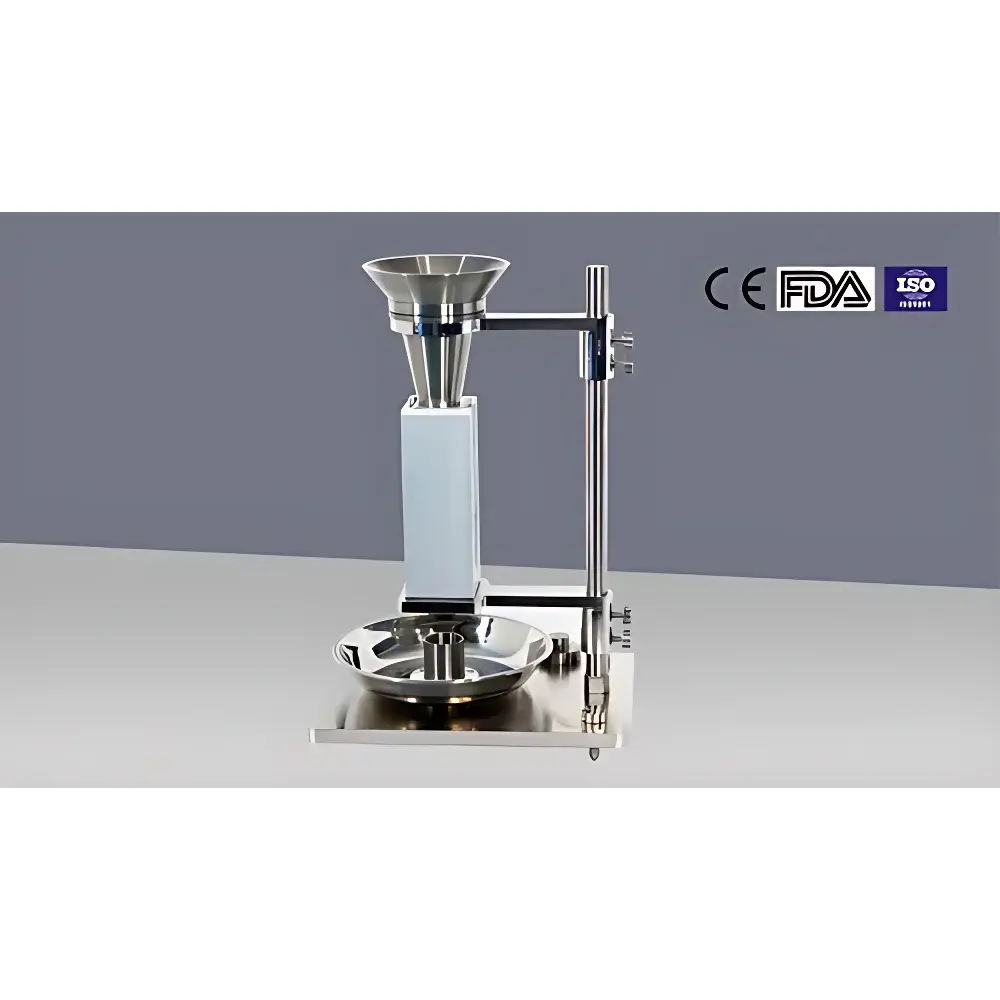
Kyocera JK-SZ2000 Scott Volumeter for Bulk Density Measurement of Metal Powders
| Brand | Kyocera |
|---|---|
| Origin | Beijing, China |
| Manufacturer Type | Authorized Distributor |
| Country of Origin | China |
| Model | JK-SZ2000 |
| Instrument Type | Scott Volumeter |
| Instrument Category | Benchtop Laboratory Densitometer |
| Sample Type | Free-Flowing Metallic Powders |
| Standard Compliance | GB/T 5060–1985 (equivalent to ISO 3923-2) |
| Measurement Principle | Gravimetric Volumetric Method with Controlled Flow Damping |
| Configuration | Integrated Funnel Assembly, Quadruple Baffle System, Cylindrical Receiving Cup (25.0 mL nominal volume), Stainless Steel Straightedge & Tapping Platform |
Overview
The Kyocera JK-SZ2000 Scott Volumeter is a precision benchtop instrument engineered for the standardized determination of bulk density (also termed “apparent density” or “loose density”) of free-flowing metallic powders. It implements the internationally recognized Scott volumeter method—defined in ISO 3923-2 and harmonized in Chinese national standard GB/T 5060–1985—which addresses a critical limitation of conventional funnel-based methods: uncontrolled powder acceleration during free fall. Unlike simple hopper systems, the JK-SZ2000 incorporates a four-stage baffle assembly positioned within the material flow path. As metal powder descends from the upper sieve through the distribution box and square funnel, successive impacts against these precisely angled stainless steel baffles dissipate kinetic energy, reduce terminal velocity, and preserve the natural packing morphology of the powder bed upon entry into the calibrated cylindrical cup. This controlled deceleration minimizes compaction artifacts and ensures high reproducibility in bulk density values—particularly essential for quality control in powder metallurgy, additive manufacturing feedstock qualification, and sintered component process validation.
Key Features
- Compliant Scott volumeter architecture per ISO 3923-2 and GB/T 5060–1985, validated for metallic powders including iron, copper, aluminum, titanium, and stainless steel alloys
- Four-tier stainless steel damping baffle system integrated into the vertical flow channel to attenuate particle velocity and suppress impact-induced densification
- Precision-machined cylindrical receiving cup with nominal volume of 25.0 mL (±0.1 mL tolerance), manufactured from corrosion-resistant 304 stainless steel
- Modular funnel assembly comprising upper ASTM E1917-compliant sieve (1.0 mm aperture), distribution box, and square discharge funnel—all aligned coaxially to ensure laminar, non-turbulent flow
- Benchtop footprint (W × D × H ≈ 280 × 220 × 450 mm) with stable base plate and anti-vibration rubber feet for consistent tapping performance
- Includes calibrated stainless steel straightedge (ISO 7500-1 Class 1 compliant), tapping platform with defined drop height (3 ± 0.2 mm), and cleaning brush set
Sample Compatibility & Compliance
The JK-SZ2000 is specifically designed for powders exhibiting moderate-to-high flowability (Hall flow rate > 25 s/50 g) and particle size distributions typically ranging from 10 µm to 250 µm. It is not suitable for cohesive, hygroscopic, or highly irregular particles (e.g., dendritic or flake-shaped powders) that fail to pass freely through the 1.0 mm sieve. Regulatory alignment includes full traceability to ISO 3923-2 Annex A (test procedure), ISO 13320 (laser diffraction sizing context), and ASTM B212 (standard test method for apparent density of free-flowing metal powders). The instrument supports GLP-compliant documentation when used with certified analytical balances (0.001 g readability) and calibrated volumetric cups—enabling audit-ready records for ISO 9001, IATF 16949, and aerospace AS9100 environments.
Software & Data Management
As a manual gravimetric instrument, the JK-SZ2000 operates without embedded electronics or firmware. All measurement data—including mass (g), calculated bulk density (g/cm³), temperature (°C), and relative humidity (%RH)—are recorded manually or via external laboratory information management systems (LIMS). Users are advised to employ electronic balances with RS-232 or USB output and LIMS-integrated spreadsheet templates to maintain 21 CFR Part 11–compliant audit trails. Calibration certificates for the receiving cup and straightedge must be retained per ISO/IEC 17025 requirements; annual verification against NIST-traceable standards is recommended.
Applications
- Quality assurance of atomized metal powders prior to laser powder bed fusion (LPBF) or binder jetting processes
- Batch release testing in powder metallurgy production lines (e.g., automotive sintered gears, filters)
- Comparative evaluation of surface oxidation effects on bulk density drift in stored titanium alloy powders
- Process development studies correlating milling time, annealing atmosphere, and resultant bulk density changes
- Reference method validation for automated density analyzers (e.g., gas pycnometers, oscillating U-tube densimeters)
FAQ
What powders are incompatible with the JK-SZ2000 Scott volumeter?
Powders that cannot pass freely through the 1.0 mm ASTM E1917 sieve—such as agglomerated, electrostatically charged, or highly elongated particles—are excluded from valid testing per ISO 3923-2.
Is temperature control integrated into the JK-SZ2000?
No. Ambient temperature and humidity must be monitored externally and reported alongside results; ISO 3923-2 specifies testing at 23 ± 2 °C and 50 ± 5 %RH.
Can the cylindrical cup volume be recalibrated?
Yes—users may perform volumetric calibration using distilled water at 20 °C and certified Class A volumetric pipettes, following ISO 4787 procedures.
How many replicate measurements does ISO 3923-2 require?
A minimum of three independent determinations, with the final result expressed as the arithmetic mean rounded to 0.01 g/cm³.
Does the JK-SZ2000 meet FDA requirements for pharmaceutical excipient testing?
No—pharmaceutical applications require USP <616> or EP 2.9.35 methods; this instrument is restricted to metallic and industrial powder characterization per metallurgical standards.



