
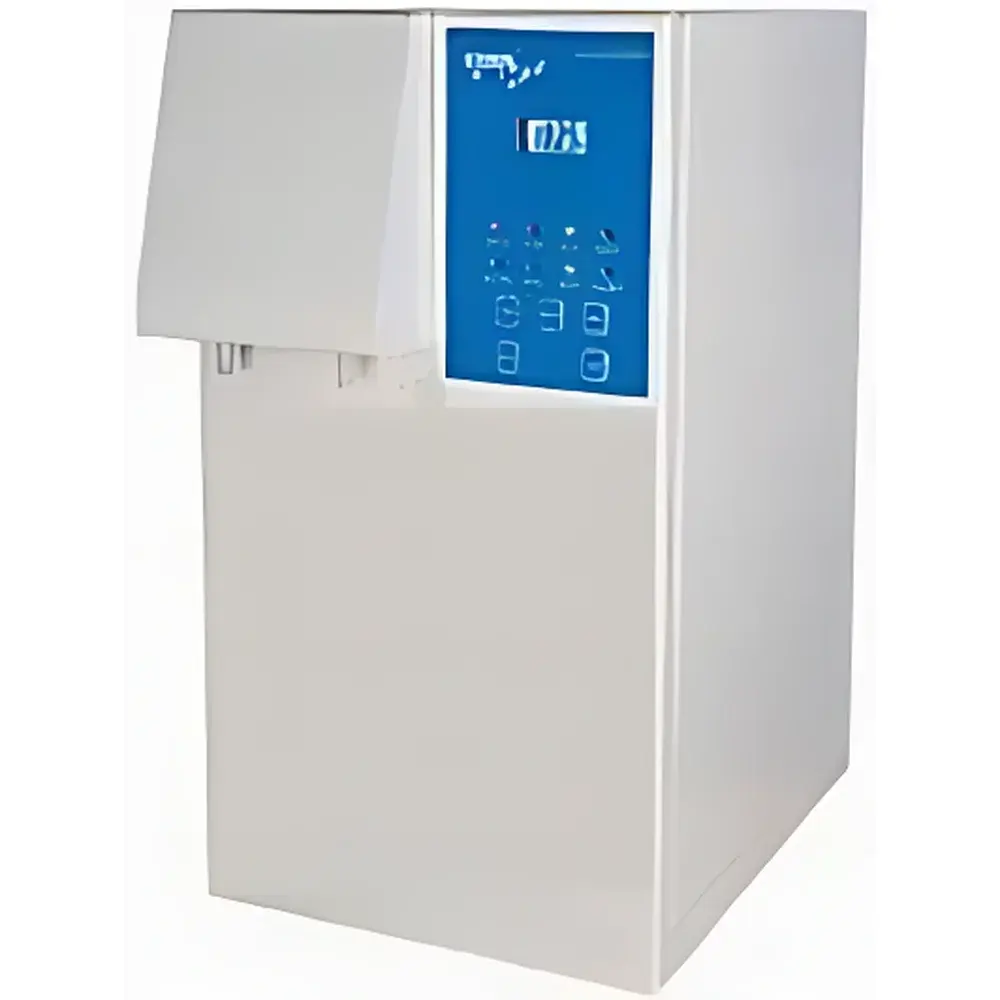
Molelement 1810C Ultra Pure Water System
| Origin | Shanghai, China |
|---|---|
| Manufacturer Type | Authorized Distributor |
| Origin Category | Domestic (China) |
| Model | 1810C |
| Price | Upon Request |
| Input Water | Municipal tap water (high hardness), 1.0–5.0 kg/cm² pressure, 5–40 °C |
| Power Supply | 220 V / 50 Hz, 80 W |
| Ambient Operating Conditions | 5–40 °C, 10–80% RH |
| Production Rate | 10 L/h |
| Continuous Dispense Flow | 1.5 L/min |
| Type III Water Conductivity | <10 µS/cm (meets GB/T 6682–1992 Grade III & ASTM CAP/NCCLS standards) |
| Type I Water Resistivity | 18.25 MΩ·cm @ 25 °C (meets GB/T 6682–1992 Grade I & ASTM CAP/NCCLS standards) |
| TOC | <10 ppb |
| Silica Rejection | >99.9% |
| UV Absorbance (254 nm, 1 cm path) | ≤0.001 |
| Soluble Silica (as SiO₂) | <0.01 ppm |
| Particles (>0.22 µm) | <1 /mL |
| Heavy Metals (total) | <0.01 ppm |
| Cationic Impurities (Fe, Cu, Al, Ni, Zn, Cr, Na, K) | <0.001–0.02 ppb |
| Anionic Impurities (Cl⁻, NO₂⁻, NO₃⁻, SO₄²⁻) | <0.01–0.02 ppb |
| Display | 4-line color LCD |
| Housing | Matte black ABS |
| Control | Touch keypad with self-diagnostic boot sequence |
| Integrated Functions | Auto-flush timer, RO antiscalant algorithm, manual RO flush, low-water alarm, power-fail safeguard, full-tank standby mode, real-time resistivity monitoring, manual recirculation, scheduled ultrapure water recirculation |
| Purification Pathway | Tap water → Pre-filter → Water softener → Coarse filter → Fine filter → Activated carbon filter → Booster pump → RO membrane → Pure water tank → Membrane pump → Ultra-purification cartridge → Final 0.22 µm terminal filter → Type I outlet / Type III outlet |
| Accessories | 30 L polyethylene pure water storage tank |
| Documentation | User manual, installation guide, maintenance manual, warranty card |
| Service | On-site commissioning, system validation, and operator training included |
Overview
The Molelement 1810C Ultra Pure Water System is a fully integrated, laboratory-grade water purification platform engineered to deliver consistent, on-demand Type I (ultrapure) and Type III (purified) water from municipal tap feed sources. Designed for high-reliability analytical applications, the system employs a multi-stage purification architecture grounded in reverse osmosis (RO), ion exchange, activated carbon adsorption, and sub-micron terminal filtration. Its core operational principle relies on sequential contaminant removal: particulate matter and chlorine are first eliminated via pre-filtration and carbon treatment; dissolved ions and organics are reduced by high-rejection RO membranes; residual ionic species, silica, and trace organics are removed through proprietary ultra-purification cartridges incorporating mixed-bed ion exchange resins and specialty adsorbents. Real-time resistivity monitoring at 25 °C ensures continuous verification of Type I water quality—critical for sensitive instrumentation where even picomolar-level ionic contamination compromises data integrity.
Key Features
- Robust pretreatment configuration including dedicated water softener and multi-stage mechanical filtration—optimized for high-hardness municipal supplies to maximize RO membrane service life and minimize downtime.
- Integrated microprocessor control with intelligent RO antiscalant management, automated periodic membrane flushing, and adaptive flow regulation to maintain stable production under variable inlet conditions.
- Real-time, temperature-compensated resistivity monitoring (18.25 MΩ·cm @ 25 °C) with on-screen display of conductivity, system status, and alarm history—enabling immediate assessment of water quality compliance.
- Dual-output design: independent Type I (ultrapure) and Type III (purified) water ports, each with dedicated flow paths and final 0.22 µm sterilizing filters to prevent cross-contamination.
- High-efficiency DC-powered ultrapure water delivery pump enabling sustained dispense rates up to 1.5 L/min—designed to meet dynamic demand from HPLC autosamplers, ICP-MS nebulizers, or cell culture media preparation stations.
- Passive recirculation architecture with programmable ultrapure water loop cycles—minimizes stagnation-related biofilm formation and preserves TOC <10 ppb and silica <0.01 ppm over extended hold periods.
Sample Compatibility & Compliance
The Molelement 1810C produces water meeting or exceeding internationally recognized specifications for critical laboratory use. Type I output conforms to GB/T 6682–1992 Grade I, ASTM D1193–2020 Type I, and NCCLS (now CLSI) EP21-A standards. Type III output satisfies GB/T 6682–1992 Grade III and ASTM D1193–2020 Type III requirements. The system supports rigorous quality assurance protocols: resistivity and TOC data are logged with timestamps for audit-ready records; optional GLP/GMP-compliant electronic logbooks can be implemented via external data acquisition interfaces. All wetted materials—including housing, tubing, and cartridge housings—are USP Class VI-certified polymers, ensuring extractables and leachables remain below detection thresholds for trace metal analysis and molecular biology workflows.
Software & Data Management
While the Molelement 1810C operates via embedded IC-based firmware without cloud connectivity, its human-machine interface supports full traceability essential for regulated environments. The 4-line color LCD displays live resistivity, system pressure differentials, cartridge saturation indicators, and fault codes with descriptive text. All operational events—including start/stop cycles, alarm triggers, manual flushes, and full-tank transitions—are time-stamped and retained in non-volatile memory for ≥30 days. For laboratories requiring FDA 21 CFR Part 11 compliance, third-party SCADA integration is supported via RS-232 or analog 4–20 mA outputs for resistivity and flow status—enabling secure, validated data archiving within existing LIMS or ELN platforms.
Applications
This system serves as a foundational utility for instrumentation demanding stringent water purity: it supplies eluent and mobile phase solvents for HPLC and UHPLC; matrix blanks and calibration diluents for ICP-MS, ICP-OES, and GF-AAS; reagent water for enzymatic assays and PCR master mixes; rinse solutions for SEM/TEM sample preparation; and bulk solvent for buffer formulation in biopharmaceutical QC labs. Its low metallic impurity profile (<0.001 ppb Fe, Cu, Cr) makes it suitable for electrochemical studies and nanomaterial synthesis, while its particle-free output (0.22 µm) supports optical spectroscopy and photolithography cleanroom processes.
FAQ
What standards does the Molelement 1810C comply with for Type I water?
It meets GB/T 6682–1992 Grade I, ASTM D1193–2020 Type I, and CLSI EP21-A specifications for resistivity (≥18.25 MΩ·cm), TOC (<10 ppb), and particle count (0.22 µm).
Can the system be used with high-hardness feed water?
Yes—the integrated water softener and staged pretreatment are specifically engineered for municipal supplies with elevated Ca²⁺/Mg²⁺ levels, reducing scaling risk on RO membranes.
Is the 30 L storage tank included standard equipment?
Yes—a food-grade polyethylene tank is supplied as part of the base configuration, with integrated level sensing and recirculation capability.
How is system performance validated post-installation?
Comprehensive on-site commissioning includes feed water analysis, resistivity baseline verification, flow rate calibration, and full functional testing per ISO 9001-aligned acceptance criteria.
What maintenance intervals are recommended for consumables?
Pre-filters and softener resin require replacement every 6–12 months depending on feed water quality; RO membranes typically last 2–3 years; ultra-purification cartridges are replaced based on resistivity decay or total volume processed—typically 1,000–1,500 liters per cartridge.



