
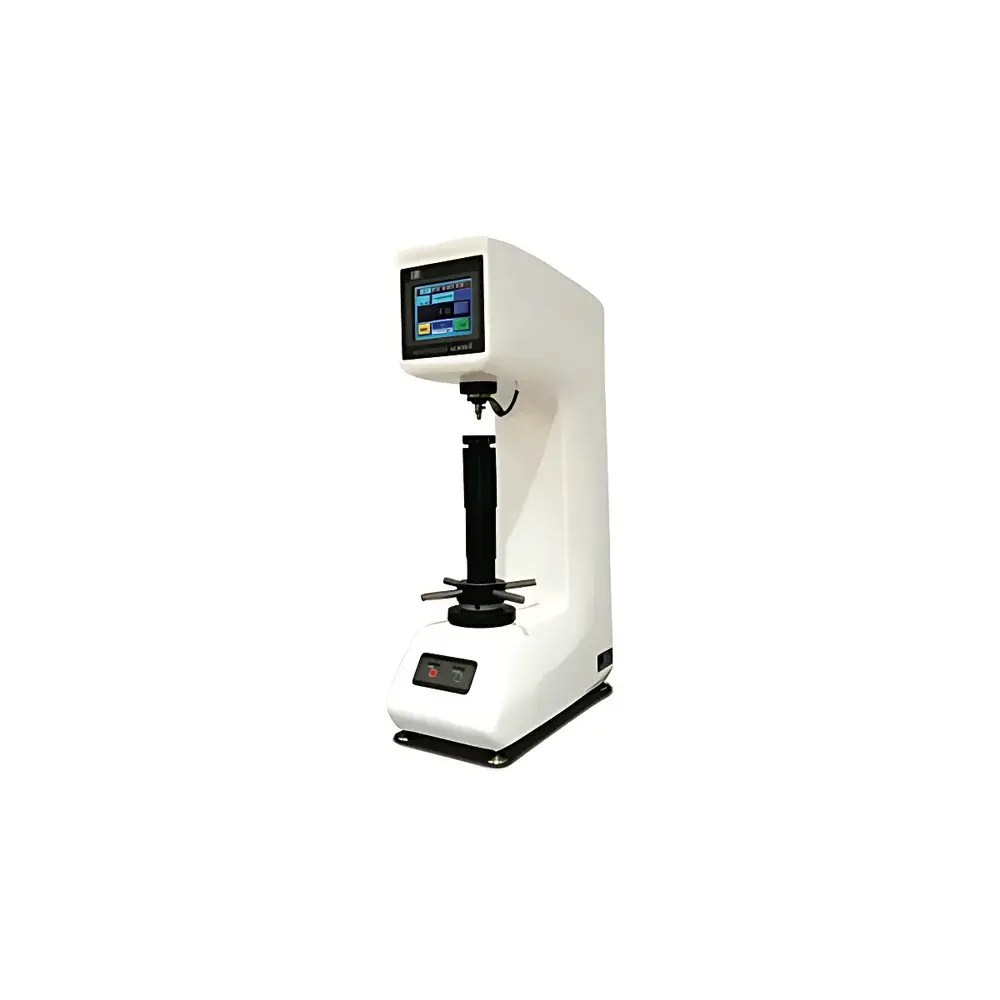
Future-Tech LC-200R / LC-200RB Fully Automatic Closed-Loop Rockwell Hardness Tester
| Brand | Future-Tech |
|---|---|
| Origin | Japan |
| Model | LC-200R / LC-200RB |
| Rockwell Scale Range | 20–70 HR |
| Total Test Force | 187.5 kgf (1839 N) |
| Maximum Specimen Height | 255 mm |
| Force Application Method | Load Cell-Based Closed-Loop Electro-Mechanical Actuation |
| Display | 8-inch Full-Color LCD Touchscreen |
| Compliance | ISO 6508-2, ASTM E18, JIS Z 2245, ISO 6506-2 (for Brinell mode on LC-200RB), ASTM D785, JIS K 7202 |
Overview
The Future-Tech LC-200R and LC-200RB are fully automatic, closed-loop Rockwell hardness testers engineered for metrological-grade repeatability and long-term stability in quality control laboratories, R&D facilities, and accredited testing centers. Unlike traditional dead-weight or semi-automatic systems, the LC-200 series employs a high-resolution load cell coupled with real-time feedback-controlled electro-mechanical actuation to precisely regulate both preliminary (minor) and total (major) test forces—eliminating mechanical hysteresis, inertia-induced overshoot, and thermal drift associated with conventional lever-arm or cam-driven mechanisms. The system operates on the fundamental Rockwell principle: indentation depth differential under minor and major loads is measured optically via a calibrated displacement transducer, with hardness values calculated and displayed per ASTM E18 and ISO 6508-2. The LC-200RB variant extends functionality with certified Brinell hardness capability (per ISO 6506-2) using optional low-force spherical indenters, enabling cross-method validation and polymer hardness assessment per ASTM D785 and JIS K 7202.
Key Features
- Closed-loop force control architecture ensures <0.5% force deviation across full range (3–187.5 kgf), meeting ISO 6508-2 Class A requirements for force accuracy.
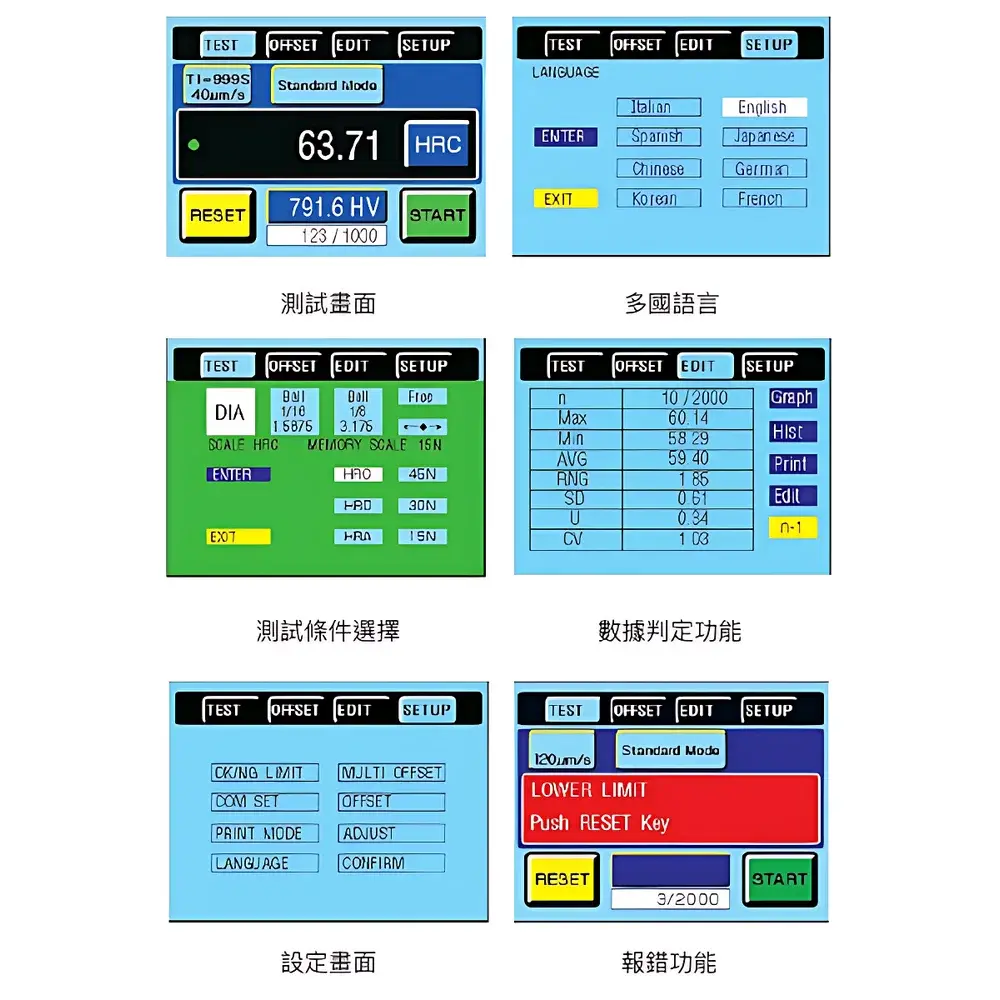
- 8-inch full-color capacitive touchscreen interface with multi-language support (English, Japanese, Chinese, Korean, German, French, Italian, Spanish) and intuitive workflow navigation.
- Automated indenter positioning with programmable approach distance (0.5–8 mm), eliminating manual focusing errors and reducing operator dependency.
- Five-point linear calibration routine using certified HRC, HRB, and HR30N reference blocks—enabling traceable correction of nonlinearity across the entire scale range.
- Geometric compensation algorithms for cylindrical, spherical, and offset surfaces—validated per ASTM E18 Annex A3 and JIS Z 2245 Clause 7.3.
- Configurable dwell time (0–999 s), customizable Rockwell scales (including superficial N/T/W/X/Y series), and dual-mode operation (Rockwell + Brinell on LC-200RB).
- Integrated white LED coaxial illumination with adjustable intensity, optimized for consistent contrast on polished, matte, or coated surfaces.
Sample Compatibility & Compliance
The LC-200R/LC-200RB accommodates specimens up to 255 mm in height and 170 mm in depth, supporting flat plates, shafts, gears, castings, and injection-molded thermoplastics. Its V-groove and 60° anvil fixtures comply with JIS B 7726 mechanical mounting requirements. All hardness measurements adhere to international standards governing method definition, uncertainty estimation, and reporting: ISO 6508-2 (Rockwell), ISO 6506-2 (Brinell, LC-200RB only), ASTM E18 (Rockwell), ASTM E10 (Brinell), ASTM D785 (plastics), and JIS K 7202. The instrument supports GLP/GMP-aligned audit trails when connected to compliant LIMS or data acquisition software—full traceability of operator ID, timestamp, calibration history, and raw depth data is retained internally for ≥2000 tests.
Software & Data Management
Embedded firmware enables direct statistical evaluation—including mean, standard deviation, max/min, tolerance banding (HI/OK/LO), and process capability indices (Cp/Cpk). Measurement data export is supported via RS-232 serial interface to external PCs or printers; optional digital I/O module allows integration into automated production lines for pass/fail signaling. All stored records include hardness value, scale identifier, test force, dwell time, indenter type, specimen ID, and environmental timestamp. Raw depth readings (in µm, resolution 0.01 µm) are retained alongside final HR values, permitting retrospective reanalysis without physical retesting. Export formats include CSV and plain-text reports compatible with Excel, Minitab, and JMP.
Applications
This system is routinely deployed for incoming material inspection of tool steels, aerospace alloys (e.g., Ti-6Al-4V, Inconel 718), automotive crankshafts, bearing races, and case-hardened components. The LC-200RB’s Brinell extension supports hardness verification of aluminum die-castings, copper alloys, and elastomeric composites where Rockwell scales lack sensitivity. Regulatory-compliant applications include FDA 21 CFR Part 11–enabled environments (with third-party validated software), ISO/IEC 17025-accredited testing labs, and automotive PPAP submissions requiring ASME B89.10.3 traceability. Its plastic hardness mode satisfies ISO 2039-2 and ASTM D785 requirements for rigid thermoplastics and thermosets.
FAQ
What standards does the LC-200R/LC-200RB comply with?
It meets ISO 6508-2 (Rockwell), ASTM E18, JIS Z 2245, and for the RB model, ISO 6506-2 (Brinell) and ASTM D785 (plastics).
Can it perform Brinell hardness testing?
Only the LC-200RB model supports Brinell testing using optional 1 mm, 2.5 mm, or 5 mm tungsten-carbide ball indenters at forces from 6.25 kgf to 187.5 kgf.
Is calibration traceable to national standards?
Yes—certified reference blocks (HRC, HRB, HR30N) are supplied with NIST-traceable certificates of calibration; five-point linearization ensures linearity compliance per ISO 6508-2 Annex B.
How is geometric compensation implemented?
Cylindrical and spherical corrections apply curvature-based depth offset algorithms derived from ASTM E18 Annex A3 and JIS Z 2245 Section 7.3.
What data security and audit capabilities are available?
Internal storage retains full test metadata including operator ID, timestamp, raw depth values, and calibration logs; RS-232 output supports integration with 21 CFR Part 11–compliant data management systems.



