
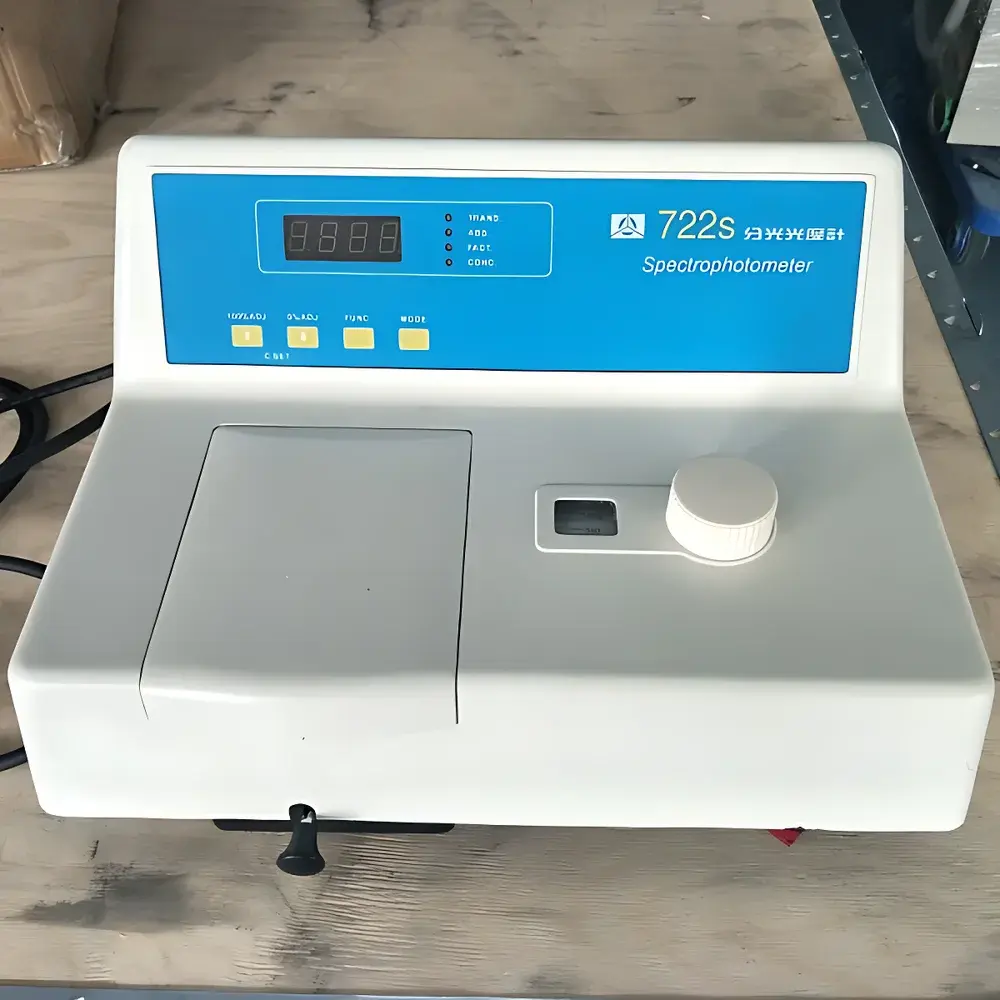
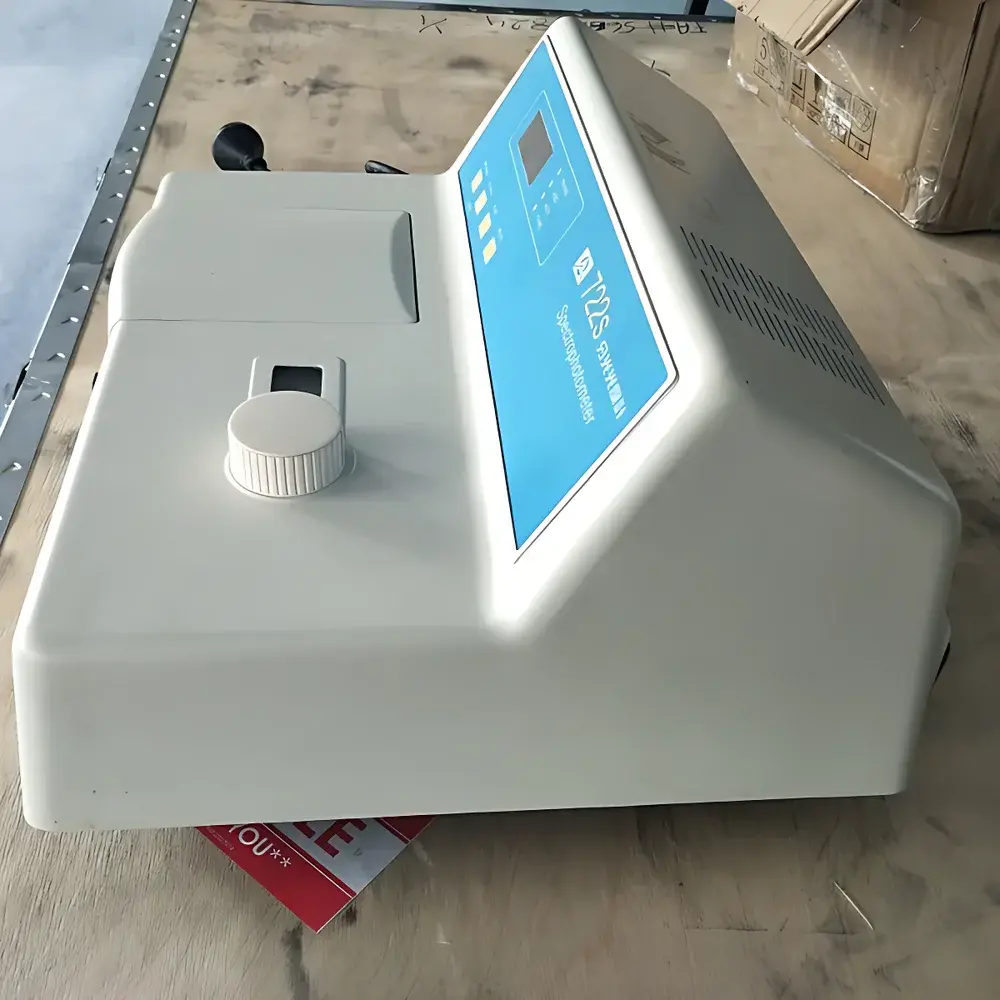
Shanghai Lengguang 722 Visible Spectrophotometer
| Brand | Lengguang |
|---|---|
| Origin | Shanghai, China |
| Model | 722 |
| Optical System | Double-beam |
| Detector | Photodiode Array |
| Wavelength Range | 325–1000 nm |
| Wavelength Accuracy | ±2.0 nm |
| Spectral Bandwidth | 4 nm |
| Stray Light | ≤1.0% T |
| Wavelength Scanning | Motorized Auto-Positioning |
| Display | 4-digit LCD |
| Auto Zero/Full-Scale Calibration | Yes |
| Transmittance/Absorbance/Concentration/Factor Mode | Automatic Switching |
| Compliance | Meets GB/T 21186–2007 (Chinese National Standard for Visible Spectrophotometers) |
Overview
The Shanghai Lengguang 722 Visible Spectrophotometer is a benchtop double-beam optical instrument engineered for routine quantitative and qualitative analysis in the visible spectrum. It operates on the principle of Beer–Lambert law-based absorbance measurement, utilizing a Czerny–Turner monochromator with a blazed holographic grating (1200 grooves/mm) to deliver stable spectral dispersion. Designed for educational laboratories, quality control environments, and small-scale R&D facilities, the 722 provides reliable photometric performance across 325–1000 nm — covering the full visible range (380–780 nm) and extending into near-UV and near-IR regions for broader application flexibility. Its double-beam architecture compensates for source drift and detector instability in real time, ensuring high baseline stability and measurement reproducibility without manual reference correction between samples.
Key Features
- Double-beam optical design with real-time reference beam compensation for enhanced photometric stability
- Czerny–Turner monochromator equipped with a 1200-line/mm blazed holographic grating for efficient light throughput and reduced aberration
- Motor-driven automatic wavelength scanning and positioning, supporting precise spectral acquisition at user-defined intervals
- Photodiode array detector offering fast response, low noise, and consistent linearity over extended operational cycles
- 4-digit LCD display with intuitive menu navigation and direct readout in transmittance (%T), absorbance (A), concentration (C), or factor (F) mode
- Integrated auto-zero and auto-full-scale functions, eliminating manual alignment and reducing operator-induced variability
- Fixed 4 nm spectral bandwidth optimized for resolution–sensitivity balance in standard colorimetric assays (e.g., phosphate, nitrate, protein assays)
- Stray light level ≤1.0% T at 360 nm, meeting national technical requirements per GB/T 21186–2007 for visible spectrophotometers
Sample Compatibility & Compliance
The 722 accommodates standard 10 mm pathlength cuvettes (glass or quartz) and supports both liquid and transparent solid samples. Its optical design ensures compatibility with common colorimetric reagents used in environmental testing (e.g., APHA color, COD), food analysis (e.g., anthocyanin quantification), and pharmaceutical QC (e.g., dissolution testing of dyed tablets). The instrument conforms to GB/T 21186–2007, the Chinese national standard specifying performance criteria for visible spectrophotometers—including wavelength accuracy (±2.0 nm), photometric accuracy (±1.0% T), and repeatability (≤0.5% T). While not certified to ISO/IEC 17025 or ASTM E275, its metrological traceability supports internal calibration protocols aligned with GLP documentation practices.
Software & Data Management
An optional Windows-compatible PC software package is available for advanced data acquisition, spectral scanning, kinetic profiling, and multi-point calibration curve generation. The software enables export of ASCII-formatted spectral data (.txt) and absorbance/time series (.csv), facilitating integration with LIMS or statistical analysis platforms such as OriginLab or JMP. Audit trail functionality is limited to manual logbook entries; the system does not support FDA 21 CFR Part 11-compliant electronic signatures or automated audit trails. However, all measurement parameters—including date/time stamp, wavelength, mode, and sample ID—are retained in memory for up to 100 readings and can be manually reviewed or exported via serial interface.
Applications
- Quantitative determination of analytes in water quality monitoring (e.g., iron, copper, ammonia via complexometric methods)
- Enzyme kinetics studies requiring time-resolved absorbance at fixed wavelengths (e.g., NADH oxidation at 340 nm)
- Educational demonstrations of spectral absorption, Beer’s law validation, and filter characterization
- Raw material verification in dye manufacturing and pigment formulation
- Stability testing of colored pharmaceutical formulations under accelerated storage conditions
- Calibration of secondary standards in metrology labs operating under ISO/IEC 17025 scope limitations
FAQ
What is the maximum pathlength supported by the 722?
The instrument is calibrated for 10 mm rectangular cuvettes; longer pathlength cells may be used but require manual correction factors and are not covered under factory calibration.
Does the 722 support wavelength scanning and peak identification?
Yes — motorized wavelength drive enables discrete point scanning across 325–1000 nm; however, continuous scanning and automated peak detection require the optional PC software.
Is quartz cuvette compatibility confirmed across the full 325 nm lower limit?
Yes — when using UV-grade quartz cuvettes, measurements down to 325 nm are valid; standard optical glass cuvettes transmit only above ~350 nm.
Can the 722 be integrated into an automated lab workflow?
It features RS-232 serial output for basic remote control and data transfer, but lacks Ethernet, USB device mode, or programmable logic controller (PLC) interfacing capability.
How often should wavelength calibration be performed?
Annual verification against holmium oxide or didymium glass reference filters is recommended; more frequent checks are advised if operated in variable ambient temperature or high-humidity environments.




