
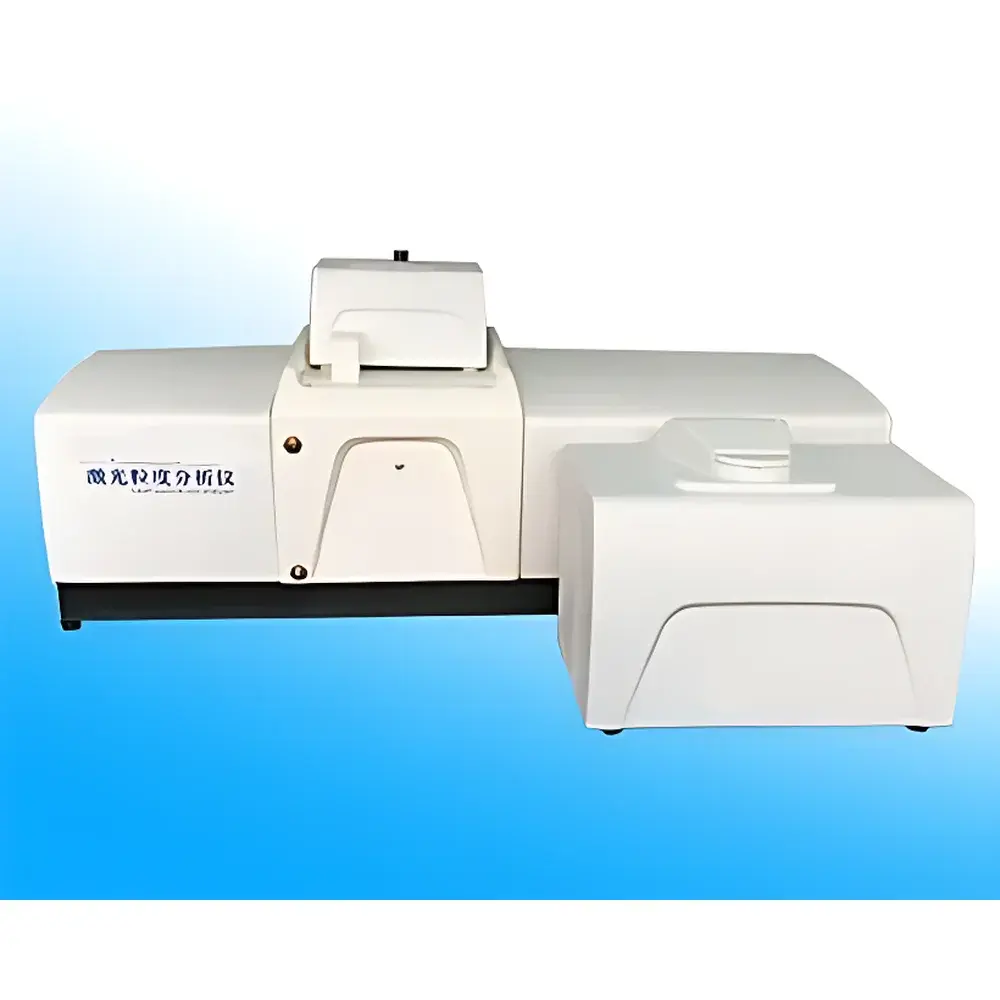
Kyocera JK-JG8000 Wet-Dispersion Full-Range Laser Particle Size Analyzer
| Brand | Kyocera |
|---|---|
| Origin | Beijing, China |
| Manufacturer Type | Authorized Distributor |
| Country of Origin | China |
| Model | JK-JG8000 |
| Price | USD 10,800 (FOB Beijing) |
| Dispersion Method | Wet Dispersion |
| Measurement Range | 0.01–2000 µm |
| Repeatability | <0.5% RSD (D50 of NIST-traceable standard) |
| Measurement Time | <2 min per run |
| Standard Compliance | ISO 13320:2020, GB/T 19077–2016, Q/0100JWN001–2013 |
| Detector Channels | 127 |
| Primary Laser | He–Ne, 632.8 nm, >3.0 mW |
| Auxiliary Laser | Semiconductor, 650 nm, >2.0 mW |
| Ultrasonic Dispersion | 40 kHz, 50 W |
| Stirring Speed | 0–3000 rpm (adjustable) |
| Circulation Flow Rate | 30 L/min |
| Sample Cell Volume | 1000 mL |
| Auto-Alignment System | Quadruple Hybrid Stepper Motor Drive, <1 µm positioning resolution |
| Dimensions | 1040 × 440 × 540 mm |
| Weight | 58 kg |
Overview
The Kyocera JK-JG8000 Wet-Dispersion Full-Range Laser Particle Size Analyzer is an engineered solution for high-fidelity particle size distribution (PSD) analysis across a continuous dynamic range from 0.01 µm to 2000 µm. It operates on the principle of laser diffraction—specifically Mie scattering theory for submicron particles and Fraunhofer approximation for coarse fractions—combined with dual-laser orthogonal optical geometry to ensure comprehensive angular light scattering capture. The system integrates a convergent beam Fourier transform optical design with dual detection planes, enabling unambiguous resolution of both nano- and millimeter-scale features within a single measurement cycle. Unlike segmented or hybrid instrument architectures, the JK-JG8000 delivers true full-range characterization without manual lens swapping, fluidic reconfiguration, or algorithmic stitching—minimizing operator dependency and inter-run variability. Its design targets laboratories requiring traceable, reproducible PSD data under routine QC, R&D, or regulatory-compliant environments.
Key Features
- Full-range optical architecture: Dual-laser (He–Ne + semiconductor), dual-spectrum detection (forward and side-scatter from 45° to 135°) eliminates range gaps and enables seamless coverage from colloidal nanoparticles to coarse granules.
- Integrated wet dispersion module: High-efficiency 40 kHz ultrasonication (50 W), variable-speed stirring (0–3000 rpm), and 30 L/min recirculation pump with optimized flow-path hydraulics prevent sedimentation and ensure representative sampling of polydisperse suspensions.
- Sub-micron auto-alignment system: Four-axis hybrid stepper motor drive achieves real-time optical centering with ≤1 µm positional accuracy, maintaining optimal beam alignment throughout extended operation—critical for long-term measurement stability.
- Unconstrained distribution fitting: Non-parametric inverse algorithm applies no pre-assumed distribution model (e.g., log-normal or Rosin-Rammler), preserving raw scattering intensity data integrity and yielding physically realistic PSDs independent of user bias.
- Rugged industrial enclosure: All-optical components housed in thermally stabilized, vibration-damped chassis; meets IP20 environmental rating for controlled lab environments; CE-marked for EMC and safety compliance.
Sample Compatibility & Compliance
The JK-JG8000 is validated for aqueous and organic suspensions of inorganic oxides (e.g., SiO₂, Al₂O₃), pharmaceutical actives and excipients, ceramic precursors, pigment dispersions, coal-water slurries, catalyst supports, and food-grade powders. It accommodates sample concentrations from 0.001% to 20% w/v via adjustable flow and ultrasonic energy delivery. Regulatory alignment includes full adherence to ISO 13320:2020 (laser diffraction methodology), GB/T 19077–2016 (Chinese national standard equivalent), and supports audit-ready documentation per GLP and GMP frameworks. While not FDA 21 CFR Part 11–certified out-of-box, its software architecture permits integration with validated electronic lab notebook (ELN) systems supporting electronic signatures, audit trails, and user access controls.
Software & Data Management
The proprietary JK-ParticleSuite v4.2 software provides ISO-compliant reporting templates (D10, D50, D90, span, specific surface area), batch comparison tools, statistical process control (SPC) charts, and customizable export to CSV, PDF, or XML formats. Raw scattering patterns are stored in HDF5 format with embedded metadata (timestamp, operator ID, instrument serial, calibration ID). Version-controlled firmware updates are delivered via secure HTTPS portal. Data integrity safeguards include automatic checksum validation on file write, time-stamped calibration logs, and optional network-based backup to NAS or cloud storage (AWS S3-compatible).
Applications
- Cement & construction materials: Quantification of clinker fineness, fly ash reactivity index, and slag particle morphology impact on hydration kinetics.
- Pharmaceuticals: Monitoring micronization efficiency of APIs, excipient blend uniformity, and suspension stability in oral liquid formulations per USP <724>.
- Advanced ceramics: Correlating green-body density with submicron alumina or zirconia PSD; detecting agglomerate breakage during ball milling.
- Pigments & coatings: Optimizing TiO₂ dispersion quality in latex emulsions; assessing shear-induced flocculation in architectural paints.
- Energy materials: Characterizing graphite anode particle distribution in lithium-ion battery slurries; evaluating coal pulverization consistency for combustion efficiency modeling.
FAQ
Does the JK-JG8000 require external compressed air or chilled water?
No—it operates as a self-contained benchtop unit with only AC power (220 V ±10%, 50/60 Hz) and tap-water cooling for the ultrasonic transducer.
Can it measure dry powders directly?
No—the JK-JG8000 is configured exclusively for wet dispersion; dry powder analysis requires optional pneumatic dispersion accessories not included in this model.
Is the He–Ne laser replaceable in the field?
Yes—the laser module is user-serviceable with factory-supplied alignment jig and lifetime specification (>25,000 h); replacement takes <15 minutes without optical recalibration.
How is traceability ensured for calibration verification?
Each instrument ships with NIST-traceable polystyrene latex standards (e.g., 100 nm, 1 µm, 10 µm, 100 µm) and a certified calibration report issued by CNAS-accredited lab (Certificate No. CNAS LXXXXX).
What maintenance intervals are recommended?
Ultrasonic transducer inspection every 6 months; flow cell cleaning after each abrasive sample; annual full optical path verification using built-in reference scatterers.



