
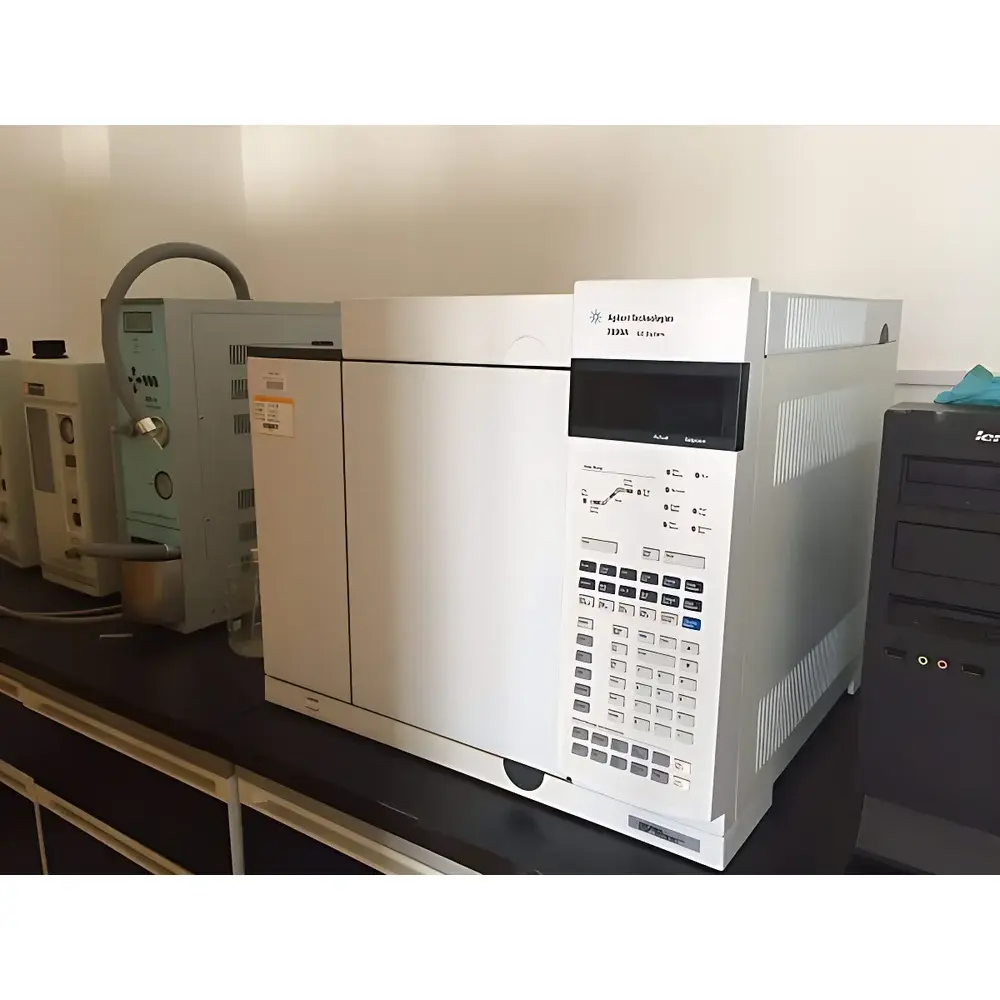
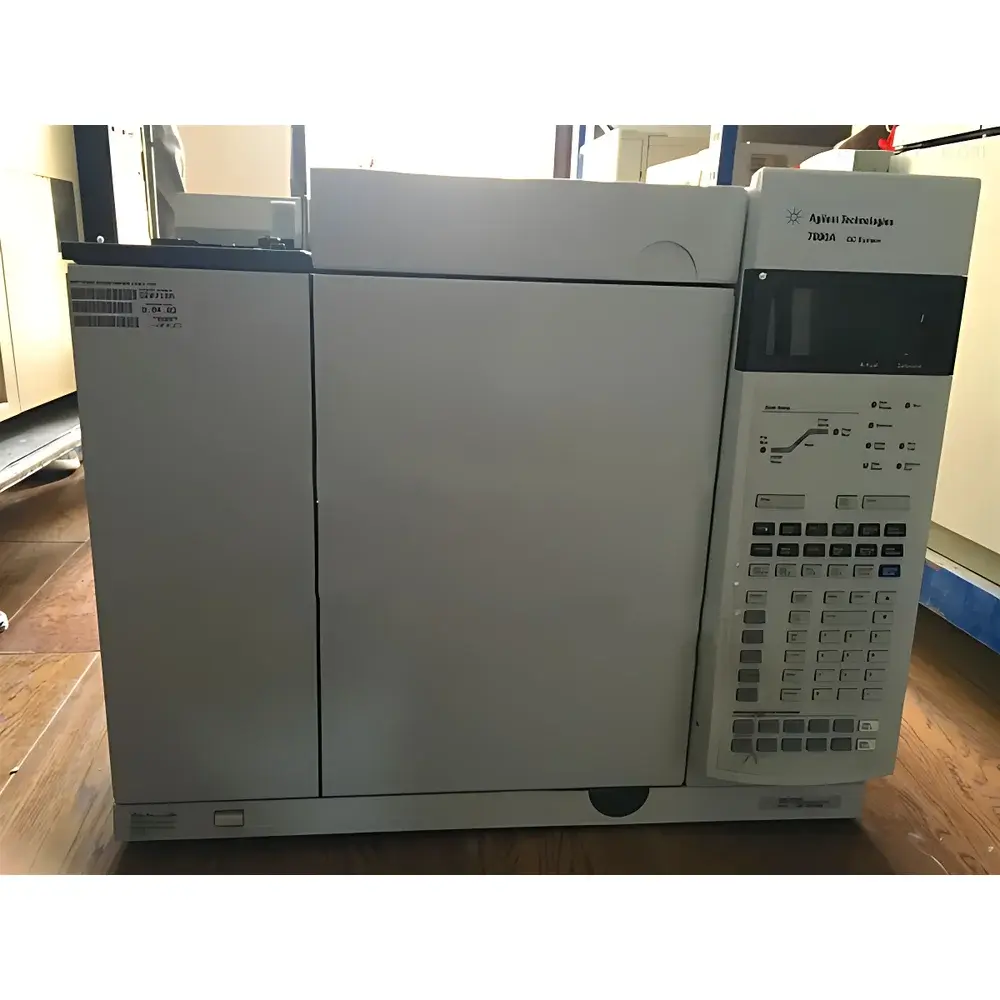
Agilent 7890A Gas Chromatograph for Environmental Analysis
| Brand | Agilent Technologies |
|---|---|
| Origin | USA |
| Model | Agilent 7890A |
| Instrument Type | Laboratory Gas Chromatograph |
| Application Field | Environmental Monitoring |
| Temperature Control Range | Ambient to 450 °C (oven) |
| Ramp Rate | Up to 120 °C/min |
| Cool-down Rate | From 450 °C to 50 °C in <3.5 min |
| Carrier Gas Flow Range | 0–1200 mL/min (He, H₂, N₂) |
| Carrier Gas Pressure Control | 0–100 psi (EPC resolution: 0.001 psi) |
| Inlet Pressure Setting Range | 0–100 psi (split/splitless), 0–150 psi (high-pressure option) |
| Total Inlet Flow Setting Range | 0–1200 mL/min |
| Inlet Operating Temperature | Up to 450 °C |
Overview
The Agilent 7890A Gas Chromatograph is a high-performance, laboratory-grade analytical platform engineered for rigorous environmental monitoring applications—including volatile organic compound (VOC) analysis in air, water, soil, and wastewater matrices per EPA Methods 502.2, 524.2, 8260D, 8270E, and ASTM D5504. Built upon proven GC architecture and enhanced with microfluidic flow control (MFC) technology, the 7890A delivers precise, reproducible separations through integrated column switching, backflush, heart-cutting, and solvent venting capabilities—all within a single oven environment. Its electronic pressure control (EPC) system ensures sub-millibar precision across all gas lines, enabling method robustness under variable ambient conditions and long-term retention time stability critical for regulatory compliance workflows.
Key Features
- Microfluidic Flow Control (MFC) module: Enables leak-free, on-column connections for complex configurations—such as multidimensional GC (GC×GC-ready), backflush, and heart-cutting—without manual plumbing or external valves.
- Advanced Electronic Pressure Control (EPC): Delivers 0.001 psi pressure resolution across split/splitless, programmed temperature vaporizing (PTV), and cool-on-column inlets; supports helium, hydrogen, and nitrogen carrier gases with dynamic flow optimization.
- QuickSwap inlet design: Patented flip-top inlet cap allows liner replacement in under 30 seconds without tools, minimizing downtime and reducing operator error during routine maintenance.
- Integrated Agilent 7683 autosampler control: Native support for liquid, headspace, purge-and-trap, and valve-based injection; expandable via modular sample introduction options including 7697A Headspace Sampler and 7693A AutoHS.
- Dual independent oven zones: Provide simultaneous thermal control of main column oven and auxiliary detector compartments, improving baseline stability for multi-detector configurations (e.g., FID + ECD).
- Intelligent diagnostics and predictive maintenance: Embedded instrument monitoring software tracks consumable usage (e.g., septa, liners, columns), detects peak shape degradation, and alerts users prior to system failure—supporting GLP/GMP audit readiness.
Sample Compatibility & Compliance
The 7890A accommodates diverse environmental sample types—including aqueous extracts (via purge-and-trap or static headspace), solid-phase microextraction (SPME) fibers, thermal desorption tubes, and direct air canisters—when paired with appropriate inlet modules and detectors. It meets essential regulatory requirements for environmental laboratories operating under ISO/IEC 17025 accreditation, EPA Contract Lab Program (CLP) guidelines, and EU Water Framework Directive (WFD) testing protocols. All EPC-controlled parameters are logged with timestamped audit trails, ensuring full traceability for FDA 21 CFR Part 11-compliant data integrity when used with OpenLab CDS or ChemStation software.
Software & Data Management
Controlled via Agilent OpenLab CDS or legacy ChemStation software, the 7890A supports fully validated method development, sequence execution, real-time chromatogram review, and automated report generation. Data files adhere to AIA/ANDI standards for cross-platform compatibility. The system includes built-in calibration verification tools, peak integration algorithms compliant with USP , and optional electronic signatures for regulated environments. Method transfer from Agilent 6890 systems is seamless due to hardware and firmware backward compatibility—preserving legacy validation investments while enabling performance upgrades.
Applications
Primary use cases include quantification of BTEX (benzene, toluene, ethylbenzene, xylenes), chlorinated solvents (e.g., PCE, TCE), pesticides (organochlorines, organophosphates), polycyclic aromatic hydrocarbons (PAHs), and halogenated compounds in environmental media. The platform supports EPA Method 8260D (VOCs in solids/water), Method 8270E (semivolatiles), and ASTM D5504 (total sulfur in natural gas). With optional mass spectrometric detection (via 5975/5977 MSD), it extends into non-target screening and congener-specific dioxin/furan analysis when coupled with high-resolution GC columns.
FAQ
Is the Agilent 7890A compatible with third-party mass spectrometers?
Yes—the 7890A features standard GC-MS interface hardware and timing protocols supporting integration with most benchtop quadrupole and single-quadrupole MS systems, provided vacuum interlock and communication protocols (e.g., RS-232, LAN) are configured per manufacturer specifications.
Does the system support unattended operation for overnight environmental batch runs?
Absolutely—the 7890A, when equipped with the 7693A AutoHS or 7697A Headspace Sampler and OpenLab CDS, enables fully automated sequences of up to 160 samples with scheduled shutdown, column bake-out, and system self-checks.
Can existing Agilent 6890 methods be directly imported and executed?
Yes—method files (.m files) and sequence templates from ChemStation v.A.10.x and later are natively supported; minor adjustments to EPC setpoints may be required due to improved pressure resolution on the 7890A.
What certifications does the instrument carry for laboratory safety and electromagnetic compatibility?
The 7890A complies with IEC 61010-1 (safety), IEC 61326-1 (EMC), and UL 61010-1; CE marking is affixed for use in EU member states under the Low Voltage and EMC Directives.
Is remote monitoring and troubleshooting available?
Yes—via Agilent Remote Manager (ARM) software, authorized personnel can access real-time instrument status, view chromatograms, adjust run parameters, and initiate diagnostics over secure HTTPS connections—subject to local IT policy and firewall configuration.





