
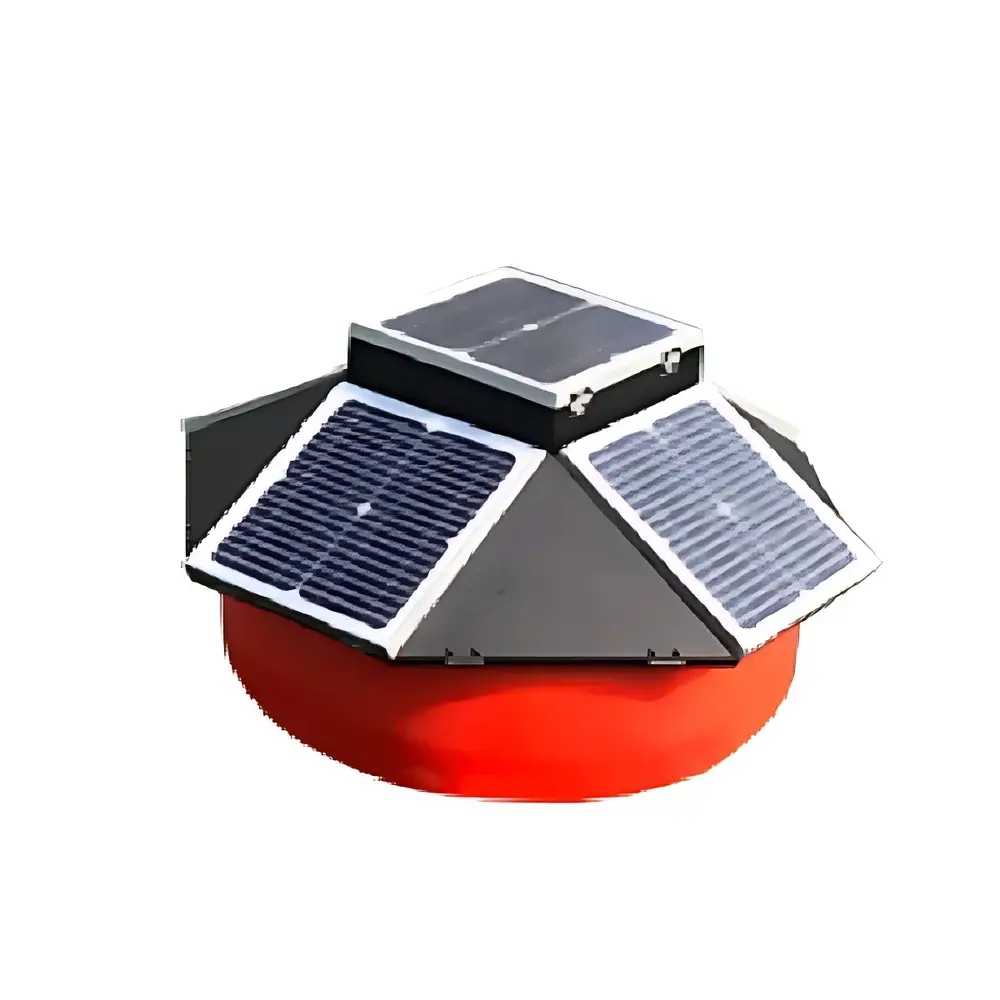
HS-W-B (400–1000 nm) Hyperspectral Online Water Quality Monitoring System
| Origin | Tianjin, China |
|---|---|
| Manufacturer Type | Authorized Distributor |
| Origin Category | Domestic (PRC) |
| Model | HS-W-B (400–1000) |
| Price Range | USD 42,000 – 70,000 |
| Spectral Range | 400–1000 nm |
| Spectral Resolution | ≤5 nm |
| Sampling Interval | <3 nm |
| Number of Spectral Channels | 300 |
| Light Source | Integrated Halogen Lamp |
| Measurement Frequency | Configurable, up to 1 measurement per 5 seconds |
| Detection Accuracy | >85% (vs. Standard Laboratory Methods) |
| Power Supply | Rechargeable Lithium Battery / Solar Panel / AC Mains |
| Operational Duration | ≥6 months (at 30-min sampling interval) |
| Dimensions | 70 cm × 20 cm × 32 cm |
| Weight | <20 kg (including buoy assembly) |
| Communication Interface | 4G/5G Cellular Module |
| Ingress Protection Rating | IP67 |
Overview
The HS-W-B (400–1000 nm) Hyperspectral Online Water Quality Monitoring System is an engineered solution for continuous, in-situ assessment of inland and coastal water bodies using UV-Vis-NIR absorption and scattering spectroscopy. Unlike discrete grab-sample analysis or single-parameter sensor arrays, this system leverages hyperspectral reflectance and transmittance signatures across 300 narrowband channels (400–1000 nm) to extract multivariate optical fingerprints correlated with key water quality constituents. The measurement principle relies on Beer–Lambert law-based inversion models combined with chemometric calibration against reference laboratory data (e.g., spectrophotometric, titrimetric, and enzymatic assays per ISO 7027, ISO 15839, and EPA Method 450.1). Designed for deployment on buoys, piers, or fixed platforms, the system operates autonomously under field conditions—capturing spectral data at user-defined intervals (as frequent as once every 5 seconds), transmitting metadata and raw spectra via embedded 4G/5G modules to a secure cloud infrastructure for real-time model inference.
Key Features
- Full-range hyperspectral acquisition from 400 nm to 1000 nm with ≤5 nm optical resolution and sub-3 nm digital sampling interval—enabling discrimination of overlapping absorption bands from chlorophyll-a, dissolved organic carbon (DOC), nitrate, turbidity, and colored dissolved organic matter (CDOM).
- Integrated halogen light source with stable spectral output and thermal management, ensuring consistent illumination intensity across operational temperature ranges (−10 °C to +50 °C).
- Triple-power architecture: supports simultaneous operation on rechargeable lithium battery, auxiliary solar panel (with MPPT charge controller), and optional AC mains—validated for uninterrupted 6-month field endurance at 30-minute sampling intervals.
- Ruggedized marine-grade housing rated IP67, corrosion-resistant stainless-steel and UV-stabilized polymer construction, and buoy-integrated hydrodynamic design for long-term deployment in rivers, reservoirs, estuaries, and aquaculture ponds.
- Edge-based preprocessing firmware: performs on-device dark-current correction, wavelength calibration, and spectral smoothing prior to transmission—reducing bandwidth usage and cloud processing latency.
Sample Compatibility & Compliance
The HS-W-B system is validated for natural freshwater, brackish, and low-salinity estuarine environments (salinity <15 ppt). It does not require reagents, consumables, or wet-chemistry modules—eliminating maintenance-related drift and cross-contamination risks inherent in electrochemical or colorimetric analyzers. All spectral calibrations are traceable to NIST-traceable reference standards and aligned with ISO 17025-accredited laboratory validation protocols. Data outputs comply with WMO GOS-2030 metadata standards and support integration into national monitoring networks (e.g., China’s National Surface Water Quality Monitoring Network, USGS NWIS, and EU WISE databases). The system architecture supports audit-ready logging for GLP/GMP-aligned environmental QA/QC workflows, including full timestamping, instrument health telemetry, and version-controlled model deployment.
Software & Data Management
The cloud-based analytics platform provides role-based web dashboards and native iOS/Android applications for real-time visualization, historical trend analysis, and alert configuration (e.g., threshold breaches, spectral anomaly detection). Each deployed unit is assigned a unique device ID linked to a dedicated tenant space within the multi-tenant SaaS environment. The platform employs ensemble machine learning models—including PLS regression, random forest, and physics-informed neural networks—to estimate 15 regulatory-relevant parameters: turbidity (NTU), chlorophyll-a (µg/L), total suspended solids (TSS, mg/L), chemical oxygen demand (COD, mg/L), biochemical oxygen demand (BOD₅, mg/L), nitrate-nitrogen (NO₃⁻-N, mg/L), ammonium-nitrogen (NH₄⁺-N, mg/L), total phosphorus (TP, mg/L), dissolved oxygen (DO, mg/L), pH (via optical indicator modeling), conductivity (µS/cm), salinity (ppt), CDOM (aCDOM(355), m⁻¹), Secchi depth (m), and water temperature (°C). All model updates undergo version control, A/B testing, and uncertainty quantification (95% confidence intervals reported per parameter). Raw spectral datasets and processed results are exportable in NetCDF-4 and CSV formats, compatible with MATLAB, Python (xarray, pandas), and GIS tools.
Applications
- Real-time early warning of algal bloom onset and cyanotoxin precursor accumulation in drinking water source reservoirs.
- Regulatory compliance monitoring for wastewater discharge points under national effluent standards (e.g., China’s GB 8978-1996, EU Urban Wastewater Treatment Directive).
- Long-term trend analysis of eutrophication drivers in lake restoration projects—correlating spectral shifts with nutrient loading histories.
- Support for adaptive management in aquaculture operations—optimizing feed input and aeration based on DO, chlorophyll-a, and TSS dynamics.
- Calibration and validation anchor for satellite-derived water quality products (e.g., Sentinel-3 OLCI, Landsat 9 OLI-2) through match-up analysis of coincident in-situ and remote sensing data.
FAQ
What spectral calibration protocols are used during factory commissioning and field recalibration?
Each unit undergoes factory calibration using NIST-traceable tungsten-halogen and deuterium lamps, followed by empirical linearity verification across the full 400–1000 nm range. Field recalibration is supported via optional removable reference tiles (certified reflectance standards at 10%, 50%, and 99%) and automated dark-reference cycles triggered before each measurement sequence.
How is model accuracy validated against standard methods?
Accuracy validation follows ISO 5725-2:2019 guidelines. Over 1.2 million in-situ spectral measurements collected across 17 sites (Tianjin, Shandong, Jiangsu, Anhui, Chongqing) were paired with concurrent grab samples analyzed per ISO 10510 (turbidity), ISO 10260 (chlorophyll-a), and ISO 6060 (COD). Median relative error was ≤12.3%; temporal trend correlation (Pearson r) exceeded 0.97 against reference time series.
Does the system support FDA 21 CFR Part 11-compliant electronic records?
Yes—the cloud platform offers configurable 21 CFR Part 11 mode, enabling electronic signatures, audit trails with immutable timestamps, role-based access controls, and exportable ALCOA+ compliant reports for regulated environmental monitoring programs.
Can the HS-W-B be integrated with SCADA or existing municipal water management systems?
Yes—via RESTful API (JSON over HTTPS) and Modbus TCP gateway options. Pre-built connectors are available for Siemens Desigo, Honeywell Experion, and Schneider EcoStruxure platforms, supporting OPC UA 1.04 interoperability.
What is the recommended maintenance schedule for long-term deployments?
Optical windows require quarterly cleaning with isopropyl alcohol and lint-free wipes; battery health is monitored remotely and replacement recommended every 24 months. Full functional verification—including spectral flat-field check and reference tile response—is advised semiannually per ISO/IEC 17025 Clause 7.7.
Related Products







