
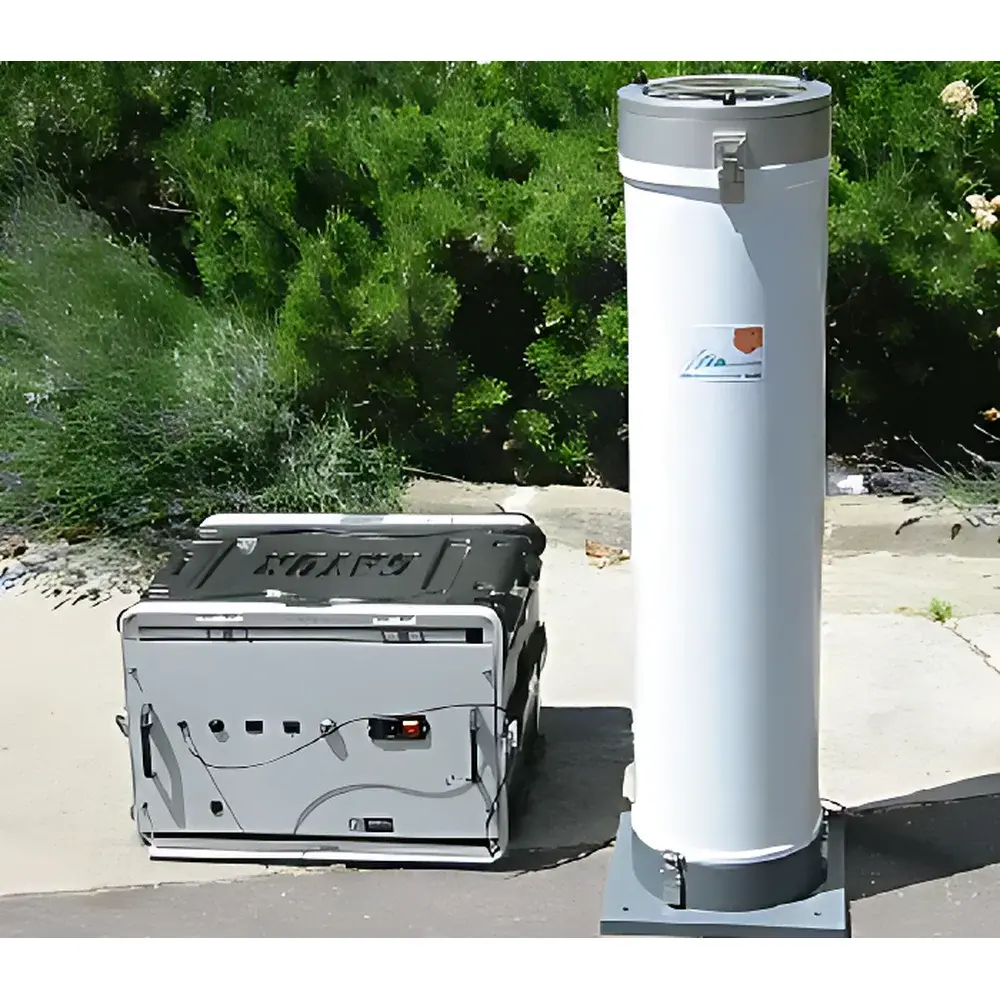
CIMEL CE370-2 Micro-Pulse Lidar (MPL)
| Brand | CIMEL |
|---|---|
| Origin | France |
| Model | CE370-2 |
| Eye-Safe Laser Pulse Energy | 8–12 µJ |
| Laser Wavelength | 532 nm |
| Pulse Repetition Rate | 5 kHz |
| Pulse Width | <12 ns |
| Telescope Type | Galilean |
| Aperture Diameter | 200 mm |
| Effective Focal Length | 900 mm |
| Field Stop | Double |
| Total Field of View (FOV) | 55 µrad (standard fiber) / 55/110 µrad (enhanced fiber) |
| Detector | Si APD with 55% Quantum Efficiency |
| Filter Bandwidth | 0.2 nm |
| Spatial Resolution | 15 m |
| Maximum Detection Range | Up to 30 km (atmosphere-dependent) |
| Range Gates | 2048 |
| Data Acquisition Mode | Photon Counting |
| Maximum Counting Rate | 20 Mc/s |
| Operating Temperature | –10 °C to +40 °C |
| Power Supply | 100/115/230 VAC, ≤500 W |
| Weight | 35 kg |
| Enclosure | 6U Rack-mounted Electronics + Telescope (Ø220 mm × 500 mm) |
| Fiber Interconnect | 10 m optical fiber |
| Optional Dual-Axis Scanner | Azimuth –180° to +180°, Zenith 0° to 90°, Positional Accuracy ±3′ |
Overview
The CIMEL CE370-2 Micro-Pulse Lidar (MPL) is a fully automated, eye-safe, ground-based remote sensing instrument engineered for high-resolution vertical profiling of atmospheric aerosols and thin clouds. Operating on the principle of elastic backscatter lidar at 532 nm, the CE370-2 employs a frequency-doubled Nd:YAG laser with micro-pulse energy (8–12 µJ), enabling compliance with Class 1M laser safety standards per IEC 60825-1. Its coaxial Galilean telescope design—featuring a 200 mm aperture and 900 mm effective focal length—ensures precise spatial overlap between transmit and receive paths without manual alignment. The system delivers 15 m vertical resolution across up to 30 km altitude, capturing photon-counted signals with a maximum acquisition rate of 20 Mc/s and 2048 range gates. Designed for long-term unattended operation in diverse climatic conditions, the electronics rack (6U) and telescope are physically decoupled via a 10 m optical fiber, enhancing thermal and mechanical stability. The CE370-2 serves as a core component in atmospheric observation networks, supporting boundary layer height (PBL) retrieval, diurnal/seasonal aerosol dynamics analysis, and synergistic validation with CIMEL sun photometers (AERONET-compliant).
Key Features
- Eye-safe operation certified under IEC 60825-1 Class 1M, eliminating need for controlled access zones or operator laser safety training
- Coaxial transceiver architecture with automatic optical axis alignment—no periodic collimation required
- 15 m native vertical resolution with full-range profiling capability up to 30 km under typical clear-sky conditions
- Modular hardware design: optically isolated telescope (Ø220 mm × 500 mm) and rack-mounted electronics (6U) linked by 10 m fiber for environmental resilience
- USB 2.0 interface for real-time data streaming, remote configuration, and firmware updates
- Optional dual-axis scanning unit (azimuth ±180°, zenith 0–90°, ±3′ positional accuracy) for multi-directional profiling and tomographic reconstruction
- Compact transportable form factor (35 kg total mass) suitable for mobile campaigns, mountain stations, and urban monitoring nodes
Sample Compatibility & Compliance
The CE370-2 is optimized for continuous, quantitative measurement of tropospheric and lower stratospheric aerosol and cloud layers. It detects elastic backscatter coefficients (β532) and derives extinction profiles (α532) using standard Klett-Fernald inversion techniques with calibrated molecular atmosphere reference. The system complies with international observational protocols including EARLINET methodology and WMO GAW Aerosol Measurement Procedures. Its photon-counting architecture meets GLP-aligned data integrity requirements when paired with timestamped acquisition logs and metadata embedding. While not FDA-regulated, its software architecture supports audit-trail generation and user-access logging compatible with ISO/IEC 17025 laboratory quality management frameworks.
Software & Data Management
CIMEL’s proprietary CAML software suite provides integrated control, real-time visualization, and offline processing. The application supports synchronized operation with CIMEL CE318 sun photometers for combined AOD–lidar ratio analysis and hygroscopic growth modeling. Raw photon counts are stored in HDF5 format with embedded geolocation, time stamps (GPS-synchronized), and instrument status parameters. Level-1 processing includes dead-time correction, background subtraction, and range-square normalization. Level-2 outputs include calibrated backscatter coefficient profiles, PBL height (using wavelet covariance transform or gradient methods), and cloud base/top detection. Export modules generate NetCDF files compliant with ICARE and ESA Aerosol CCI standards. All software binaries undergo annual regression testing against NIST-traceable calibration references.
Applications
- Long-term monitoring of planetary boundary layer evolution and pollution transport pathways
- Validation of satellite aerosol products (e.g., CALIPSO, Aeolus, Sentinel-5P)
- Source apportionment studies in urban and industrial regions via depolarization-capable variants (CE370-3 with optional polarization module)
- Volcanic ash plume tracking and aviation hazard assessment
- Cloud microphysical property estimation (cloud base height, geometric thickness, phase discrimination when co-located with ceilometers)
- Support for climate model evaluation through multi-year vertical extinction trend analysis
- Network deployment in GAW, ACTRIS, and NDACC infrastructure for inter-site calibration harmonization
FAQ
Is the CE370-2 suitable for unattended operation in extreme environments?
Yes—the optical separation of telescope and electronics via 10 m fiber enables stable performance across –10 °C to +40 °C ambient ranges; enclosure IP54 rating protects against dust and rain ingress.
What level of calibration traceability does the system provide?
Factory calibration includes absolute detector quantum efficiency mapping and laser pulse energy monitoring; field recalibration is supported via built-in Rayleigh scattering cross-checks against US Standard Atmosphere models.
Can the CE370-2 be integrated into an existing atmospheric observation network?
Yes—its USB interface supports integration with Linux-based data acquisition servers; CAML software includes APIs for ingestion into EUDAT B2SAFE and ICOS Carbon Portal workflows.
Does the system support real-time data transmission to central servers?
Yes—via configurable FTP/SFTP upload schedules or MQTT publish-subscribe protocols with TLS 1.2 encryption for secure telemetry transfer.
What maintenance intervals are recommended for long-term deployments?
Optical window cleaning every 3 months in dusty environments; annual verification of laser pulse energy and detector dark count rate; no routine alignment procedures required due to passive coaxial stability.







