
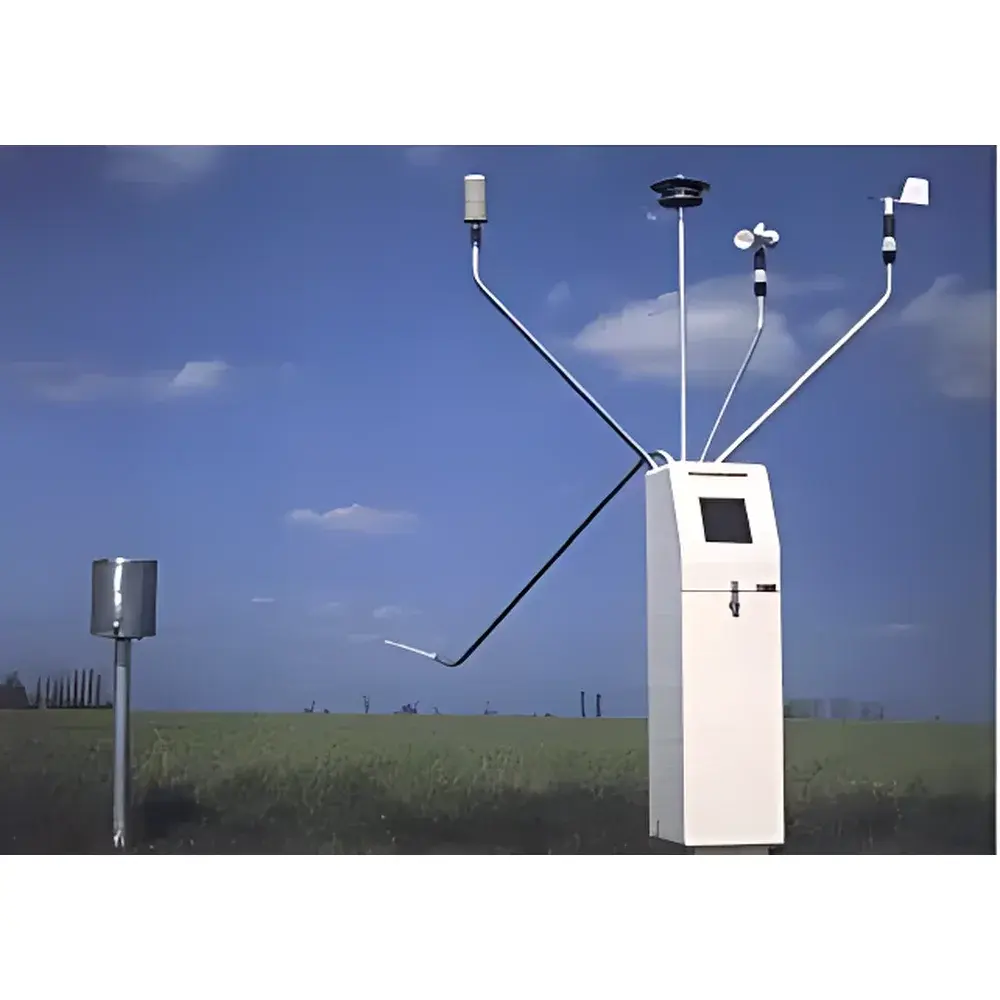
Cimel ENERCO 400 Portable Automatic Weather Station
| Brand | Cimel |
|---|---|
| Origin | France |
| Model | ENERCO 400 |
| Type | Portable Weather Station |
| Certification | Compliant with WMO Guide to Meteorological Instruments and Methods of Observation (WMO-No. 8) |
| Power Supply | Integrated solar panel + rechargeable battery (5 V, <1 mA standby current) |
| Data Interface | RS-232 serial output |
| Environmental Rating | IP65 enclosure (ventilated, waterproof, humidity-resistant) |
| Operating Altitude | Up to 5,000 m ASL |
| Operating Temperature Range | −40 °C to +60 °C |
| Sensor Mounting | Modular hollow-arm assembly with plug-in, electrically isolated sensor interfaces |
| Data Logging Interval | Configurable from 5 s (temperature, wind) to 60 s (barometric pressure, water level) |
| Battery Autonomy | ≥30 days without solar charging |
| Compliance | Designed for GLP-aligned environmental monitoring |
Overview
The Cimel ENERCO 400 Portable Automatic Weather Station is a field-deployable, WMO-compliant meteorological observation system engineered for long-term, unattended operation across extreme climatic zones—from polar stations to tropical islands and high-altitude Himalayan sites. Built upon Couette-flow-optimized sensor geometry and thermally stabilized analog-to-digital conversion architecture, the ENERCO 400 implements standardized physical measurement principles defined in WMO-No. 8 and ISO 2533 (standard atmosphere), ensuring metrological consistency with national weather services and research-grade climate networks. Its modular design integrates calibrated, traceable sensors—including platinum resistance thermometers (Pt100), capacitive hygrometers, piezoresistive barometers, ultrasonic anemometers, pyranometers compliant with ISO 9060:2018 Class C, tipping-bucket rain gauges (0.2 mm resolution), and dew duration sensors—each independently powered and signal-conditioned to eliminate crosstalk. The station’s low-power electronics (<1 mA quiescent draw at 5 V DC) enable continuous operation via compact monocrystalline solar panels, validated under real-world conditions including the 1358 mm rainfall event recorded on Réunion Island (1987) and sustained functionality at 5,000 m elevation in Nepal.
Key Features
- Modular hollow-arm sensor mounting system with internal cable routing, enabling rapid sensor replacement and minimizing electromagnetic interference
- Ventilated, IP65-rated reinforced polyester enclosure with passive thermal regulation and integrated solar panel mounting
- Electrically isolated, plug-in sensor interfaces with overvoltage protection (dual-stage surge suppression on MODEM and power inputs)
- Embedded microcontroller-based data acquisition unit supporting configurable sampling intervals (5 s to 60 s per parameter)
- Onboard self-diagnostic routines for sensor health, power status, clock synchronization, and memory integrity verification
- RS-232 serial interface for direct PC connection or modem-based remote telemetry (PSTN/GSM optional)
- Battery autonomy exceeding 30 days without solar recharging; compatible with standard 12 V sealed lead-acid or LiFePO₄ backup units
Sample Compatibility & Compliance
The ENERCO 400 is designed for deployment in regulatory and research environments requiring adherence to international meteorological standards. All sensors are factory-calibrated against NIST-traceable references and documented per ISO/IEC 17025 requirements. The system meets WMO observational accuracy thresholds for surface weather parameters: temperature (±0.02 °C at 25 °C), relative humidity (±0.5 % RH), atmospheric pressure (±0.01 hPa), wind speed (±0.1 m/s), and solar irradiance (±5 % uncertainty per ISO 9060:2018 Class C). It supports automated generation of WMO SYNOP-coded reports and is deployed by Météo-France, INRAE, and national hydrological services across 50+ countries—including agencies affiliated with FAO, WMO, and the European Environment Agency—under GLP-aligned operational protocols.
Software & Data Management
Data acquisition and post-processing are managed through Cimel’s proprietary ENERCO Control Suite (Windows-based), which provides real-time telemetry visualization, remote configuration of sampling schedules, sensor parameter tuning, and firmware updates via secure serial link. Raw binary logs are timestamped with GPS-synchronized UTC and stored in ASCII-delimited format (CSV) compliant with CF-NetCDF metadata conventions. The software supports automated export to SQL databases, integration with SCADA platforms via OPC-UA, and generation of audit trails meeting FDA 21 CFR Part 11 requirements for electronic records. Hourly and daily summary files include statistical aggregates (min/max/mean/integrated values), event-triggered alerts (e.g., dew duration > 300 min), and quality flags per WMO QC Level 1–3 methodology.
Applications
- Climate baseline monitoring in UNESCO biosphere reserves and alpine glaciological observatories
- Real-time input for numerical weather prediction (NWP) models used by national meteorological services
- Agricultural microclimate assessment for irrigation scheduling and pest phenology modeling
- Hydrological network support for flood forecasting and reservoir inflow estimation
- Environmental impact assessments (EIA) for infrastructure projects in remote or ecologically sensitive zones
- Calibration reference for satellite-derived LST (Land Surface Temperature) and albedo validation campaigns
FAQ
Does the ENERCO 400 support wireless telemetry (e.g., LoRaWAN or cellular)?
Yes—while RS-232 is standard, optional GSM/GPRS and LoRaWAN communication modules are available as certified add-ons, fully integrated into the station’s power management and diagnostic framework.
Can sensor calibration certificates be provided with traceability to national standards?
Yes—each delivered system includes ISO/IEC 17025-accredited calibration reports issued by Cimel’s accredited metrology lab, with full uncertainty budgets and NIST/EURAMET traceability statements.
Is the system compatible with third-party data ingestion platforms such as EDF Climate or Weewx?
Yes—the ASCII CSV output format and configurable time-stamping protocol ensure interoperability with open-source and commercial environmental data platforms without proprietary middleware.
What maintenance is required beyond periodic sensor cleaning?
No routine recalibration is needed within the first 24 months; annual visual inspection of solar panel efficiency, desiccant replacement in humidity sensor housing, and battery capacity verification constitute the complete preventive maintenance schedule.
How is data integrity ensured during extended power outages?
The onboard flash memory retains >12 months of raw interval data even during total power loss; all timestamps are maintained by a temperature-compensated RTC with ±2 ppm accuracy.







