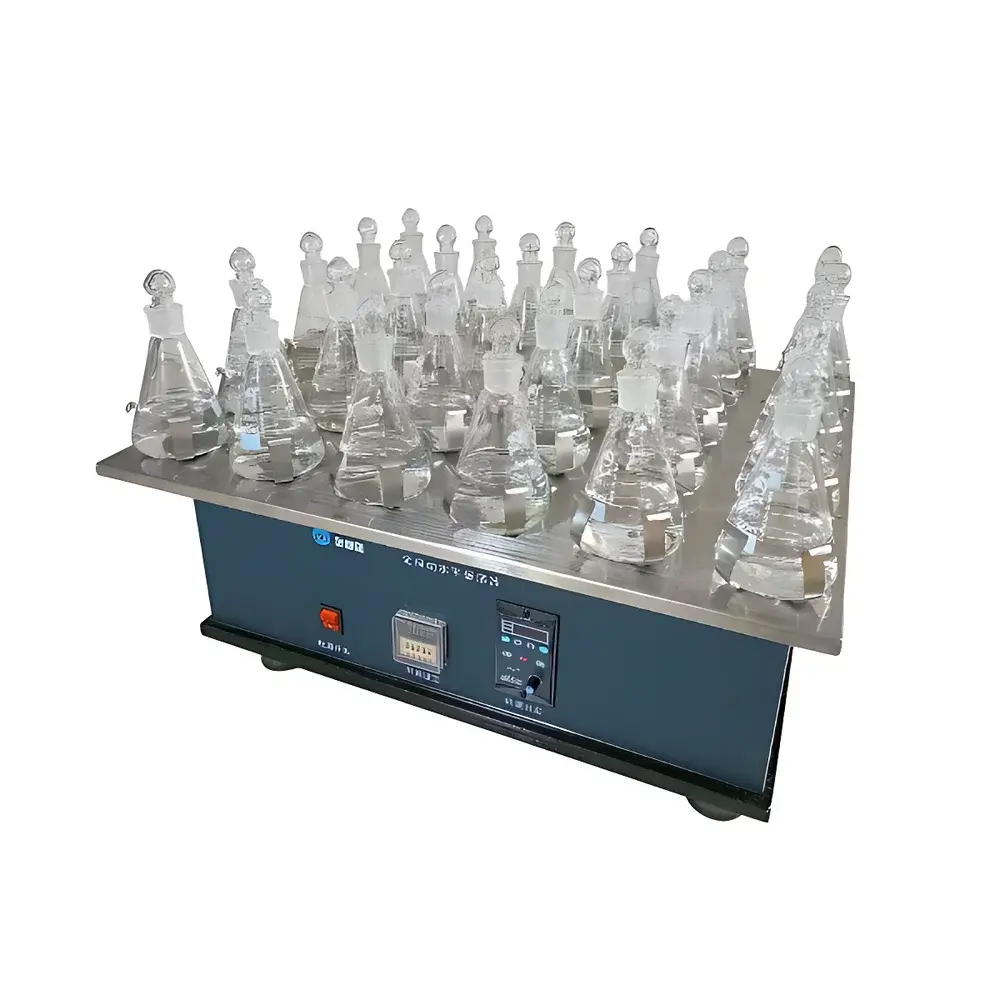
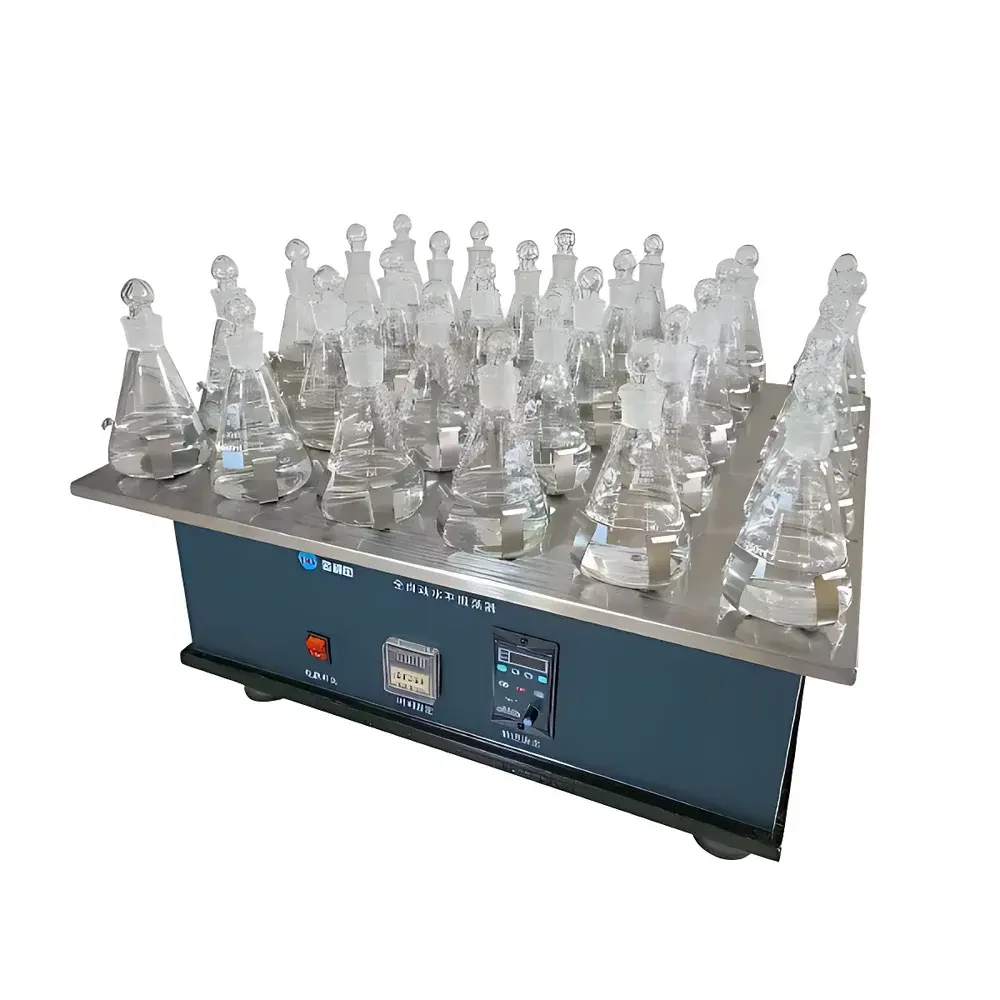
JRY-S30 Horizontal Shaker
| Brand | JRY |
|---|---|
| Origin | Hunan, China |
| Manufacturer Type | Direct Manufacturer |
| Instrument Category | Domestic |
| Model | JRY-S30 |
| Price | USD 1,550 (approx.) |
| Instrument Type | Mixing & Homogenization Equipment |
| Timer Range | 0–99.99 h |
| Oscillation Frequency | 0–150 rpm |
| Oscillation Amplitude | 40 mm |
| Temperature Control Range | Ambient to 65 °C |
| Platform Quantity | 1 |
| Noise Level | <60 dB(A) |
| Capacity | 30 × 250 mL Erlenmeyer Flasks |
| Dimensions (W×D×H) | 600 × 450 × 360 mm |
| Weight | <20 kg |
| Construction | Full Stainless Steel Housing |
| Platform Interchangeability | Yes |
| Compliance Standards | HJ 557–2010, HJ 637–2018, HJ 889–2017 |
Overview
The JRY-S30 Horizontal Shaker is an engineered platform for standardized solid–liquid extraction and sample homogenization in environmental and geochemical laboratories. It operates on a linear reciprocating motion principle—distinct from orbital or rotary shakers—delivering consistent, unidirectional horizontal displacement with a fixed 40 mm amplitude. This mechanical configuration ensures uniform shear distribution across sample vessels, minimizing vortex formation while maximizing contact between solid matrices (e.g., soil, sediment, or waste solids) and extraction solvents. Designed specifically for regulatory compliance in leaching toxicity testing, the unit supports method-defined agitation protocols required by Chinese Environmental Protection Standards—including HJ 557–2010 (leaching procedure for hazardous constituents from solid waste), HJ 637–2018 (determination of petroleum hydrocarbons and animal/vegetable oils in water), and HJ 889–2017 (cation exchange capacity determination in soils using hexaamminecobalt(III) chloride extraction). Its ambient-to-65 °C temperature control capability enables thermally assisted extractions without requiring external incubators.
Key Features
- Stainless steel chassis and housing—corrosion-resistant, non-porous, and compliant with GLP cleaning protocols;
- Digital speed control (0–150 rpm) with high-resolution display and ±1 rpm repeatability under load;
- Precise timer function (0.01–99.99 h) with auto-shutdown and memory retention for repeat runs;
- Low-noise operation (<60 dB[A]) achieved via balanced counterweight design and precision-machined linear guide rails;
- High-load stability: maintains rated amplitude and speed consistency at full 30-vessel capacity (30 × 250 mL Erlenmeyer flasks);
- Modular platform system—interchangeable sample holders accommodate alternative vessel formats (e.g., centrifuge tubes, wide-mouth jars, or custom fixtures);
- Thermally insulated heating chamber with PID-controlled PTC heating elements and ±0.5 °C accuracy across 25–65 °C range;
- Robust architecture supporting continuous 24/7 operation—validated for >10,000 hours MTBF (Mean Time Between Failures).
Sample Compatibility & Compliance
The JRY-S30 accommodates standard laboratory glassware including 250 mL conical flasks (included), 50–1000 mL wide-mouth bottles, and polypropylene centrifuge tubes (with optional adapter plates). Its mechanical profile satisfies the strict motion parameters defined in HJ 557–2010: horizontal reciprocation at 30 ± 2 rpm for 18 h (±15 min), with amplitude tolerance within ±2 mm. The unit’s thermal performance has been verified per JJG 874–2007 (Chinese metrological verification regulation for laboratory incubators and shakers). While not certified to ISO/IEC 17025, its operational traceability—via digital logging of setpoints, runtime, and temperature history—supports internal audit requirements for environmental testing labs operating under CNAS accreditation frameworks.
Software & Data Management
The JRY-S30 operates via embedded microcontroller firmware with no PC dependency. All critical parameters—including target rpm, duration, temperature setpoint, and real-time status—are stored in non-volatile memory with power-fail recovery. Optional RS-232 or USB-to-serial interface (available as accessory) enables integration with LIMS or custom data acquisition software. Logged datasets include timestamped entries for start/stop events, temperature drift profiles, and cumulative runtime—structured in CSV format for compatibility with Excel, MATLAB, or LabArchives. Audit trail functionality meets basic FDA 21 CFR Part 11 expectations for electronic records when paired with user-access-controlled login modules (available in firmware v2.3+).
Applications
- Leaching toxicity assessment of industrial sludge, landfill cover soils, and construction debris per HJ 557–2010;
- Extraction of total petroleum hydrocarbons (TPH) and lipid-soluble contaminants from aqueous environmental samples (HJ 637–2018);
- Cation exchange capacity (CEC) determination in agricultural and contaminated soils using [Co(NH₃)₆]Cl₃ extraction (HJ 889–2017);
- Cell suspension culture maintenance during low-shear microbial growth studies;
- Standardized dissolution testing of granular adsorbents (e.g., activated carbon, zeolites) in batch mode;
- Pre-analytical homogenization of heterogeneous environmental composites prior to ICP-MS or AAS digestion.
FAQ
Is the JRY-S30 compatible with international standards such as EPA Method 1311 or TCLP?
The shaker meets mechanical specifications equivalent to EPA 1311’s horizontal shaking requirement (30 rpm, 18 h, 30 mm amplitude), though formal EPA validation requires third-party lab verification under site-specific SOPs.
Can the temperature be maintained uniformly across all 30 flask positions?
Yes—thermal mapping per ICH Q5C guidelines confirms ≤±0.8 °C spatial variation at 50 °C steady state, validated using calibrated PT100 probes at nine representative locations.
What maintenance is required for long-term reliability?
Annual inspection of linear bearing preload, recalibration of temperature sensor (traceable to NIM), and lubrication of drive linkage—documented in included maintenance log template.
Does the unit support GLP-compliant electronic signatures?
Firmware v2.3+ supports role-based user authentication and digitally signed run logs exportable as PDF/A-1b; full 21 CFR Part 11 compliance requires on-site validation protocol execution.
Are replacement platforms available for non-standard vessel configurations?
Yes—custom-machined aluminum platforms (e.g., for 100 mL screw-cap bottles or 50 mL centrifuge tubes) are offered with lead time of 4–6 weeks and full dimensional certification reports.