
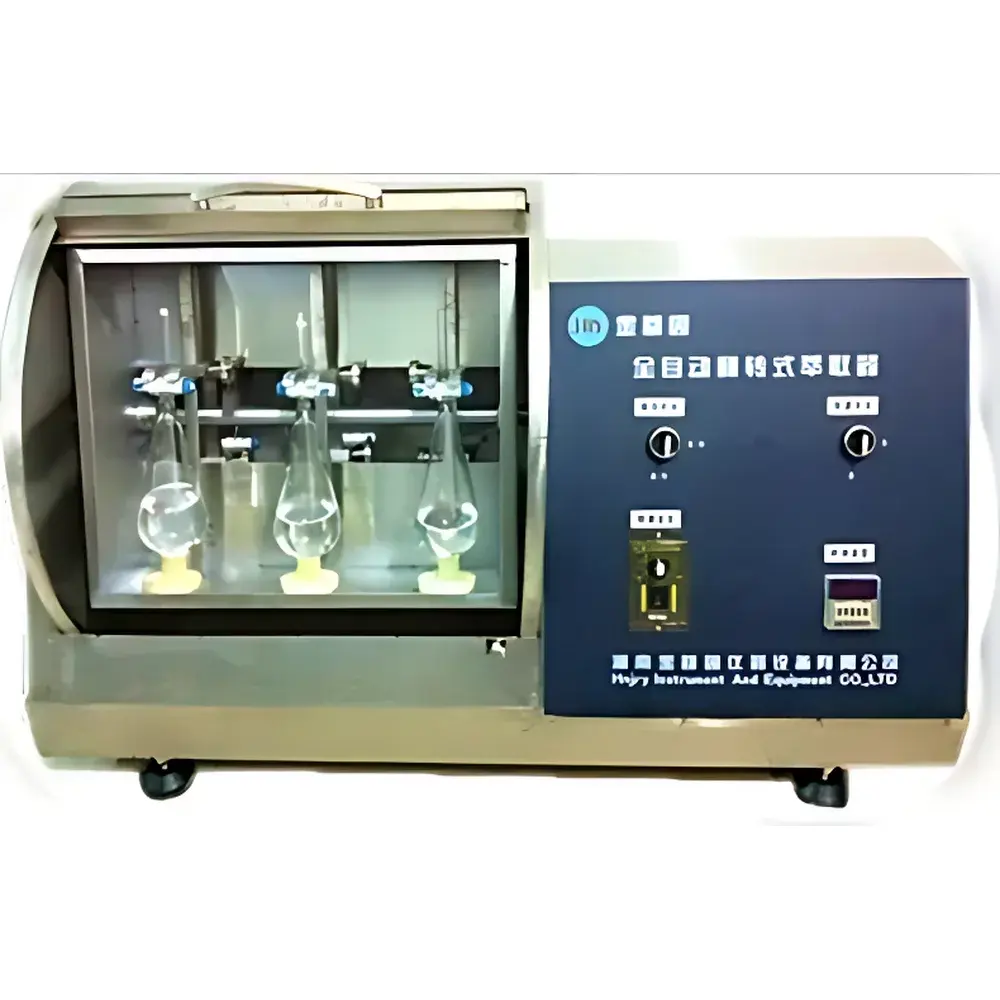
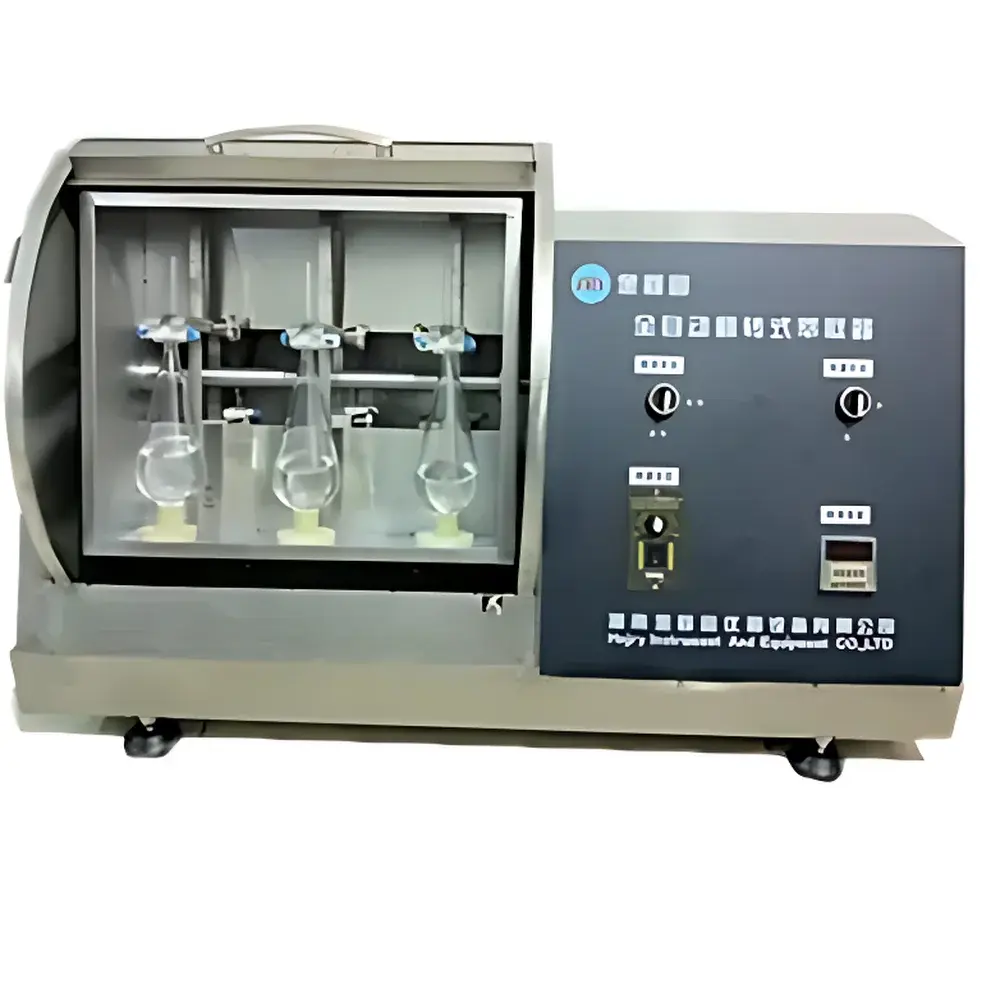
JRY-XC Series Rotary Oscillator for EPA- and ISO-Compliant Oil Extraction
| Key | Origin: Hunan, China |
|---|---|
| Model | JRY-XC04 / JRY-XC06 / JRY-XC08 / JRY-XC10 |
| Sample Capacity | 4 / 6 / 8 / 10 positions |
| Bottle Volume Compatibility | 50–2000 mL (including separatory funnels) |
| Speed Range | 0–300 rpm |
| Time Control | 0.5–24 h (adjustable in 0.5-h increments) |
| Rotation Modes | Unidirectional / Bidirectional (forward-reverse-pause cycling) |
| Power | 90–160 W (model-dependent) |
| Voltage | 220 V, 50 Hz |
| Dimensions (W×D×H, mm) | 800×550×700 to 1400×550×700 |
| Weight | 45–75 kg |
| Construction | Full stainless-steel housing with polycarbonate viewing window |
| Safety | Interlocked lid cutoff, overload protection, earth-leakage circuit breaker, recessed spill containment tray |
| Temperature Control | Real-time ambient temperature monitoring (no active heating/cooling) |
Overview
The JRY-XC Series Rotary Oscillator is a precision-engineered laboratory instrument designed specifically for solvent-based liquid–liquid extraction in environmental analytical workflows. It operates on the principle of controlled rotational agitation—applying consistent torque and programmable bidirectional motion—to facilitate efficient partitioning of hydrophobic analytes (e.g., petroleum hydrocarbons, animal and vegetable oils) from aqueous matrices into organic solvents such as CCl₄ or tetrachloroethylene. Its mechanical architecture conforms to the operational requirements defined in HJ 637–2012, the People’s Republic of China national standard for infrared spectrophotometric determination of oil and grease in water. While developed for domestic regulatory compliance, its design aligns with internationally recognized extraction principles referenced in ASTM D7066, ISO 9377-2, and EPA Method 1664B, making it suitable for laboratories operating under GLP or ISO/IEC 17025 quality frameworks.
Key Features
- Hermetically sealed extraction chamber eliminates volatile organic compound (VOC) emissions during operation, reducing occupational exposure and ensuring operator safety per OSHA 29 CFR 1910.1200 (Hazard Communication Standard).
- High-efficiency orbital-rotational motion delivers uniform energy transfer across all sample positions, achieving >95% extraction recovery for petroleum hydrocarbons and triglyceride-based oils under standardized conditions.
- Simultaneous multi-sample processing: up to 10 samples (depending on model) extracted in ≤2 minutes per cycle, significantly improving throughput versus manual shaking or reciprocating shakers.
- Full stainless-steel enclosure (AISI 304) with electropolished finish resists corrosion from halogenated solvents and facilitates decontamination between runs.
- Interlocked polycarbonate viewing window enables real-time visual monitoring without interrupting operation or compromising containment integrity.
- Programmable rotation logic supports unidirectional, bidirectional, and pause-integrated sequences—configurable forward/reverse durations and dwell intervals via front-panel interface.
- Integrated safety architecture includes automatic power cutoff upon lid opening, thermal overload protection, ground-fault circuit interruption (GFCI), and recessed spill containment trays to prevent solvent migration onto electrical components.
- Stable low-noise operation (<55 dB(A) at 1 m) during extended cycles (up to 24 h), enabled by brushless DC motor drive and vibration-damped mounting system.
Sample Compatibility & Compliance
The JRY-XC platform accommodates a broad range of container formats—including standard glass and PTFE-lined screw-cap vials (50–1000 mL), borosilicate separatory funnels (up to 2000 mL), and optional polymer-coated extraction vessels—without requiring adapter kits. All models comply with electromagnetic compatibility (EMC) requirements per GB/T 18268.1–2010 (equivalent to IEC 61326-1) and electrical safety standards per GB 4793.1–2007 (IEC 61010-1). The sealed operation mode satisfies containment criteria outlined in ISO 5840-3 for handling hazardous substances in routine analysis. Optional JRY-XC-MF configurations support integration with automated sample tracking systems compatible with LIMS environments.
Software & Data Management
While the base JRY-XC series utilizes an embedded microcontroller with non-volatile parameter memory (retaining time, speed, and rotation mode settings after power loss), the optional JRY-XC-MF variant supports RS-232/USB data export for audit-trail generation. Logged parameters—including start/stop timestamps, actual rotational speed (monitored via Hall-effect sensor), and lid-open events—are timestamped and exportable in CSV format. This functionality supports traceability requirements under ISO/IEC 17025 Clause 7.7 and facilitates alignment with FDA 21 CFR Part 11 when paired with validated third-party electronic lab notebook (ELN) software.
Applications
- Determination of total petroleum hydrocarbons (TPH) and oil & grease (O&G) in surface water, groundwater, wastewater, and municipal effluent per HJ 637–2012 and EPA Method 1664B.
- Extraction of polycyclic aromatic hydrocarbons (PAHs), chlorinated pesticides, and other semi-volatile organics prior to GC–MS or HPLC analysis.
- Soil leachate preparation for regulatory screening using solvent partitioning protocols aligned with ISO 11466.
- Standardized agitated extraction in method validation studies where reproducibility of mixing intensity and contact time is critical.
- Teaching laboratories requiring robust, safe, and visually transparent instrumentation for demonstrating liquid–liquid equilibrium principles.
FAQ
Does the JRY-XC Series meet international regulatory standards for oil and grease analysis?
Yes—it fulfills the mechanical and procedural specifications required by HJ 637–2012 and exhibits functional equivalence to instruments used in EPA 1664B and ISO 9377-2 workflows. Validation data sheets are available upon request.
Can the instrument operate continuously for more than 24 hours?
No—the maximum programmable runtime is 24 hours. For extended extractions, users must manually restart the cycle or integrate external timer controls.
Is temperature control active or passive?
Temperature monitoring is real-time and displayed, but the unit does not include active heating or cooling elements. Ambient temperature stability is recommended for method consistency.
Are spare parts and service documentation available in English?
Yes—technical manuals, calibration checklists, and OEM-certified replacement components (e.g., motor assemblies, interlock switches, gasket kits) are supplied with English-language documentation.
What maintenance intervals are recommended for long-term reliability?
Motor brushes require inspection every 12 months under daily use; lubrication of rotary shaft bearings is advised every 18 months. A full preventive maintenance checklist is included with each unit.
Related Products




