
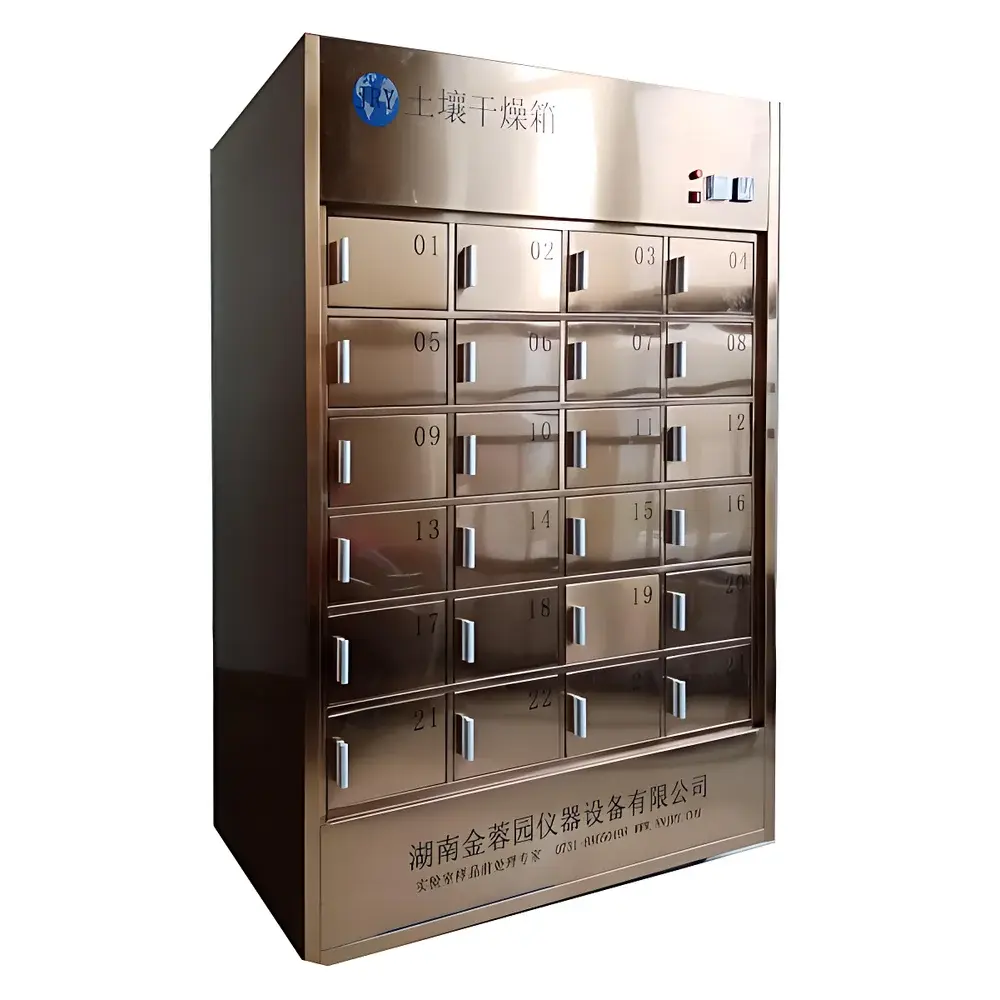
JRY-T24 Soil Drying Cabinet with Infrared Heating and Individual Sample Compartments
| Brand | JRY |
|---|---|
| Origin | Hunan, China |
| Manufacturer Type | Direct Manufacturer |
| Product Category | Domestic |
| Model | JRY-T24 |
| Instrument Type | Low-Temperature Drying Cabinet |
| Temperature Range | Ambient to 60 °C |
| Temperature Uniformity | ±1 °C |
| External Dimensions | H1600 × L1100 × W550 mm |
| Internal Chamber Dimensions (per compartment) | 200 × 120 × 300 mm (L × H × D) |
| Interior Material | 304 Stainless Steel |
| Heating Method | Far-Infrared Radiant Heating |
| Power Consumption | 200–1000 W |
| Electrical Supply | 220 V, 50 Hz |
| Sample Capacity | 24 Independent Compartments |
| Operating Environment | 15–35 °C, 20–90% RH |
| Noise Level | <55 dB(A) |
| Mobility | Equipped with Locking Casters |
| Compliance | Designed for GLP-aligned environmental and geochemical laboratories |
Overview
The JRY-T24 Soil Drying Cabinet is an engineered solution for controlled, contamination-free air-drying of soil, sediment, and environmental solid samples in analytical and regulatory laboratories. Unlike conventional convection ovens or ambient benchtop drying, this cabinet employs a unidirectional, non-recirculating airflow system combined with far-infrared radiant heating—eliminating cross-contamination while ensuring thermal homogeneity across all 24 independent sample compartments. Each compartment functions as a sealed, thermally isolated chamber with its own dedicated airflow path, enabling parallel processing of heterogeneous matrices—including high-moisture river sediments, clay-rich soils, and organic-contaminated sludges—without inter-sample vapor migration or particulate carryover. The system operates strictly within the ambient-to-60 °C range, preserving volatile organic compounds (VOCs), semi-volatiles, and labile metal speciation that would otherwise degrade under forced hot-air convection or vacuum desiccation.
Key Features
- 24 individually sealed sample compartments with standardized internal dimensions (200 × 120 × 300 mm), each fitted with coded labeling, ergonomic handles, and spring-loaded latches for rapid, error-resistant loading/unloading.
- Far-infrared radiant heating elements mounted behind perforated stainless-steel panels ensure uniform thermal energy distribution without direct contact—minimizing localized overheating and moisture gradient formation within samples.
- Single-pass, laminar airflow design: Ambient air is drawn through a three-stage conditioning train—desiccant-based drying, coarse particulate filtration (≥5 µm), and activated carbon adsorption—before entering each compartment at low velocity (<0.3 m/s), preventing dust resuspension and cross-contamination.
- Full 304 stainless-steel construction—including inner walls, shelves, ductwork, and chassis—resists corrosion from acidic leachates, halogenated organics, and sulfide-rich sediments; surface finish meets ISO 8502-3 for cleanability verification.
- Independent compartment temperature monitoring with PID-controlled feedback ensures inter-compartment deviation ≤ ±1 °C across full operating range (ambient to 60 °C); no shared heating zones or thermal bridging.
- Integrated acoustic damping throughout the cabinet structure reduces operational noise to <55 dB(A) at 1 m distance—suitable for shared laboratory environments requiring low ambient disturbance.
- Modular tray compatibility: Accepts standard porcelain crucibles, 304 stainless steel trays (polished or electropolished), and food-grade polypropylene inserts—enabling method-specific sample containment per ASTM D2234, ISO 11464, or EPA Method 5035A protocols.
Sample Compatibility & Compliance
The JRY-T24 supports a broad spectrum of environmental solid matrices: mineral soils (clay, silt, sand), aquatic sediments (freshwater/marine), sludge from wastewater treatment, and contaminated site dig samples. Its non-turbulent, low-velocity drying protocol aligns with U.S. EPA SW-846 Method 3550C (soil extraction preparation), ISO 11465 (determination of dry matter), and CLP Regulation (EC) No 1272/2008 Annex I requirements for pre-analysis stabilization. All wetted surfaces comply with FDA 21 CFR 177.1520 for indirect food-contact polymers (where plastic trays are used). The cabinet’s traceable temperature control architecture supports GLP audit readiness, including calibration certificate documentation for integrated Pt100 sensors and NIST-traceable validation reports upon request.
Software & Data Management
The JRY-T24 operates via a front-panel digital controller with real-time display of setpoint, actual compartment temperature, and elapsed drying time. While standalone operation is standard, optional RS-485 Modbus RTU interface enables integration into centralized Lab Information Management Systems (LIMS) or building automation platforms. Logged temperature data (sampled every 30 seconds) is stored onboard for ≥30 days and exportable via USB flash drive in CSV format—supporting 21 CFR Part 11-compliant electronic records when paired with validated user access controls and audit trail software (e.g., LabArchives or Thermo Fisher SampleManager).
Applications
- Preparation of soil/sediment samples prior to heavy metal analysis (ICP-MS, AAS), organic contaminant quantification (GC-MS, HPLC), and particle size distribution testing (laser diffraction).
- Stabilization of field-collected samples during transport and interim storage under chain-of-custody protocols (EPA 5035B, ISO 5667-3).
- Controlled dehydration of reference materials and certified test soils (e.g., NIST SRM 2710a) without altering matrix integrity.
- Method development for moisture content determination per ISO 11465 or gravimetric loss-on-ignition (LOI) workflows where thermal degradation must be minimized.
- High-throughput batch processing in environmental testing labs accredited to ISO/IEC 17025:2017, particularly those handling >500 soil samples monthly.
FAQ
Does the JRY-T24 meet ISO/IEC 17025 requirements for accredited soil testing labs?
Yes—the cabinet’s temperature uniformity (±1 °C), material traceability (304 SS grade certification), and documented calibration procedures support compliance with ISO/IEC 17025 Clause 6.4.1 (equipment suitability) and 6.6 (measurement traceability).
Can the cabinet be used for drying samples containing volatile organic compounds (VOCs)?
Yes—its low-velocity, single-pass airflow and absence of recirculation minimize VOC loss; recommended operating temperature is 35–45 °C for VOC-sensitive matrices per EPA Method 5035A.
Is remote monitoring or network connectivity available?
Standard configuration includes local digital control; optional RS-485 Modbus RTU interface allows integration with SCADA or LIMS systems using third-party gateway hardware.
What maintenance is required for long-term reliability?
Desiccant cartridges require replacement every 6 months under continuous use; activated carbon filters every 12 months; stainless-steel interior requires weekly wipe-down with 70% ethanol or citric acid solution to prevent biofilm accumulation.
Are validation documents (IQ/OQ/PQ) provided?
Factory-issued IQ/OQ protocols are included; PQ execution requires on-site environmental conditions assessment and is supported by JRY application engineers under service contract.



