
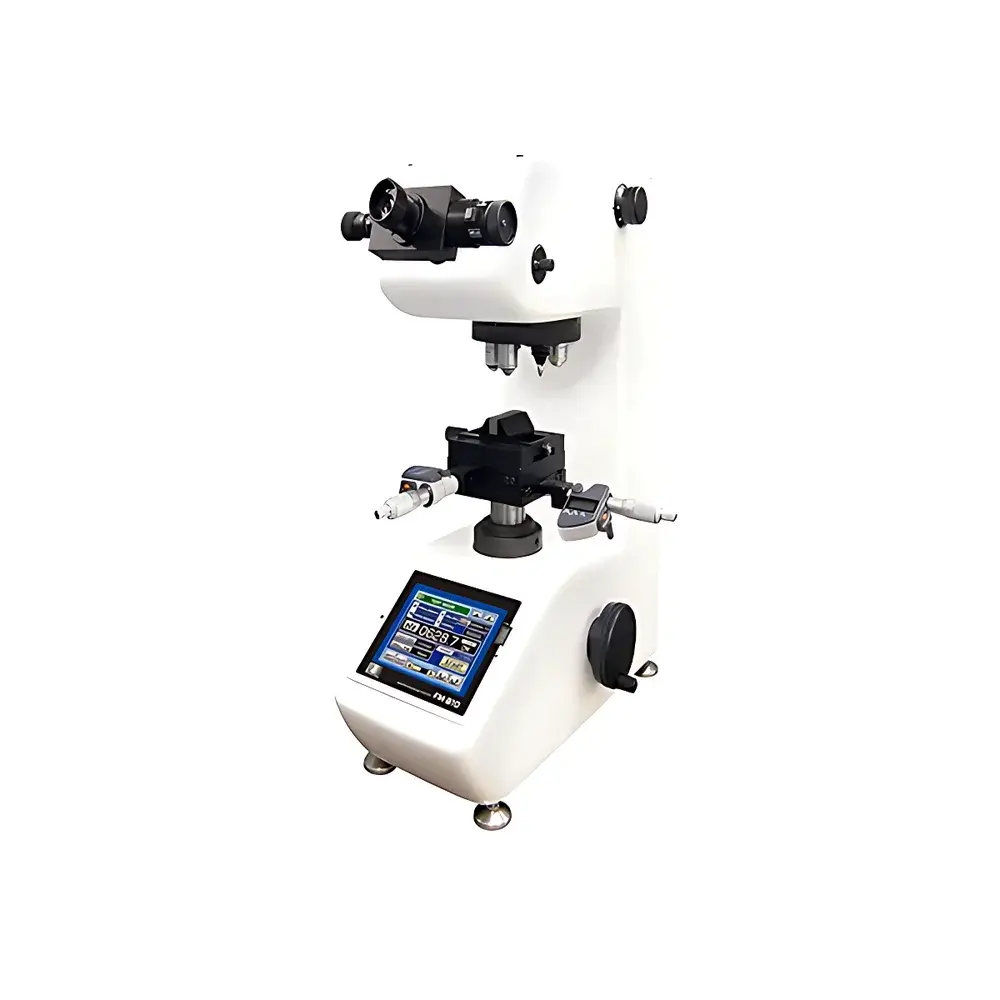
Future-Tech FM-310e Micro-Vickers Hardness Tester
| Brand | Future-Tech |
|---|---|
| Origin | Japan |
| Model | FM-310e |
| Test Load Range | 1 g to 1000 g (selectable combinations) |
| Maximum Test Load | 1000 g |
| Specimen Height Clearance | 95 mm (H) × 115 mm (D) |
| Compliance | JIS B7734, JIS B7735, ASTM E384, ISO 6507-2 |
| Display | 7-inch Full-Color LCD Touchscreen (FM-810 Controller Unit) |
| Optional Features | Digital Micrometer Integration, Automatic Indentation Measurement (AR System), Up to Four Objective Lenses (5×, 10×, 20×, 40×, 50×, 100×), Cylindrical & Spherical Surface Correction, HV/HK/HBW/HS/KC Toughness Testing Modes |
| Data Interface | USB & RS232C |
| Power Supply | AC 100–115 V / 240 V, 50/60 Hz |
| Dimensions (W×D×H) | 186 × 450 × 504 mm |
| Weight | ~40 kg (incl. tool case) |
Overview
The Future-Tech FM-310e is a precision-engineered micro-Vickers hardness tester designed for high-reproducibility indentation testing of metallic, ceramic, and thin-film materials in R&D laboratories, quality control environments, and academic institutions. Based on the fundamental principle of diamond pyramid indentation under controlled static load—per ASTM E384 and ISO 6507-2—the instrument applies calibrated forces ranging from 1 g to 1000 g, generating measurable diagonal impressions on polished surfaces. Its optical-mechanical architecture integrates Japanese-manufactured optics with rigid cast-iron frame construction, minimizing thermal drift and mechanical hysteresis during extended measurement sessions. The system operates within a defined specimen workspace of 95 mm vertical clearance and 115 mm depth, accommodating standard metallurgical mounts and custom fixtures without compromising alignment stability.
Key Features
- High-contrast optical path with dual-standard objective lenses (10× and 50×), expandable to four objectives (5×, 20×, 40×, 100×) for scalable magnification and resolution optimization.
- 7-inch full-color LCD touchscreen controller (FM-810 unit) featuring intuitive touch-based operation, real-time hardness value display (HV, HK), dual diagonal measurements (D1/D2), dwell time adjustment (5–99 s), and programmable test sequences.
- Automated load application cycle: precise electro-mechanical loading at 60 µm/sec, dwell phase stabilization, and controlled unloading—ensuring compliance with JIS B7725 repeatability requirements.
- Surface geometry correction algorithms for cylindrical and spherical specimens, enabling accurate hardness calculation on curved interfaces per ASTM E384 Annex A4.
- Digital micrometer integration support (optional) for direct X-Y coordinate acquisition into the controller, facilitating traceable stage positioning and multi-point mapping protocols.
- Multi-scale hardness conversion engine compliant with SAE J417b and ASTM E140, supporting cross-referenced reporting across Vickers (HV), Knoop (HK), Brinell (HBW/HS), and fracture toughness (KC) scales.
- Durable powder-coated chassis with vibration-damped base and adjustable leveling feet, validated for long-term dimensional stability under ISO 14644-1 Class 8 cleanroom-compatible conditions.
Sample Compatibility & Compliance
The FM-310e accommodates a broad range of specimen geometries—including flat plates, cylindrical rods (up to Ø115 mm), and irregularly shaped components—within its 95 mm height and 115 mm depth envelope. Sample preparation follows standardized metallographic polishing protocols per ASTM E3-22. The system meets metrological traceability requirements outlined in ISO/IEC 17025:2017 for hardness calibration laboratories and supports audit-ready documentation workflows aligned with GLP and GMP frameworks. Regulatory compliance includes JIS B7734 (microhardness testing methods), JIS B7735 (verification procedures), ASTM E384 (microindentation hardness), and ISO 6507-2 (calibration of reference blocks). All hardness values are referenced to NIST-traceable certified reference materials supplied with each unit.
Software & Data Management
The integrated FM-ZERO hardness measurement software (v3.2+) provides secure, timestamped data capture with optional 21 CFR Part 11-compliant user authentication, electronic signatures, and audit trail logging. Raw image files (130 MP CMOS sensor output), measured diagonals, calculated hardness numbers, and environmental metadata (load, dwell time, lens ID, operator ID) are stored in encrypted SQLite databases. Export formats include CSV, PDF reports with embedded calibration certificates, and XML for LIMS integration. The AR-enabled automatic indentation recognition module (optional upgrade) uses edge-detection algorithms trained on >50,000 reference indentations to achieve sub-pixel measurement accuracy at ×500 magnification. Software updates are delivered via HTTPS-secured firmware portal with version-controlled release notes.
Applications
- Thin-film coating evaluation (TiN, DLC, CrN) on substrates requiring low-load testing (1–10 g).
- Heat-affected zone (HAZ) characterization in welded joints using step-load profiling across microstructural gradients.
- Carbide phase hardness mapping in tool steels and cemented carbides (e.g., WC-Co composites).
- Quality assurance of additive-manufactured metal parts, including lattice structures and internal surface assessment via cross-sectioning.
- Fracture toughness estimation (KC) of brittle ceramics using Palmqvist or median crack models per ISO 28079.
- Intermetallic compound analysis in aerospace alloys (e.g., Ni-Al, Ti-Al systems) where localized phase hardness correlates with service performance.
FAQ
What standards does the FM-310e comply with for calibration and verification?
It conforms to JIS B7725 (verification of hardness testers), JIS B7734/B7735 (microhardness testing), ASTM E384 (test method), and ISO 6507-2 (calibration of reference blocks). All units ship with a factory calibration certificate traceable to national metrology institutes.
Can the FM-310e perform Knoop hardness testing?
Yes—the FM-810 controller supports both Vickers (HV) and Knoop (HK) modes, with automatic calculation based on measured long and short diagonals and selected test load.
Is automated indentation measurement available as a factory option?
Yes—the AR-Vickers Auto Read system (130 MP CMOS camera + FT-ZERO v3.2 software) is an optional upgrade enabling fully automated detection, measurement, and statistical reporting of indentations.
How many objective lenses can be installed simultaneously?
Up to four objective lenses may be mounted on the motorized turret; standard configuration includes 10× and 50×, with optional 5×, 20×, 40×, and 100× objectives for specialized applications.
Does the system support GLP/GMP-compliant data handling?
With FM-ZERO software and optional 21 CFR Part 11 module, it delivers full audit trail, role-based access control, electronic signature capability, and immutable record retention meeting FDA and EMA regulatory expectations.



