
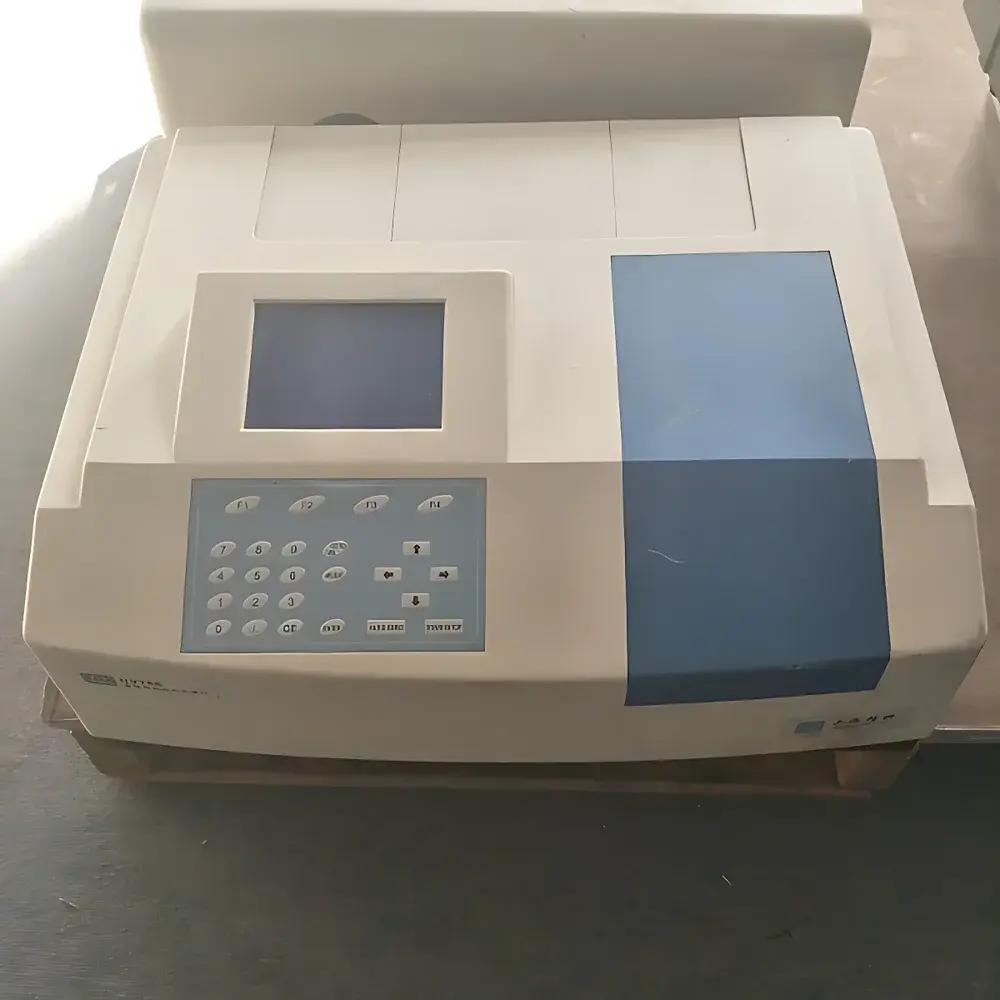
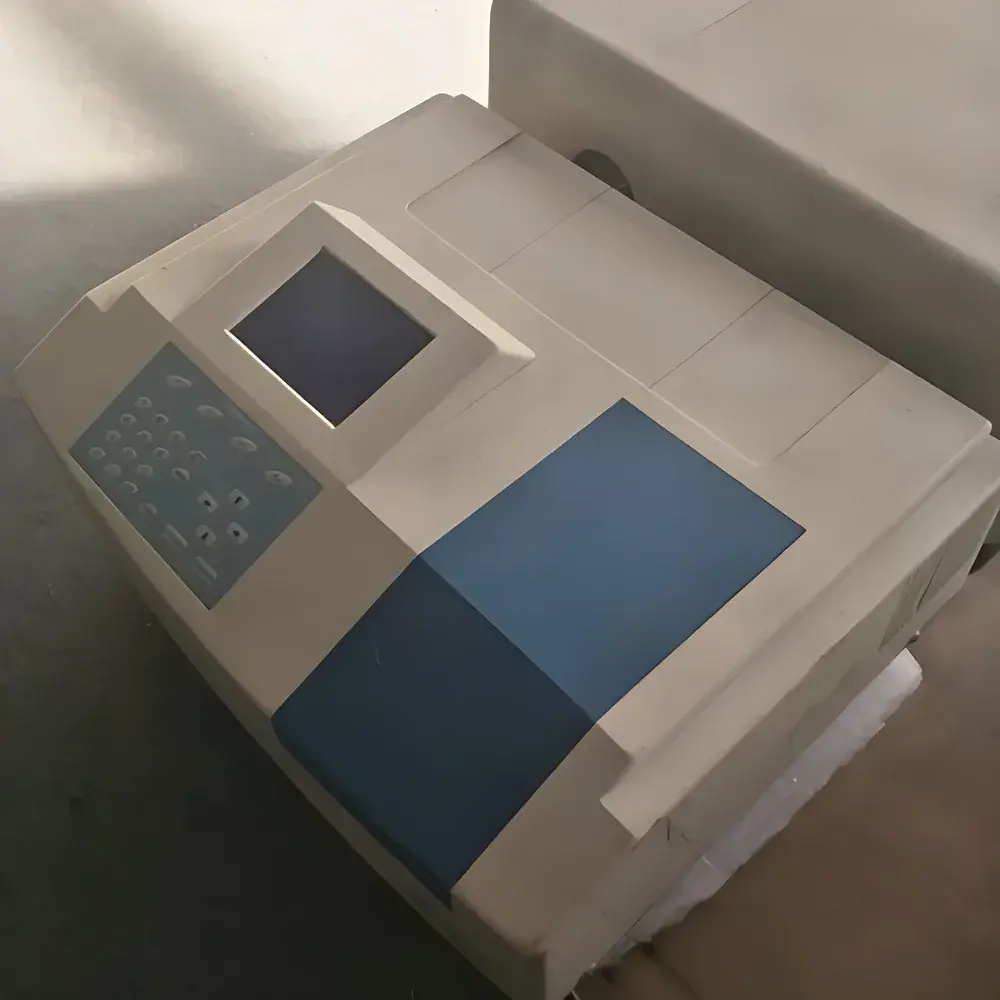
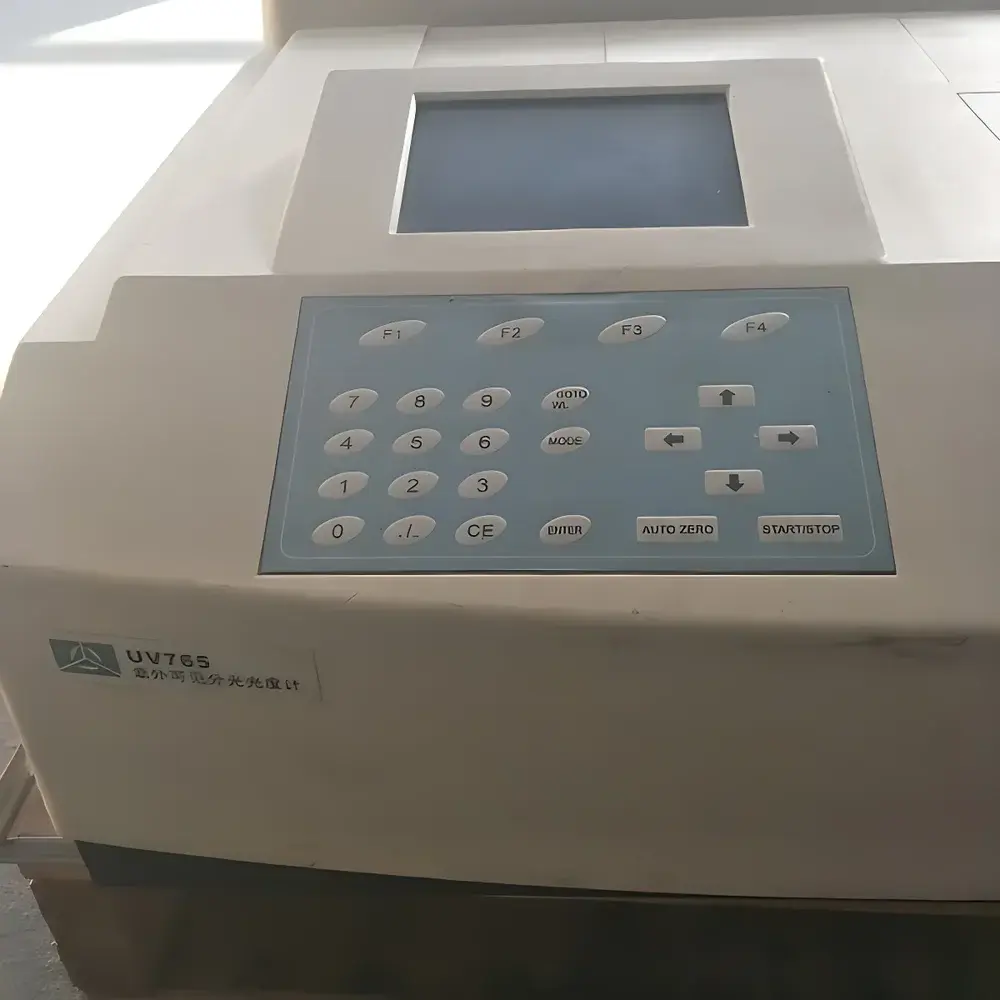
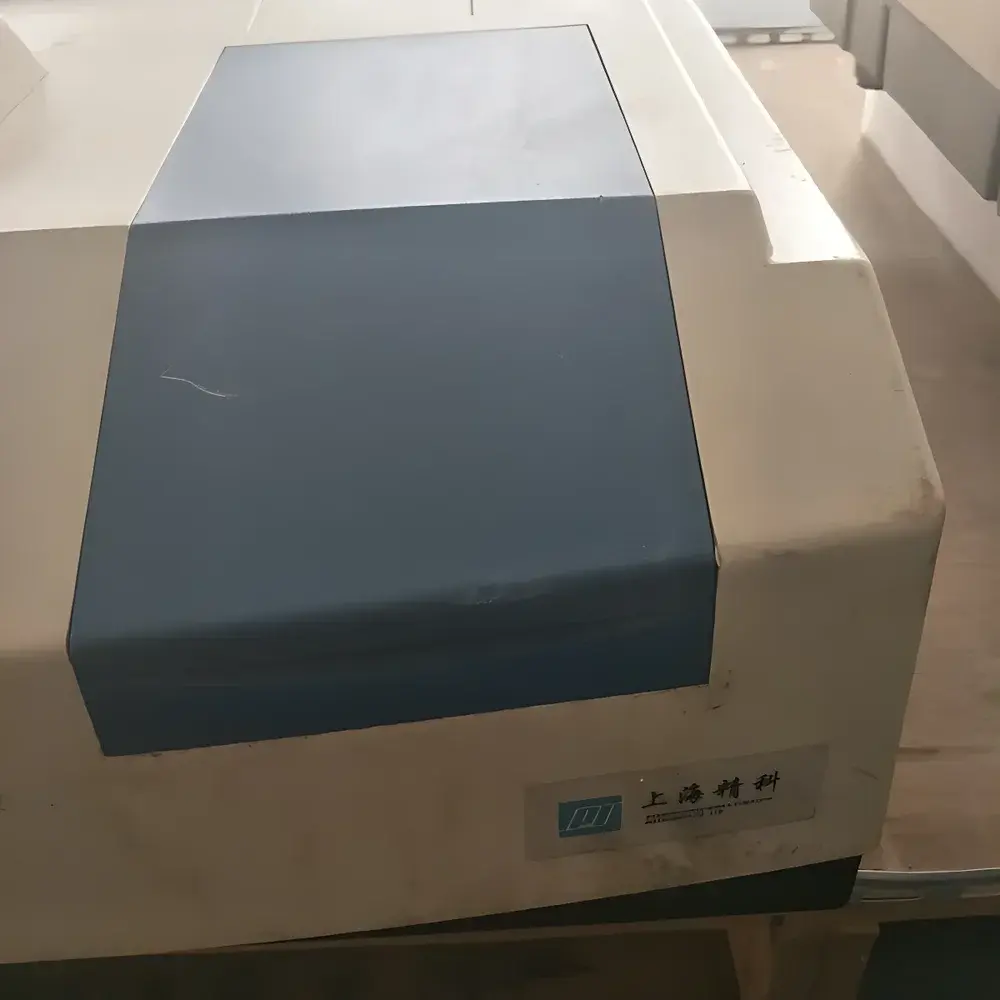
Jingke UV-765 Used Double-Beam Ultraviolet-Visible Spectrophotometer
| Origin | Shanghai, China |
|---|---|
| Manufacturer Type | Distributor |
| Origin Category | Domestic (PRC) |
| Model | UV-765 |
| Price | ¥2500 |
| Optical Design | Double-Beam |
| Detector | Photodiode Array (PDA) |
| Wavelength Range | 190–1100 nm |
| Wavelength Automation | Motorized Scanning |
| Spectral Bandwidth | 2 nm |
| Wavelength Accuracy | ±0.5 nm |
| Stray Light | ≤0.05%T (at 220 nm with NaI |
Overview
The Jingke UV-765 is a used double-beam ultraviolet-visible (UV-Vis) spectrophotometer engineered for routine quantitative analysis, spectral characterization, and method development in academic laboratories, quality control environments, and industrial R&D settings. Based on a stable dual-optical-path design, the instrument employs a fixed grating monochromator coupled with a photodiode array (PDA) detector to enable rapid, reproducible acquisition of absorbance, transmittance, and reflectance spectra across the full 190–1100 nm range. Its optical architecture minimizes path-length drift and photometric error through real-time reference beam compensation—critical for long-duration kinetic studies or multi-sample batch analysis. The system integrates a quartz-coated optical train with extended lifetime performance and reduced thermal sensitivity, supporting consistent operation under standard laboratory conditions (20–25 °C, <65% RH). Designed for compliance-ready workflows, the UV-765 meets foundational requirements for method validation per ISO/IEC 17025 and supports traceable calibration practices aligned with ASTM E275 and USP <857>.
Key Features
- Double-beam optical configuration with real-time reference correction for enhanced baseline stability and photometric reproducibility
- Photodiode array (PDA) detector enabling simultaneous multi-wavelength acquisition without mechanical scanning delays
- Motorized wavelength drive with automatic peak search and lamp positioning—reducing manual alignment and operational variability
- Large sample compartment accommodating up to eight cuvettes via programmable 8-position autosampler interface
- High-contrast backlit LCD display with intuitive menu navigation and on-board data visualization (absorbance, %T, spectrum overlays)
- Integrated self-diagnostic routines verifying lamp status, detector response, grating position, and optical alignment prior to measurement
- Automatic wavelength calibration using built-in holmium oxide and didymium filters (optional accessory support)
- Low-stray-light optical design (≤0.05%T), validated at critical wavelengths (220 nm with NaI; 360 nm with NaNO₂) per ISO 9022-12
Sample Compatibility & Compliance
The UV-765 accepts standard 10-mm pathlength quartz, glass, or plastic cuvettes (including matched pairs for ratio-based quantitation) and supports microvolume adapters (down to 50 µL) via optional accessories. It complies with core optical safety standards (IEC 61010-1) and electromagnetic compatibility (EMC) directives (EN 61326-1). While not pre-certified for regulated GMP environments, its architecture supports audit-ready documentation when paired with external LIMS integration and controlled user access protocols. The instrument’s wavelength accuracy (±0.5 nm) and repeatability (≤0.2 nm) satisfy typical QC acceptance criteria outlined in pharmacopeial methods (e.g., USP <857>, EP 2.2.25) and environmental testing guidelines (EPA Method 450.1).
Software & Data Management
The UV-765 operates via embedded firmware with local data storage (up to 200 spectra and 500 quantitative results). Raw and processed data—including time-scan kinetics, multi-point calibration curves, and derivative spectra—are exportable via RS-232 or USB to CSV or ASCII format for downstream analysis in MATLAB, OriginLab, or Excel. Optional PC-based software (Jingke UVWin v8.x) provides expanded functionality: GLP-compliant audit trails, electronic signatures, customizable report templates, and 21 CFR Part 11–compatible user role management (administrator, analyst, reviewer). All spectral files retain embedded metadata: date/time stamp, operator ID, instrument serial number, and calibration verification status.
Applications
- Quantitative determination of nucleic acids (A260/A280 ratios), proteins (Bradford/Lowry assays), and enzymatic reaction kinetics
- Pharmaceutical assay validation and dissolution profile monitoring per ICH Q2(R2)
- Water quality analysis (nitrate, phosphate, COD estimation) following APHA Standard Methods
- Polymer characterization (conjugation degree, degradation kinetics) via time-resolved spectral tracking
- Colorimetric sensor development and calibration curve linearity assessment (R² ≥ 0.999 over 0.0–2.5 A)
- Educational use in undergraduate analytical chemistry labs for Beer–Lambert law verification and spectral deconvolution exercises
FAQ
Is the UV-765 compliant with 21 CFR Part 11 for electronic records?
The base instrument does not include Part 11–compliant features; however, optional UVWin software with password-protected user roles, electronic signatures, and immutable audit logs enables regulatory alignment when deployed in validated environments.
What maintenance is required for long-term reliability?
Annual verification of wavelength accuracy and photometric linearity is recommended using NIST-traceable standards. Lamp replacement (deuterium and tungsten-halogen) is typically needed every 1,000–2,000 hours of operation.
Can the UV-765 perform kinetic measurements?
Yes—it supports time-scan mode with adjustable interval (0.1–60 s) and duration (up to 999 minutes), enabling enzyme activity assays and oxidation-reduction monitoring.
Does it support fiber-optic probes or flow cells?
Not natively; however, third-party OEM-compatible flow-through cuvette holders and immersion probes can be integrated via standard 12.5-mm port adapters.
What is the typical warm-up time before stable operation?
Optimal photometric stability is achieved within 30 minutes after power-on, with lamp thermal equilibrium confirmed by ≤0.001 A/h baseline drift specification.




