
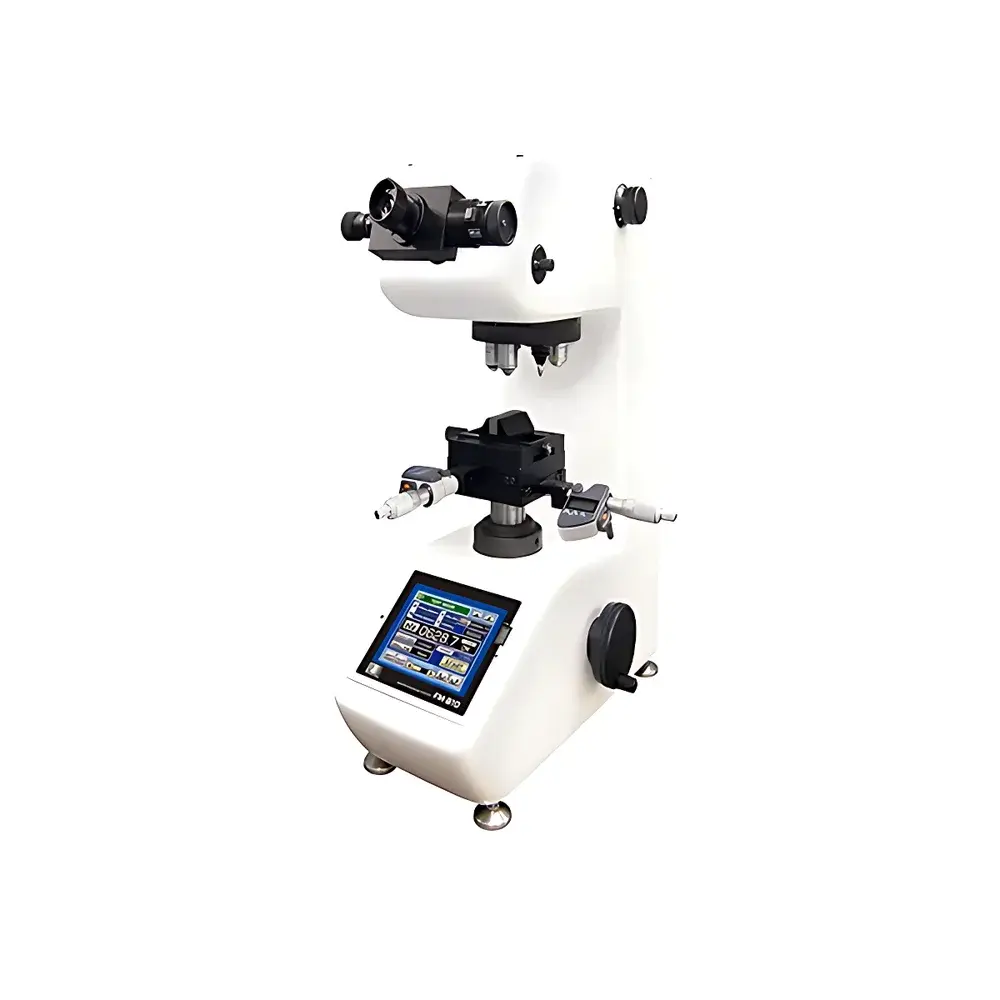
Future-Tech FM-700 Micro-Vickers Hardness Tester
| Brand | Future-Tech |
|---|---|
| Origin | Japan |
| Model | FM-700 |
| Instrument Type | Microhardness Tester |
| Measurement Range | 1–5000 HV |
| Total Test Load | 2 kgf |
| Maximum Specimen Height | 95 mm |
| Maximum Specimen Depth | 115 mm |
| Compliance | JIS B 7734, JIS B 7735, ASTM E384, ISO 6507-2 |
| Optional Automation | Motorized X-Y Stage, Auto-indent Recognition System (AR-Vickers), FT-ZERO Hardness Analysis Software |
| Standard Optical Configuration | 10× & 50× Objectives (up to 4 objectives supported) |
| Indentation Measurement | Digital Image-Based (1.3 MP CMOS camera), Resolution: 0.01 µm at 500× magnification |
| Load Application | Fully Automatic Loading–Holding–Unloading Cycle (60 µm/sec), Hold Time Adjustable from 5–99 s |
| Focus Mechanism | Manual Coaxial Fine/Coarse Adjustment |
| Turret | Motorized (FM-810 control unit) |
| Display Interface | 7-inch Full-Color LCD Touchscreen (FM-810 Unit) |
| Data Output | USB & RS-232C |
| Power Supply | AC 100–115 V / 240 V, 50/60 Hz |
| Dimensions (W×D×H) | 186 × 450 × 504 mm |
| Weight | ~40 kg (incl. tool case) |
Overview
The Future-Tech FM-700 is a precision-engineered micro-Vickers hardness tester designed for high-reproducibility quantitative indentation testing in R&D laboratories, metallurgical quality control, and advanced materials characterization. Based on the established principles of Vickers microhardness measurement—where a diamond pyramid indenter (136° apex angle) is applied under controlled static load to produce a geometrically defined impression—the FM-700 delivers traceable, standardized hardness values in HV (Vickers Hardness Number) across a broad range of metallic, ceramic, and thin-film specimens. Its optical-mechanical architecture integrates Japanese-assembled optics with high-rigidity cast-iron frame construction, minimizing thermal drift and mechanical hysteresis during extended test sequences. The system conforms rigorously to international metrological standards including ISO 6507-2, ASTM E384, and JIS B 7734, ensuring data integrity for regulatory submissions, inter-laboratory comparisons, and GLP-compliant reporting.
Key Features
- Motorized turret with programmable objective selection (supports up to four objectives: 5×, 10×, 20×, 40×, 50×, 100×) for seamless magnification switching and optimized field-of-view calibration.
- 7-inch full-color LCD touchscreen interface (FM-810 control unit) enabling intuitive operation: real-time load display, adjustable dwell time (5–99 s), dual diagonal measurement (D1/D2), automatic hardness calculation, and on-screen pass/fail evaluation against user-defined upper/lower limits.
- Digital image-based indentation analysis via integrated 1.3 MP CMOS camera and FT-ZERO hardness analysis software—delivering sub-micron measurement resolution (0.01 µm at 500×) and eliminating parallax error associated with manual eyepiece reticle reading.
- Advanced surface geometry compensation algorithms—including cylindrical and spherical curvature correction—enabling accurate HV determination on non-planar specimens without manual correction factors.
- Multi-scale hardness conversion engine compliant with SAE J417b and ASTM E140, supporting cross-referenced reporting in HK (Knoop), HBW (Brinell), HBS, and fracture toughness (KC) indices where applicable.
- Modular automation pathway: optional motorized X-Y stage (±0.5 µm repeatability), AR-Vickers auto-indent recognition module, and configurable data export protocols for LIMS integration.
Sample Compatibility & Compliance
The FM-700 accommodates specimens up to 95 mm in height and 115 mm in depth, accommodating standard metallographic mounts, coated substrates, heat-treated components, and miniature engineered parts. Its rigid stage design and precision-ground anvil ensure stable loading alignment even for low-stiffness or irregularly shaped samples. All hardness measurements are traceable to national standards through certified reference blocks (supplied with NIST-traceable calibration certificate). The instrument satisfies requirements for audit-ready documentation per FDA 21 CFR Part 11 when used with FT-ZERO software configured for electronic signatures, audit trails, and secure user access levels. Routine verification follows JIS B 7725 procedures for indenter calibration and force verification, while daily operational checks align with ISO/IEC 17025 internal quality control guidelines.
Software & Data Management
FT-ZERO is a Windows-based hardness analysis platform supporting automated report generation (PDF/Excel), statistical process control (SPC) charting, multi-sample batch processing, and customizable templates compliant with ISO 14284 and ASTM E92. Raw image files (.TIF/.BMP), coordinate metadata (X/Y/Z), load profiles, and environmental logs are archived with timestamped audit trails. Data export supports CSV, XML, and HL7 formats for enterprise-level integration with MES or QMS systems. Software validation documentation (IQ/OQ/PQ protocols) is available upon request for GMP-regulated environments.
Applications
- Case depth profiling of carburized, nitrided, or induction-hardened steel components.
- Thin-film hardness evaluation (e.g., PVD/CVD coatings, DLC, TiN) using low-load testing (down to 10 gf).
- Grain-level hardness mapping in multiphase alloys (e.g., duplex stainless steels, nickel superalloys).
- Quality assurance of brazed joints, weld HAZ (heat-affected zones), and additive-manufactured lattice structures.
- Academic research in solid-state physics, phase transformation kinetics, and irradiation-induced hardening studies.
- Failure analysis labs requiring repeatable, operator-independent indentation quantification.
FAQ
Does the FM-700 support fully automated hardness mapping?
Yes—when equipped with the optional motorized X-Y stage and AR-Vickers module, the system performs unattended grid-based indentation, image capture, measurement, and hardness contour generation.
Can the FM-700 measure Knoop hardness?
Yes—the FM-810 control unit includes dedicated HK testing mode with elongated diamond indenter geometry and corresponding calculation algorithms per ASTM E384.
Is the instrument compatible with ISO/IEC 17025 accredited laboratories?
Yes—its documented uncertainty budget, traceable calibration chain, and software audit trail functionality meet key technical requirements for accreditation scope expansion.
What is the minimum resolvable indentation diagonal length?
At 500× magnification, the digital measurement system resolves features down to 0.01 µm, enabling reliable HV determination on impressions as small as ~5 µm in diagonal length.
Can third-party software interface with the FM-700’s data output?
Yes—USB and RS-232C ports support ASCII-based command/response protocols, allowing custom integration with LabVIEW, Python-based analytics pipelines, or proprietary QA databases.



