
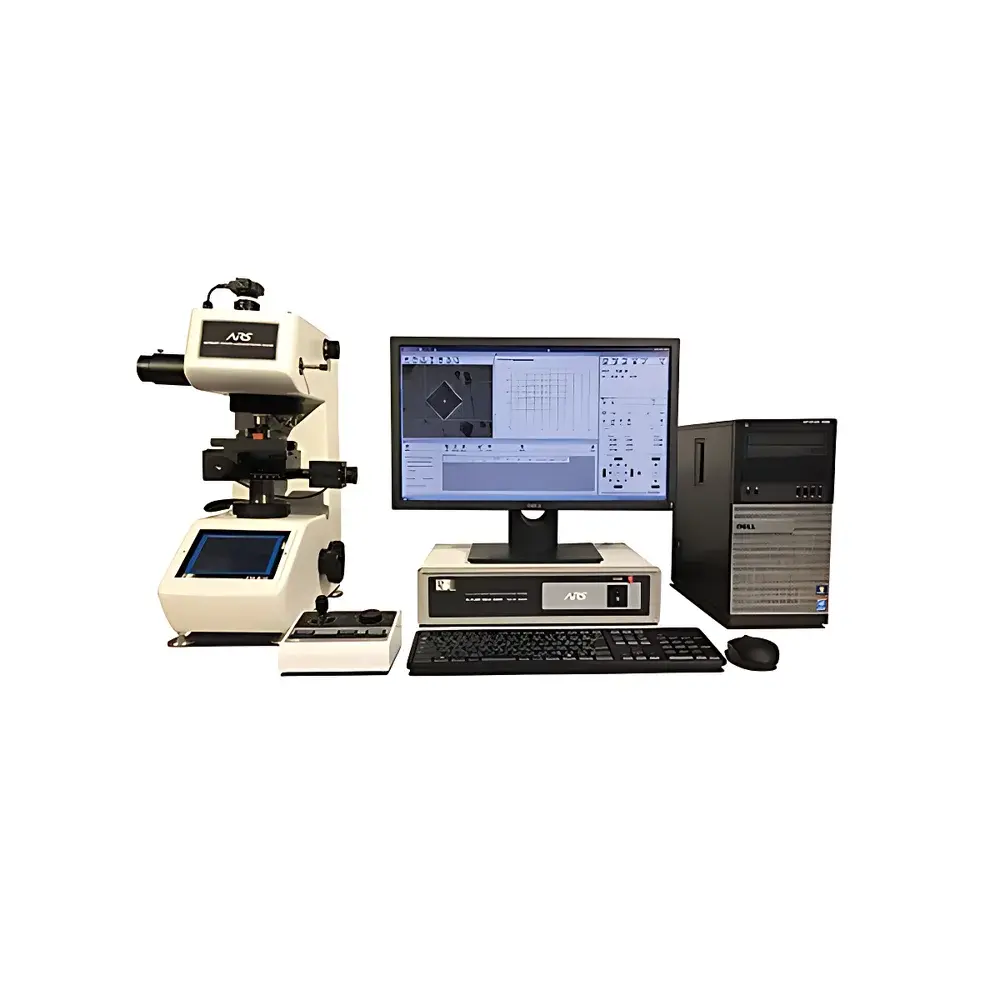
Future-Tech FM110-ARSF Fully Automated Vickers Hardness Tester
| Brand | Future-Tech |
|---|---|
| Origin | Japan |
| Model | FM110-ARSF |
| Total Test Force | 1000 gf |
| Measurement Range | 1–1000 gf selectable |
| Test Height | 95 mm (H) × Depth: 115 mm |
| Minimum Indentation Size | 16 µm (diagonal) |
| Minimum Resolution | 0.1 µm |
| Repeatability | ±0.5% at HV500 (500 gf load) |
| XY Stage Travel (FM/FV Series) | 50 mm × 50 mm |
| Minimum Stage Step | 1 µm |
| Hardness Scales | HV, HK |
| Camera | 1.3 MP CMOS |
| Software | FT-ZERO |
Overview
The Future-Tech FM110-ARSF is a fully automated Vickers microhardness testing system engineered for precision metrology in metallurgical laboratories, quality control departments, and R&D facilities requiring high reproducibility in hardness evaluation of heat-treated steels, thin coatings, case-hardened components, and advanced alloys. It operates on the principle of diamond pyramid indentation under controlled static load, followed by optical measurement of the resulting diagonal impression using high-resolution digital imaging and advanced shadow-based image processing algorithms. Unlike conventional systems reliant on edge contrast, the ARSF architecture employs adaptive shadow analysis to suppress interference from grain boundaries, surface scratches, oxidation layers, and machining marks—enabling robust, operator-independent measurement even on non-ideal specimens. The system integrates motorized Z-axis autofocus, programmable XY stage navigation, and closed-loop load application compliant with ISO 6507-1, ASTM E384, and JIS Z 2244 standards.
Key Features
- Fully automated indentation cycle: auto-focusing, load application, dwell time control, unloading, and optical measurement—all executed without manual intervention after sample placement.
- Shadow-based image processing engine: mitigates misidentification caused by microstructural artifacts, ensuring stable detection of indentation diagonals across heterogeneous or imperfect surfaces.
- Motorized XYZ stage with 1 µm positioning resolution and integrated safety interlocks: prevents lens or indenter collision via hardware-limited Z-axis travel and real-time proximity monitoring.
- 1.3 MP CMOS camera with adjustable illumination geometry: supports both bright-field and oblique lighting modes optimized for low-contrast indentations on polished or etched metallographic sections.
- Intelligent stage path programming: enables linear, arc, spiral, matrix, contour-following, and teach-mode trajectories—automatically adapting to irregular sample geometries using edge-detection-assisted boundary recognition.
- Tilt-surface tracking (ARS-F exclusive): compensates for specimen inclination by dynamically adjusting Z-axis focus during XY traversal, maintaining consistent depth-of-field and indentation depth accuracy.
- Comprehensive statistical reporting suite: calculates mean, standard deviation, min/max, confidence intervals, case depth (e.g., effective case depth per ISO 2639), and pass/fail compliance against user-defined specification limits.
Sample Compatibility & Compliance
The FM110-ARSF accommodates specimens up to 95 mm in height and 115 mm in depth, supporting standard metallographic mounts (30 mm, 40 mm, 50 mm diameter), large-section forgings, and cross-sectional weld coupons. Its optical path and stage design comply with ISO/IEC 17025 calibration traceability requirements when used with NIST-traceable hardness reference blocks. All hardness values are reported in accordance with ISO 6507-2 (verification of hardness testers) and ASTM E92 (Vickers hardness of metallic materials). The system supports GLP/GMP audit trails through FT-ZERO software’s built-in electronic logbook, including timestamped operator ID, test parameters, raw image archives, and revision history—fully compatible with FDA 21 CFR Part 11 data integrity requirements when configured with user authentication and digital signature modules.
Software & Data Management
FT-ZERO is a Windows-based control and analysis platform offering full integration of instrument operation, image acquisition, measurement validation, and report generation. It provides dual-mode operation: guided workflow for routine QC testing and scriptable batch mode for high-throughput applications such as carburized gear inspection or turbine blade coating qualification. All measured indentation images are stored losslessly with metadata (load, dwell time, position, date/time, operator ID). Users may reprocess archived images with updated threshold settings or recalibrate scale factors without retesting. Export formats include CSV, XLSX, PDF, and XML—supporting direct import into LIMS environments. Color-coded hardness distribution maps, depth-profile plots, and statistical summaries are generated in real time; Excel templates can be preconfigured for automatic population of header fields, charts, and compliance statements.
Applications
- Case depth analysis of carburized, nitrided, or induction-hardened components per ISO 2639 and AMS 2750.
- Thin-film and PVD/CVD coating hardness verification on substrates ranging from silicon wafers to aerospace superalloys.
- Weld HAZ (heat-affected zone) hardness mapping for ASME Section IX and AWS D1.1 compliance.
- Microstructural gradient assessment in additive-manufactured parts, where localized hardness variation correlates with build orientation and thermal history.
- Research-grade indentation studies requiring statistical confidence intervals across >100-point arrays, including Weibull modulus estimation for brittle materials.
- Failure analysis labs performing comparative hardness profiling across fracture surfaces, inclusion-rich zones, and intermetallic phases.
FAQ
Does the FM110-ARSF support Knoop hardness testing?
Yes—the system measures both Vickers (HV) and Knoop (HK) hardness scales using the same optical path and indentation geometry, with automatic scale conversion applied during post-processing.
Can the system perform hardness testing on curved or tilted surfaces?
The ARS-F configuration includes active tilt compensation: users input the specimen’s inclination angle, and the software adjusts Z-axis focus trajectory in real time to maintain consistent indentation depth and optical clarity.
Is FT-ZERO software validated for regulated environments?
FT-ZERO meets core ALCOA+ principles (Attributable, Legible, Contemporaneous, Original, Accurate) and supports 21 CFR Part 11 compliance when deployed with role-based access control, electronic signatures, and audit trail archiving enabled.
What is the smallest measurable indentation diagonal?
The system reliably resolves diagonals ≥16 µm under 500 gf load, corresponding to ~HV1000 on hardened tool steel—validated per ISO 6507-1 Annex B guidelines for minimum indentation size.
How does the shadow-based algorithm improve measurement robustness?
By analyzing intensity gradients rather than binary edges, the algorithm remains insensitive to localized reflectivity variations caused by grain orientation, polishing scratches, or surface contamination—reducing operator-dependent bias and increasing inter-laboratory reproducibility.



