
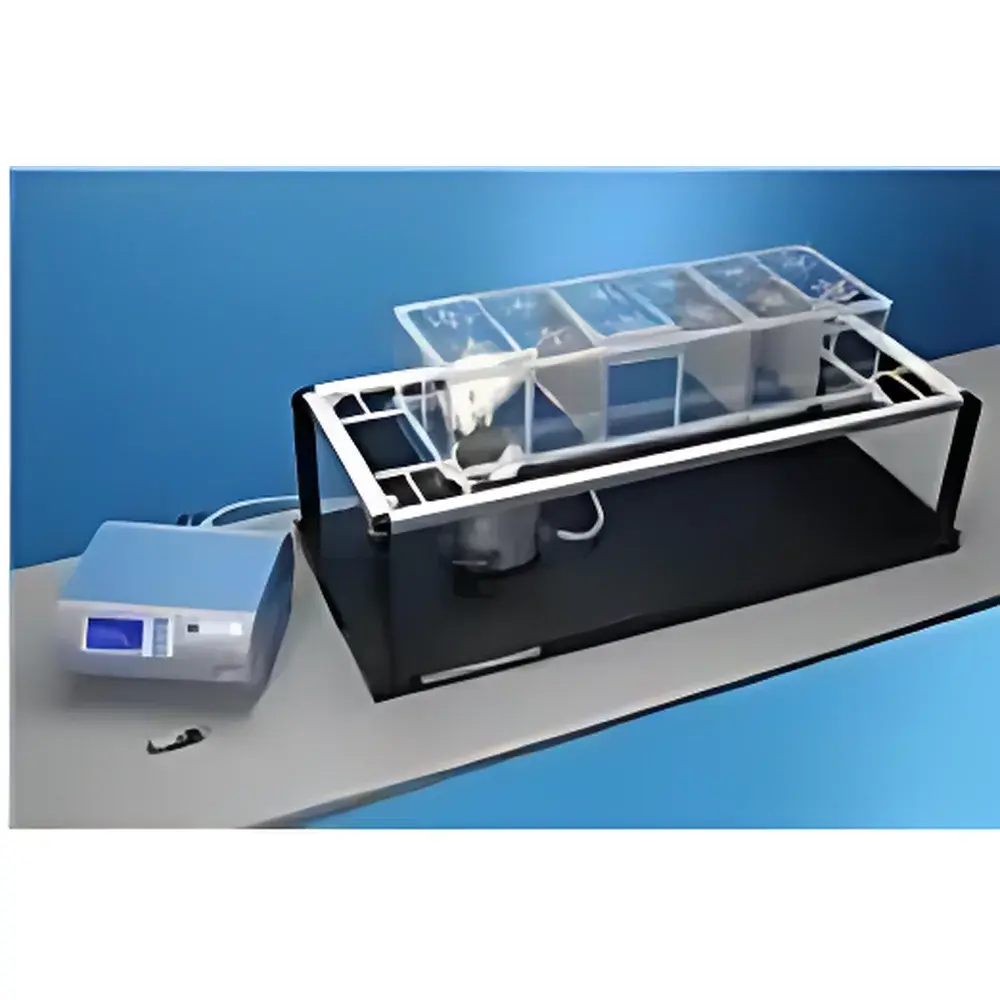
Ugo Basile 37450 Automated Paw Withdrawal Threshold Analyzer
| Brand | Ugo Basile |
|---|---|
| Origin | Italy |
| Model | 37450 |
| Force Range | 0–50.0 g (0.5 g resolution) |
| Force Ramp Rate | 1–20 s per increment (1 s resolution) |
| Stimulator Travel Distance | 12 mm |
| Timing Resolution | 0.1 s |
| Power Supply | 85–264 VAC, 50–60 Hz, ≤20 W |
| Net Weight | 10.20 kg |
| Interface | 9-pin DELTA serial port |
| Data Storage | Internal memory with USB flash export capability |
| Cage Configuration | Modular grid-based enclosure (3–12 interchangeable compartments) |
Overview
The Ugo Basile 37450 Automated Paw Withdrawal Threshold Analyzer is a precision-engineered instrument designed for objective, quantitative assessment of mechanical allodynia and hyperalgesia in unrestrained rodents—primarily rats and mice. It operates on the principle of calibrated, computer-controlled mechanical stimulation applied to the plantar surface of the hind paw via a vertically actuated von Frey filament. Unlike manual von Frey testing, this system eliminates inter-operator variability by automating force application, ramp rate, dwell time, and real-time detection of the withdrawal reflex. The device integrates optical feedback (via an adjustable mirror system) to ensure precise filament alignment and consistent contact geometry. Its core measurement—the paw withdrawal threshold (PWT)—is defined as the minimal mechanical force (in grams) at which the animal exhibits a rapid, unambiguous withdrawal response, recorded with millisecond-level temporal resolution. This metric serves as a validated endpoint in preclinical pain research, particularly in models of neuropathic, inflammatory, and post-surgical pain.
Key Features
- Automated, programmable mechanical stimulation with user-defined force range (0–50.0 g) and ramp duration (1–20 s)
- High-resolution digital force transduction and timing (0.5 g and 0.1 s resolution)
- Adjustable stimulus angle and vertical travel (12 mm stroke) enabled by integrated mirror-guided positioning
- Modular stainless-steel mesh platform with configurable multi-compartment housing (3–12 independent test zones)
- Onboard microprocessor with LCD display, internal data logging, and USB flash drive export for raw timestamped events
- Serial interface (9-pin DELTA) for optional integration with external acquisition systems or LIMS
- Compliance with GLP-aligned experimental workflows through audit-ready parameter locking and session timestamping
Sample Compatibility & Compliance
The 37450 analyzer is optimized for use with adult Sprague-Dawley, Wistar, and C57BL/6 rodents (200–300 g). Animals remain unrestrained during testing, minimizing stress-induced confounds and enabling repeated longitudinal measurements within the same cohort. The modular cage design supports simultaneous multi-animal screening while maintaining individual behavioral isolation. All mechanical and electronic components meet CE marking requirements for laboratory equipment (2014/30/EU EMC Directive and 2014/35/EU Low Voltage Directive). The system supports documentation practices aligned with OECD Test Guidelines 407 and 425, and its data structure is compatible with FDA 21 CFR Part 11–compliant validation protocols when paired with appropriate software controls and electronic signature modules.
Software & Data Management
While the 37450 operates as a stand-alone unit with embedded firmware, its serial output enables seamless integration with third-party acquisition platforms (e.g., MATLAB, LabVIEW, or custom Python-based analysis pipelines). Raw output includes stimulus onset time, applied force at withdrawal, total ramp duration, and reflex latency. Internal memory retains up to 1,000 trial records per session; data are exported in CSV format via USB flash media. For regulated environments, users may implement supplementary audit trail software to log operator ID, protocol version, calibration date, and session metadata—fulfilling traceability requirements under ISO/IEC 17025 and ICH-GCP frameworks.
Applications
This instrument is routinely deployed in pharmacological evaluation of analgesic compounds—including NSAIDs, opioids, NMDA antagonists, cannabinoid receptor modulators, and novel ion channel blockers—as described in peer-reviewed studies such as Piomelli et al. (Nat. Neurosci. 2010) and Villetti et al. (J. Pharmacol. Exp. Ther. 2003). It is equally applicable in mechanistic studies of nerve injury (e.g., chronic constriction injury, spinal nerve ligation), chemotherapy-induced peripheral neuropathy (CIPN), diabetic neuropathy, and inflammatory arthritis models (e.g., CFA-induced monoarthritis). Its ability to distinguish dynamic mechanical allodynia from static threshold shifts makes it especially valuable in translational studies bridging rodent phenotyping and human QST (Quantitative Sensory Testing) paradigms.
FAQ
What species and strains are validated for use with the 37450?
The system is validated for rats (Sprague-Dawley, Wistar) and mice (C57BL/6, BALB/c); strain-specific baseline thresholds should be established prior to intervention studies.
Is calibration required before each experiment?
Yes—daily verification using certified reference weights (supplied with calibration kit) is recommended; full recalibration by authorized service personnel is advised every 12 months.
Can the device detect partial or delayed withdrawal responses?
No—it is designed to register only unambiguous, rapid (<500 ms) withdrawal reflexes; subtle guarding or licking behaviors require complementary observational scoring.
Does the system support automated randomization of stimulus order across paws?
Not natively—the operator must manually reposition the stimulator between left/right paws; however, session logs preserve paw-side annotation for downstream statistical stratification.
Is the 37450 compliant with NIH Animal Welfare Requirements?
Yes—the non-invasive, non-noxious nature of the assay, combined with its short duration (<3 min per animal) and absence of tissue damage, satisfies AVMA Guidelines for the Euthanasia of Animals and NIH OLAW standards for minimally stressful endpoints.



