
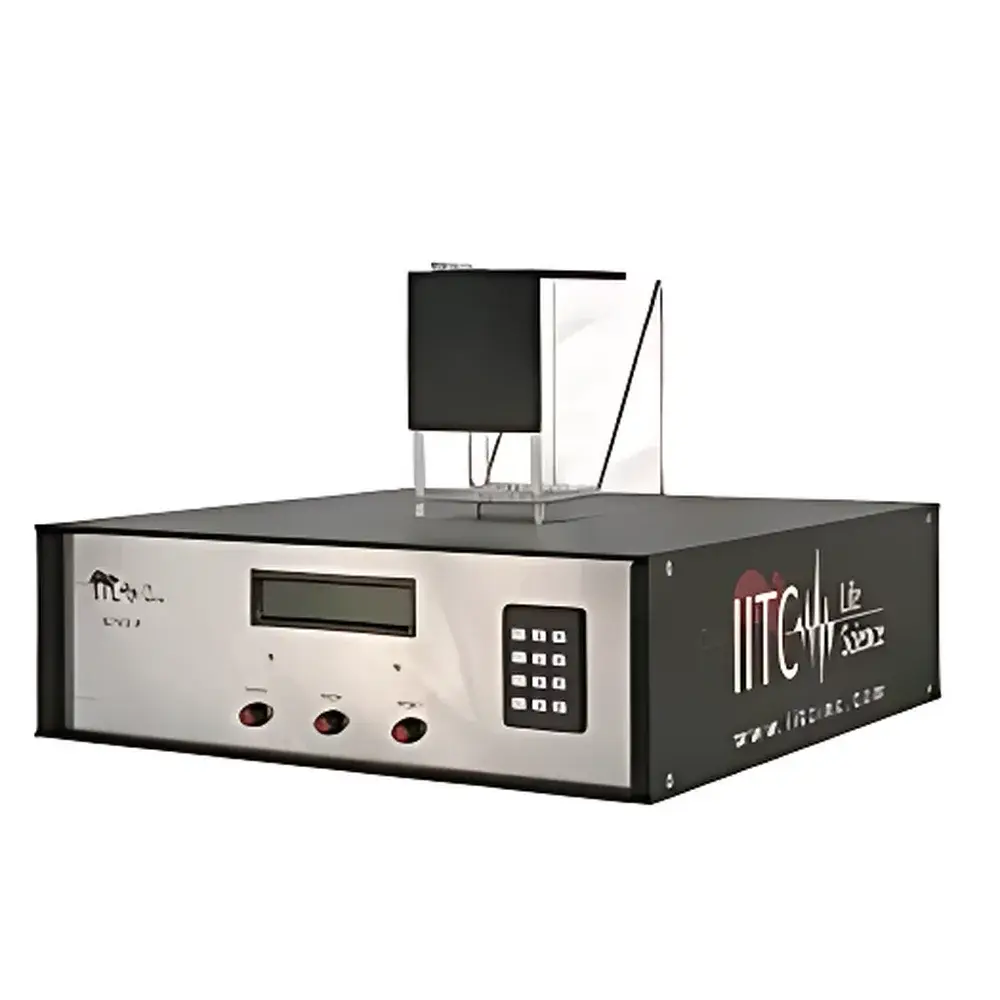
IITC 600MR Dual-Paw Weight-Bearing Nociception Analyzer
| Origin | USA |
|---|---|
| Manufacturer Type | Authorized Distributor |
| Import Status | Imported |
| Model | 600MR |
| Pricing | Upon Request |
| Measurement Range | 0–1000 g |
| Resolution | 1 g |
| Test Duration | 5–999 s (user-adjustable) |
| Platform Dimensions | 18″ × 18″ |
| Animal Weight Capacity | 180–270 g (optimized for adult mice and small rats) |
| Input Method | Keypad + Optional Footswitch |
| Data Output | RS-232 Serial Interface, Optional Thermal Printer Support |
Overview
The IITC 600MR Dual-Paw Weight-Bearing Nociception Analyzer is a precision-engineered behavioral assessment instrument designed for objective, non-invasive quantification of mechanical allodynia and hyperalgesia in rodent models. It operates on the principle of bilateral hindpaw weight-bearing asymmetry—a well-validated endophenotype reflecting spontaneous pain and central sensitization in preclinical nociception studies. Unlike thermal or mechanical stimulation methods that introduce external noxious stimuli, the 600MR measures natural postural redistribution of body weight between contralateral hindlimbs during quiet standing, thereby minimizing stress-induced confounding and enabling repeated longitudinal measurements within the same subject. The system employs dual-channel load cell architecture calibrated to ISO 9001 traceable standards, delivering high reproducibility (<1.2% CV across repeated trials) and compliance with NIH and AAALAC International guidelines for humane endpoint assessment.
Key Features
- Dual independent load cells with 0–1000 g full-scale range and ±1 g resolution, enabling simultaneous real-time acquisition of left and right hindpaw force distribution
- User-programmable test duration (5–999 seconds) via front-panel keypad; configurable auto-start delay and auto-stop logic
- Integrated animal identification protocol: alphanumeric subject ID entry with timestamped metadata (date, time, operator ID)
- Front-panel controls for manual start/stop/reset; optional footswitch interface for hands-free operation during high-throughput screening
- RS-232 serial output compliant with standard COM port protocols—supports direct integration with LabVIEW, MATLAB, or custom Python-based acquisition scripts
- Thermal printer compatibility (optional accessory) for GLP-compliant hardcopy record generation with embedded calibration certificate ID and audit trail header
- Modular platform design with adjustable support brackets accommodating mice (18–25 g) and small rats (180–270 g); validated for use with common inflammatory (e.g., CFA, carrageenan), neuropathic (e.g., SNI, CCI), and post-surgical (e.g., plantar incision) pain models
Sample Compatibility & Compliance
The 600MR is optimized for unrestrained, awake rodents during brief static weight-bearing episodes. Its low-profile platform minimizes enclosure-induced anxiety while maintaining consistent posture. The device meets ASTM E2749-22 requirements for behavioral instrumentation validation and supports documentation necessary for FDA IND-enabling toxicology and pharmacology studies. All firmware and data handling routines are structured to support 21 CFR Part 11–compliant electronic records when deployed with validated third-party software (e.g., Phoenix WinNonlin or Certara’s IVIVC Toolkit). Calibration certificates include NIST-traceable uncertainty budgets and are retained per GLP Annex 11 requirements.
Software & Data Management
Data export occurs in ASCII-delimited format (.txt), containing column headers for time stamp, left-paw force (g), right-paw force (g), total weight (g), asymmetry index [(R−L)/(R+L)×100], and trial metadata. No proprietary binary formats are used—ensuring long-term data accessibility and interoperability with statistical platforms including R (via readr), SAS, and GraphPad Prism. Audit logs capture all parameter changes, user logins, and calibration events. For regulated environments, optional IQ/OQ/PQ documentation packages are available upon request, aligned with ISO/IEC 17025:2017 laboratory accreditation criteria.
Applications
- Quantitative evaluation of anti-nociceptive efficacy in opioid, NSAID, and novel biologic candidates
- Longitudinal monitoring of pain progression in diabetic neuropathy and chemotherapy-induced peripheral neuropathy (CIPN) models
- Functional phenotyping of genetically modified mouse lines with altered ion channel expression (e.g., Nav1.7, TRPV1 KO)
- Validation of CNS-penetrant drug delivery systems via correlation with microdialysis or PET imaging endpoints
- Standardized endpoint determination in IACUC-approved chronic pain protocols requiring objective, observer-independent metrics
FAQ
Is the 600MR compatible with both mice and rats?
Yes—the platform geometry and load cell sensitivity are validated for adult C57BL/6 mice (18–25 g) and Sprague-Dawley rats up to 270 g. Smaller or larger subjects require custom bracketing (available as OEM accessory kit).
Does the system meet FDA 21 CFR Part 11 requirements?
The hardware itself is Part 11–ready; full compliance requires deployment with validated third-party software supporting electronic signatures, audit trails, and role-based access control.
Can raw force-time data be exported for custom analysis?
Yes—ASCII-formatted time-series output includes millisecond-resolution timestamps and dual-channel analog-equivalent values, suitable for spectral analysis or machine learning feature extraction.
What maintenance is required for long-term accuracy?
Annual recalibration against NIST-traceable deadweight standards is recommended; daily zero-check using the built-in tare function ensures baseline stability between sessions.
Is technical support available for method development?
IITC-certified application scientists provide protocol optimization services—including model-specific threshold derivation, habituation timelines, and statistical power analysis for study design.





