
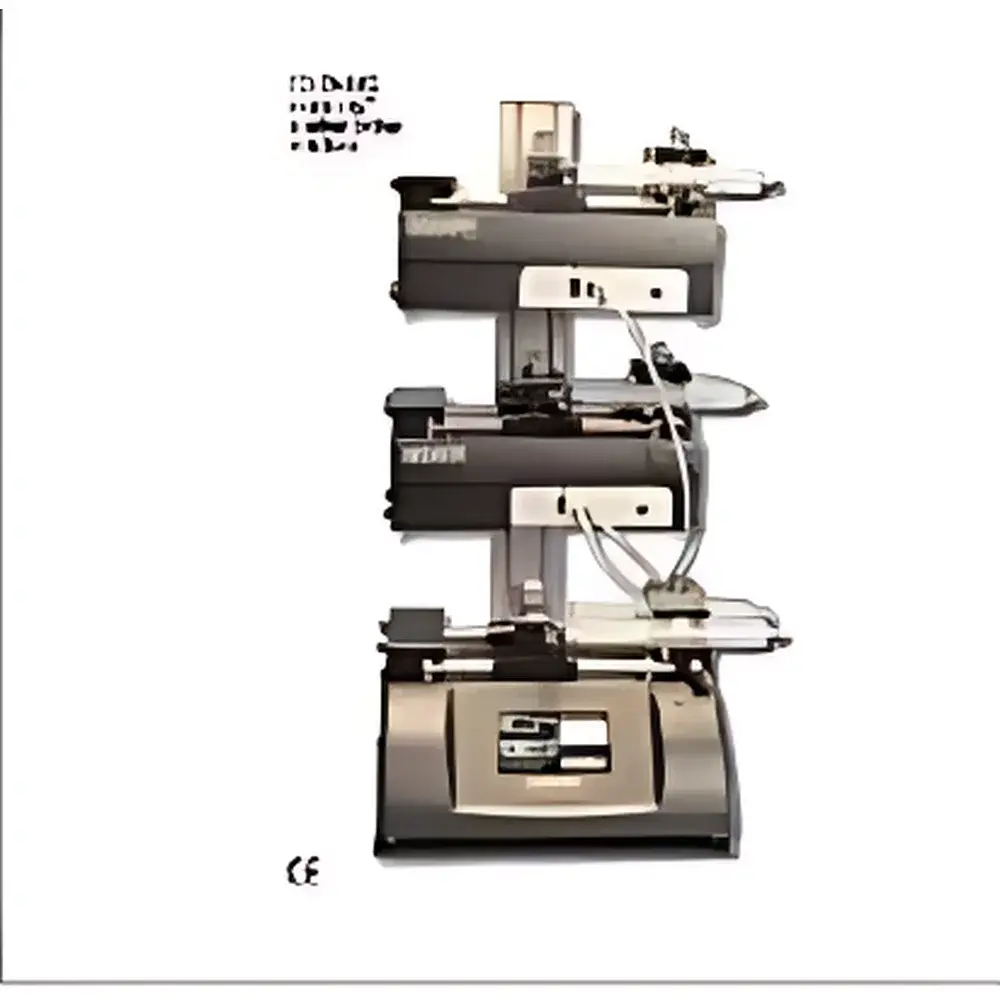
Harvard Apparatus PHD ULTRA™ Gradient System (Mixture/Dose Delivery System)
| Brand | Harvard Apparatus |
|---|---|
| Origin | Canada |
| Model | PHD ULTRA™ Gradient System |
| Drive Type | Microprocessor-controlled syringe pump |
| Operation Modes | Infuse-only, Infuse/Withdraw, Withdraw/Infuse |
| Accuracy (Stability & Reproducibility) | ±0.25% |
| Syringe Capacity | 0.5 µL – 140 mL |
| Flow Rate Range | 1.56 pL/min – 215.8 mL/min |
| Display | 4.3" WQVGA TFT color touchscreen |
| Memory | Non-volatile storage for all program settings |
| Connectivity | RS-232, RS-485, USB, TTL I/O, footswitch (9-pin D-Sub), IEEE-1394 Type B (15-pin D-Sub), phono jack |
| Linear Force | 34 kg (75 lbs) |
| Step Resolution | 0.082 µm/step |
| Power Input | 100–240 VAC, 50/60 Hz, 8 W |
| Dimensions (H×W×L) | 10.16 × 30.48 × 21.59 cm (4 × 12 × 8.5 in) |
| Weight | 4.5 kg (10 lbs) |
| Certifications | CE, ETL (UL/CSA), WEEE, EU RoHS, CB Scheme |
Overview
The Harvard Apparatus PHD ULTRA™ Gradient System is a microprocessor-driven, multi-channel syringe pump platform engineered for precise, computer-free generation of binary and tertiary fluid gradients in laboratory and preclinical research environments. Unlike conventional peristaltic or single-pump infusion systems, this system implements a master-satellite architecture—where one master pump coordinates timing, flow sequencing, and volumetric blending logic across up to two satellite pumps—enabling real-time convergence of independent fluid streams into a single, dynamically programmable output. Its core operational principle relies on synchronized volumetric displacement control rather than pressure-based regulation, ensuring high reproducibility (±0.25%) and minimal pulsation across the full flow range (1.56 pL/min to 215.8 mL/min). Designed for applications demanding strict temporal fidelity and compositional accuracy—such as serial dilution cascades, pharmacokinetic infusion protocols, and polymer solution processing—the PHD ULTRA™ Gradient System operates autonomously via its integrated 4.3″ WQVGA color touchscreen interface, eliminating dependency on external PCs or proprietary software stacks.
Key Features
- Stand-alone gradient programming: Binary and tertiary mixing profiles configured directly on-device without PC connectivity or driver installation.
- Master-satellite synchronization: One master unit orchestrates up to two satellite pumps to merge discrete flows into a unified outlet stream with programmable temporal resolution.
- Real-time syringe replacement: Seamless injection of new syringes during active operation—no system halt required—via hardware-triggered pause/resume logic and auto-calibrated plunger repositioning.
- Multi-mode dispensing: Supports infuse-only, infuse-withdraw, and withdraw-infuse sequences within a single gradient profile, enabling bidirectional solvent exchange or backflush routines.
- Rugged electromechanical design: 34 kg linear force actuation, 0.082 µm/step motor resolution, and non-volatile memory retention ensure long-term stability under continuous duty cycles.
- Regulatory-ready I/O architecture: RS-232/RS-485 serial interfaces support integration into GLP/GMP-compliant data acquisition networks; TTL I/O and footswitch inputs enable hands-free start/stop and emergency abort functions.
Sample Compatibility & Compliance
The PHD ULTRA™ Gradient System accommodates standard Luer-lock syringes constructed from glass, polypropylene, or stainless steel (0.5 µL–140 mL capacity), making it compatible with aqueous buffers, organic solvents, viscous polymer solutions (e.g., PVP, PLA in DMF), and biocompatible formulations. Its fluid path remains entirely disposable and non-metallic where in contact with sample—eliminating catalytic leaching or surface adsorption artifacts. The system conforms to international safety and electromagnetic compatibility standards including CE, ETL (UL 61010-1 / CSA C22.2 No. 61010-1), WEEE, EU RoHS Directive 2011/65/EU, and IECEE CB Scheme requirements. While not FDA-cleared as a medical device, its design aligns with engineering controls referenced in FDA 21 CFR Part 11 for audit-trail-capable instrumentation when paired with validated third-party data logging software.
Software & Data Management
Although fully functional without a host computer, the PHD ULTRA™ system supports optional ASCII-based command protocols over RS-232/RS-485 for integration into custom LabVIEW, Python, or MATLAB automation frameworks. All gradient profiles—including ramp rates, dwell times, step transitions, and volume thresholds—are stored in non-volatile memory with timestamped versioning. USB connectivity enables firmware updates and configuration backup/restore via FAT32-formatted drives. For regulated environments, the system’s deterministic execution model—coupled with hardware-level TTL pulse outputs—facilitates synchronization with external detectors (e.g., UV-Vis spectrophotometers, mass spectrometers) and satisfies traceability requirements under ISO/IEC 17025 and ASTM E2500-18 for analytical instrument qualification.
Applications
- Automated serial dilution workflows for enzyme kinetics, receptor binding assays, and cytotoxicity screening.
- Controlled drug infusion studies in rodent models requiring time-resolved concentration gradients (e.g., dose escalation, circadian dosing).
- Nutrient delivery in bioreactor perfusion systems with adaptive feed-forward control logic.
- Solution-phase precursor blending for electrospinning of graded polymer nanofibers (e.g., PCL/PLGA blends).
- Mobile phase gradient generation in preparative and analytical HPLC systems with dual-pump solvent blending.
- Flow injection analysis (FIA) and sequential injection analysis (SIA) platforms requiring precise reagent metering and zone segmentation.
FAQ
Can the PHD ULTRA™ Gradient System operate without any computer connection?
Yes. All gradient programming, execution, and monitoring occur natively via the onboard touchscreen interface.
What is the maximum number of syringe pumps that can be synchronized in one system?
The system supports one master pump and up to two satellite pumps (i.e., three total channels), configurable as either binary (1+1) or tertiary (1+2) gradient architectures.
Is it possible to change syringes mid-experiment without interrupting flow continuity?
Yes. The system implements a hardware-locked pause state that maintains valve positioning and plunger coordinate tracking, allowing syringe replacement and automatic re-homing before resuming the scheduled profile.
Does the system support bidirectional fluid movement (infuse + withdraw) within a single gradient step?
Yes. Each channel supports infuse-only, infuse-withdraw, and withdraw-infuse modes independently, enabling complex wash-and-fill cycles or solvent exchange protocols.
Are calibration certificates or IQ/OQ documentation available for GxP environments?
Harvard Apparatus provides factory calibration reports; users may perform field verification per ASTM D3418 or ISO 8573-1. Full IQ/OQ protocols are user-developed in accordance with internal validation SOPs and regulatory guidance (e.g., FDA Guidance for Industry: Process Validation).



