
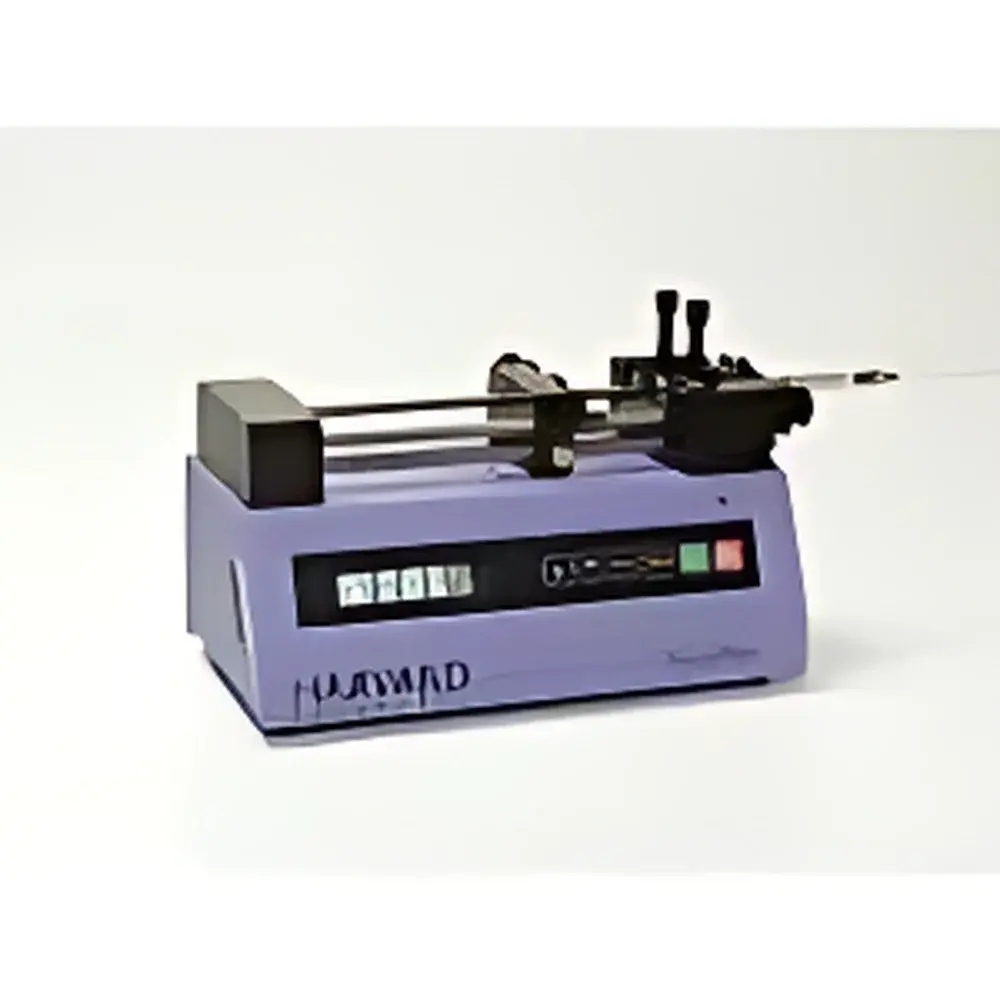
Harvard Apparatus Pump 11 Pico Plus Precision Syringe Pump
| Brand | Harvard Apparatus |
|---|---|
| Origin | USA |
| Model | Pump 11 Pico Plus |
| Type | Single- or Dual-Syringe Infusion/Withdrawal Pump |
| Stability Accuracy | ±0.5% |
| Reproducibility | ±0.1% |
| Syringe Capacity Range | 0.5 µL to 10 mL (per syringe) |
| Minimum Flow Rate | 33 pL/min (with 1 µL syringe) |
| Maximum Flow Rate | 0.4393 mL/min (dual 10 mL syringes) |
| Non-Volatile Memory | Yes |
| RS-232 Interface | Yes |
| Linear Force Output | 25 lbf |
| Stepper Motor Resolution | 0.0184 µm/step |
| Drive Speed Range | 27.6 s/step to 200 steps/sec |
| Plunger Velocity Range | 0.0388 µm/min to 0.8333 mm/min |
| Power Input | 12 V DC, 1.5 A (via universal AC input: 100–250 V AC, 50/60 Hz, 18 W) |
| Dimensions (H×W×D) | 11.4 × 22.9 × 11.4 cm |
| Weight | 2.3 kg |
Overview
The Harvard Apparatus Pump 11 Pico Plus is a high-precision, microprocessor-controlled syringe pump engineered for ultra-low-flow applications requiring nanoliter-to-milliliter volumetric accuracy and long-term stability. Based on closed-loop stepper motor actuation with sub-micron positional resolution, the Pump 11 Pico Plus delivers deterministic fluid displacement through mechanical plunger advancement—eliminating reliance on pressure-based flow estimation. Its core architecture employs a 36:1 geared 1.8° hybrid stepper motor operating in 1/4-step mode, achieving 14,400 microsteps per lead screw revolution and a theoretical positional resolution of 0.0184 µm per step. This enables reproducible delivery across six orders of magnitude in flow rate—from 33 picoliters per minute (using a 1 µL glass syringe) up to 439 microliters per minute (in dual-syringe parallel configuration). Designed for integration into automated laboratory workflows, the device supports manual, foot-switch, and computer-controlled operation via RS-232 serial protocol, ensuring compatibility with LabVIEW, MATLAB, and custom SCADA environments.
Key Features
- Dual-syringe mounting platform enabling independent or synchronized infusion/withdrawal—expanding dynamic flow range and supporting bidirectional protocols such as push-pull sampling.
- Vacuum fluorescent display (VFD) with intuitive membrane keypad for real-time parameter entry, including target volume, flow rate, acceleration/deceleration profiles, and directional polarity (infuse/withdraw).
- Non-volatile memory retains all user-defined configurations—including syringe diameter calibration, flow rate limits, and mechanical stop positions—across power cycles.
- Adjustable mechanical limit switches for both forward injection and reverse aspiration, preventing over-travel and protecting syringes and connected microfluidic interfaces.
- Programmable auto-stop upon reaching user-specified volume thresholds—critical for single-cell microinjection where over-delivery may compromise viability.
- Low-noise, low-vibration drive system optimized for vibration-sensitive setups, including inverted microscopy stages and patch-clamp rigs.
Sample Compatibility & Compliance
The Pump 11 Pico Plus accommodates standard Luer-lock and plastic/glass syringes ranging from 0.5 µL to 10 mL capacity, including Hamilton, SGE, and Nanoject-compatible formats. It supports a wide variety of chemically resistant tubing materials (e.g., FEP, PTFE, fused silica) and integrates seamlessly with microfluidic manifolds, capillary electrophoresis systems, and FIA manifolds. From a regulatory standpoint, the device meets IEC 61010-1 safety requirements for laboratory electrical equipment and complies with FCC Part 15 Class B emissions standards. While not inherently 21 CFR Part 11–compliant, its RS-232 interface and deterministic command-response architecture support integration into validated systems where electronic audit trails, user authentication, and data integrity controls are implemented at the host software level—facilitating GLP/GMP-aligned workflows in pharmaceutical development and QC laboratories.
Software & Data Management
Operation is fully scriptable via ASCII-based RS-232 commands (e.g., “RUN”, “STOP”, “VOL=5.2uL”, “RATE=12.7nL/min”), enabling direct control from Python, MATLAB, or LabVIEW environments. Harvard Apparatus provides legacy drivers and example code libraries for Windows platforms; third-party developers may implement cross-platform support using standard serial communication stacks. All parameter changes—including syringe calibration coefficients—are stored in non-volatile EEPROM, eliminating configuration drift between sessions. No proprietary runtime or cloud dependency is required—data logging and event timestamping occur externally at the host PC level, preserving full traceability under ISO/IEC 17025 or FDA-aligned documentation practices.
Applications
- Single-cell microinjection (e.g., oocyte cytoplasmic/nuclear delivery, CRISPR RNP transfection, mRNA loading) where precise femtoliter-to-nanoliter dosing is essential.
- Microfluidic assay priming and reagent metering in droplet generation, organ-on-chip, and point-of-care diagnostic platforms.
- Flow injection analysis (FIA) and capillary liquid chromatography (capLC), where pulseless, low-dead-volume delivery ensures peak shape fidelity and retention time reproducibility.
- Controlled aspiration for patch-clamp electrode filling, intracellular recording pipette backfilling, and gentle cell harvesting without shear damage.
- Calibration of microflow sensors and validation of gravimetric flow measurement systems across sub-nL/min regimes.
FAQ
What syringe sizes are supported?
Syringes from 0.5 µL to 10 mL are compatible—both glass and plastic types with standard Luer-lock or slip-tip fittings.
Can the pump operate in withdrawal-only mode?
Yes—direction is fully reversible via front-panel toggle or RS-232 command, with independent mechanical stops configurable for both infuse and withdraw travel limits.
Is remote triggering possible without a computer?
Yes—optional foot switch interface allows hands-free start/stop control, ideal for sterile or multi-tasking experimental conditions.
How is syringe calibration performed?
Users enter the internal diameter (in mm) via keypad; the pump calculates plunger displacement per step based on this value—no external calibration fluids or gravimetric verification required.
Does the device support continuous infusion over extended periods (e.g., >24 h)?
Yes—thermal management and stepper motor design enable stable, unattended operation for multi-day protocols, provided ambient temperature remains within 15–30°C and power supply is uninterrupted.



