
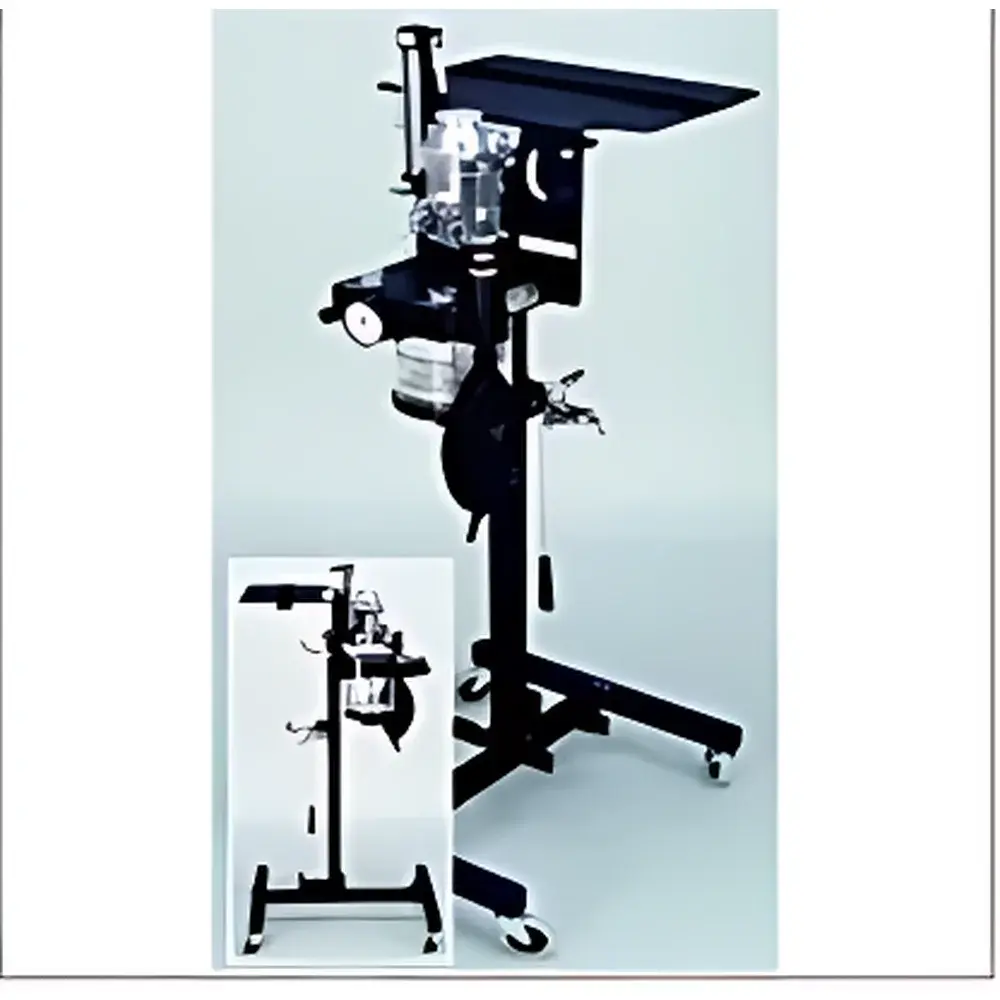
Harvard Apparatus AS-01-0001 Compact Modular Animal Anesthesia Machine
| Brand | Harvard Apparatus |
|---|---|
| Origin | USA |
| Model | AS-01-0001 |
| Gas Agent | Isoflurane |
| Carrier Gas | Oxygen |
| O₂ Inlet Pressure | 50 PSI (fixed) |
| O₂ Flow Range | 0–4 LPM (mechanically limited) |
| Max Safety Flow | 50 LPM (safety-limited bypass) |
| Vaporizer Range | 0.5–5.0% Isoflurane |
| CO₂ Absorber Capacity | 3 lb (reusable, removable) |
| Application Weight Limit | ≤136 kg (300 lb) |
| Compatibility | Rebreathing & Non-rebreathing Circuits |
| Integrable With | Veterinary Ventilators |
Overview
The Harvard Apparatus AS-01-0001 is a compact, modular veterinary anesthesia delivery system engineered for precision, safety, and adaptability in preclinical research and clinical animal care settings. Designed around the principles of calibrated vaporization and controlled gas dynamics, it delivers precise isoflurane–oxygen mixtures via dual-path architecture—supporting both rebreathing (circle) and non-rebreathing (Mapleson-type) anesthetic circuits. Its fixed 50 PSI oxygen inlet pressure regulation ensures stable upstream supply conditions, while the mechanically constrained 0–4 LPM flowmeter prevents over-torque damage and eliminates operator-induced flow calibration drift—a design feature validated under repeated laboratory use. The unit meets fundamental engineering requirements for ISO 8573-1:2010 (compressed air quality) and complies with general electrical safety standards IEC 61010-1 for laboratory equipment. It is not intended for human use and is classified as a Class II veterinary medical device per FDA guidance for animal anesthesia systems.
Key Features
- Modular, field-separable architecture enables rapid reconfiguration between surgical suites or transport between vivarium zones without full system disassembly.
- Dedicated isoflurane-specific vaporizer with linear 0.5–5.0% output range, calibrated at 20°C and 760 mmHg, traceable to NIST-traceable reference standards.
- Integrated CO₂ absorber housing rated for 3 lb of soda lime or Baralyme®, featuring quick-release clamps and visual saturation indicators for routine GLP-compliant maintenance logging.
- Oxygen flow control incorporates dual mechanical safeguards: (1) hard-stop limit at 4 LPM to prevent valve seat deformation; (2) independent 50 LPM safety-bypass circuit that activates automatically if downstream resistance exceeds 30 cm H₂O—preventing barotrauma during circuit occlusion events.
- Gas outlet manifold includes dual dedicated ports: one for rebreathing loop connection (with CO₂ scrubber interface), and one for non-rebreathing Y-piece or face mask delivery—enabling seamless transition between small-rodent (7 kg) protocols.
- Compatible with Harvard Apparatus rodent ventilators (e.g., Model 683) and third-party ICU-grade ventilators via standardized 15 mm ISO 5356-1 conical connectors, supporting controlled ventilation during thoracotomy, neurosurgery, or pharmacodynamic challenge studies.
Sample Compatibility & Compliance
The AS-01-0001 supports consistent anesthetic delivery across species including mice, rats, guinea pigs, rabbits, dogs, non-human primates, and swine—provided subject mass remains ≤136 kg. Its flow and concentration tolerances align with ASTM F2795-22 (Standard Practice for Anesthesia Delivery Systems for Laboratory Animals) and support institutional AAALAC International accreditation requirements. All wetted materials comply with USP Class VI biocompatibility testing. The system does not incorporate electronic data logging; however, analog outputs (0–5 VDC) are available for integration with external acquisition systems compliant with 21 CFR Part 11 when paired with validated third-party hardware and audit-trail software.
Software & Data Management
This is a manually operated, analog-controlled anesthesia platform with no embedded microprocessor or firmware. No proprietary software is required or supplied. All adjustments—including vaporizer dial setting, flowmeter needle valve position, and absorber canister replacement—are documented manually in study records per GLP §58.130. For institutions requiring electronic data capture, optional analog-to-digital signal adapters (e.g., National Instruments USB-6009) may be used to record flow and pressure signals—subject to validation per SOP-ANESTH-004 in institutional QA frameworks.
Applications
- Longitudinal imaging studies (MRI, PET, fUS) requiring stable, low-drift anesthetic maintenance over >4-hour sessions.
- Surgical models involving hemodynamic instability (e.g., myocardial infarction, sepsis), where rapid titration of isoflurane depth mitigates autonomic reflex interference.
- Developmental toxicology studies in pregnant rodents, leveraging fast induction/recovery kinetics to minimize maternal stress confounders.
- Neurophysiology preparations (e.g., in vivo patch-clamp, optogenetics) demanding minimal respiratory artifact and precise end-tidal agent control.
- Teaching laboratories conducting comparative anesthetic pharmacokinetics across species using standardized MAC-equivalent dosing protocols.
FAQ
Is the AS-01-0001 certified for use in GLP-regulated studies?
Yes—when operated per Harvard Apparatus’ published SOP ANESTH-AS01-001 and maintained with documented calibration logs (flowmeter verification annually; vaporizer certification every 6 months), it satisfies OECD GLP Principles Section 5.2.2 for test facility equipment.
Can this unit be used with sevoflurane or desflurane?
No—the vaporizer is physically and thermodynamically calibrated exclusively for isoflurane. Use of alternative agents will result in clinically unsafe concentration errors and void warranty.
Does the system include an oxygen analyzer or apnea alarm?
No—these are external accessories. We recommend pairing with the Harvard Apparatus O₂/CO₂ Multi-Gas Monitor (Model 7100) for real-time end-tidal monitoring and automated alarm thresholds.
What maintenance intervals are recommended for the CO₂ absorber?
Replace absorber granules after 6 hours of continuous use or upon color indicator shift (if using indicator-type soda lime); clean housing quarterly with 70% ethanol and inspect for channeling or moisture retention.
Is technical support available outside the United States?
Yes—Harvard Apparatus maintains authorized service partners in the EU, Japan, Australia, and Canada, all trained to Level 3 Field Service Technician standards per ISO/IEC 17020.




