
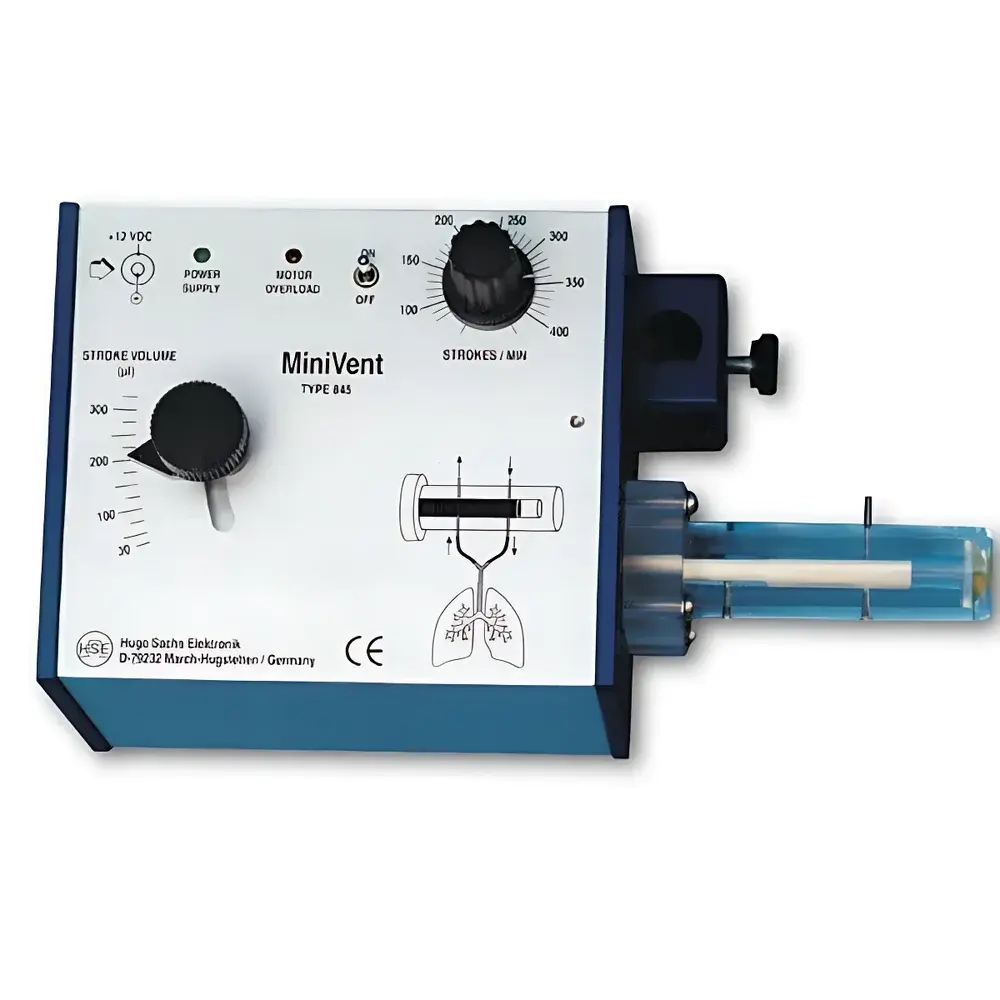
Harvard Apparatus MiniVent Small Animal Ventilator
| Brand | Harvard Apparatus |
|---|---|
| Origin | USA |
| Model | MiniVent |
| Tidal Volume Range | 30–350 µL |
| Respiratory Rate | 60–400 breaths/min |
| Power Supply | 115 V or 220 V AC |
| Dead Space Volume | <0.1 mL |
| Compliance Error Compensation | ±3 µL |
| Gas Inlet Options | Ambient air or explosion-proof gas mixtures |
| PEEP Capability | Yes |
| Included Accessories | Two silicone tubing sets (1.5 mm ID × 3.0 mm OD × 14 cm), tracheostomy cannula (1.3 mm OD, P/N 73-2730), endotracheal tube (1.2 mm OD, P/N 73-2844), multi-gas inlet adapter |
Overview
The Harvard Apparatus MiniVent is a precision-engineered small animal ventilator designed specifically for mechanically ventilating mice and other rodent models during acute surgical and physiological experiments. It operates on a valveless piston-driven displacement principle, eliminating flow resistance, pressure hysteresis, and mechanical dead space associated with conventional solenoid- or rotary-valve-based systems. This architecture ensures high fidelity delivery of tidal volume with minimal system compliance error—quantified at ±3 µL across its full operational range. The device is optimized for integration into stereotaxic or surgical setups where spatial constraints demand proximity to the animal; its compact footprint (12.7 × 8.9 × 7.6 cm) and low-mass design enable stable mounting directly adjacent to the subject without vibration transmission or acoustic interference. Unlike large-volume ventilators used in larger species, the MiniVent maintains volumetric accuracy by minimizing total system compliance through ultra-low dead space (<0.1 mL) in both internal pathways and external circuitry.
Key Features
- Valveless piston pump mechanism ensuring zero valve-induced flow delay, backpressure variation, or wear-related calibration drift
- Continuously adjustable tidal volume (30–350 µL) and respiratory rate (60–400 bpm) via front-panel digital controls—no interruption of ventilation required during parameter adjustment
- Integrated PEEP (Positive End-Expiratory Pressure) generation via expiratory limb resistance modulation, supporting alveolar recruitment studies
- Dual-gas inlet capability with optional multi-port adapter enabling simultaneous delivery of carrier gases (e.g., medical air, O₂, N₂O) and aerosolized agents at ambient pressure
- Low-noise operation (<35 dB(A)) and zero mechanical vibration—critical for electrophysiological, optical imaging, or behavioral assays requiring motion artifact suppression
- Modular accessory set including calibrated tracheostomy cannulae, endotracheal tubes, and compliant silicone tubing optimized for murine airway dimensions and flow dynamics
Sample Compatibility & Compliance
The MiniVent is validated for use with C57BL/6, BALB/c, CD-1, and other common inbred and outbred mouse strains weighing 18–35 g. Its tidal volume resolution and dynamic response are aligned with murine respiratory physiology: typical resting minute ventilation ranges from 300–600 mL/kg/min, corresponding to ~150–250 µL tidal volumes at 120–180 bpm under normocapnic conditions. All materials contacting gas pathways comply with USP Class VI biocompatibility standards. Device firmware and hardware architecture support GLP-compliant documentation workflows, including timestamped parameter logging and audit-trail-capable configuration history (when paired with optional Harvard Apparatus Data Exchange software). While not FDA-cleared as a medical device, the MiniVent meets applicable IEC 61000-6-2 (EMC immunity) and IEC 61000-6-3 (EMC emissions) requirements for laboratory equipment.
Software & Data Management
The MiniVent operates as a standalone analog/digital hybrid instrument but integrates seamlessly with Harvard Apparatus’ AcqKnowledge or LabChart software suites via TTL synchronization and analog output ports (0–5 V proportional to pressure and flow). Real-time tidal volume, peak inspiratory pressure (PIP), and expiratory time constants can be acquired at up to 1 kHz sampling rates. Optional firmware upgrade enables USB-C connectivity and CSV-exportable session logs—including timestamps, setpoints, and operator annotations—facilitating traceability in peer-reviewed publications and regulatory submissions. All data files adhere to MIAME- and MINSEQE-aligned metadata conventions when exported through the Harvard Apparatus Data Exchange platform.
Applications
- Intraoperative ventilation during craniotomy, thoracotomy, or abdominal surgery in awake or anesthetized mice
- Respiratory challenge models: hypoxia/reoxygenation, hypercapnia, bronchoconstriction (methacholine), or pulmonary edema induction
- Pharmacokinetic-pharmacodynamic (PK/PD) studies involving inhaled therapeutics or anesthetic gases
- Functional lung imaging: synchronization with micro-CT, optical coherence tomography (OCT), or two-photon microscopy
- Neurorespiratory coupling experiments requiring precise CO₂ clamping or chemoreceptor stimulation
- GMP-aligned preclinical toxicology studies where ventilator consistency must meet SOP-defined reproducibility thresholds (CV < 2.5% over 60-min sessions)
FAQ
Is the MiniVent compatible with anesthesia delivery systems?
Yes—the multi-gas inlet adapter supports concurrent connection to vaporizers or gas mixing manifolds, enabling precise control of inspired anesthetic concentration (e.g., isoflurane) alongside ventilatory parameters.
Can tidal volume be verified independently during operation?
Yes—integrated analog pressure and flow outputs allow real-time validation using external pneumotachographs or differential pressure transducers calibrated per ISO 9360-1.
Does the MiniVent support breath-to-breath variability analysis?
While the base unit does not compute variability metrics internally, synchronized high-speed data acquisition via LabChart permits post-hoc calculation of coefficient of variation (CV) for VT, RR, and PIP across defined epochs.
What maintenance is required for long-term calibration stability?
Annual verification using NIST-traceable syringe pumps and dry-calibrated flow meters is recommended; no routine lubrication or valve replacement is necessary due to the valveless piston design.
Is remote control possible via Ethernet or Wi-Fi?
No—remote operation is limited to USB-C and analog/TTL interfaces; network connectivity is intentionally excluded to maintain electromagnetic isolation in sensitive electrophysiology environments.





