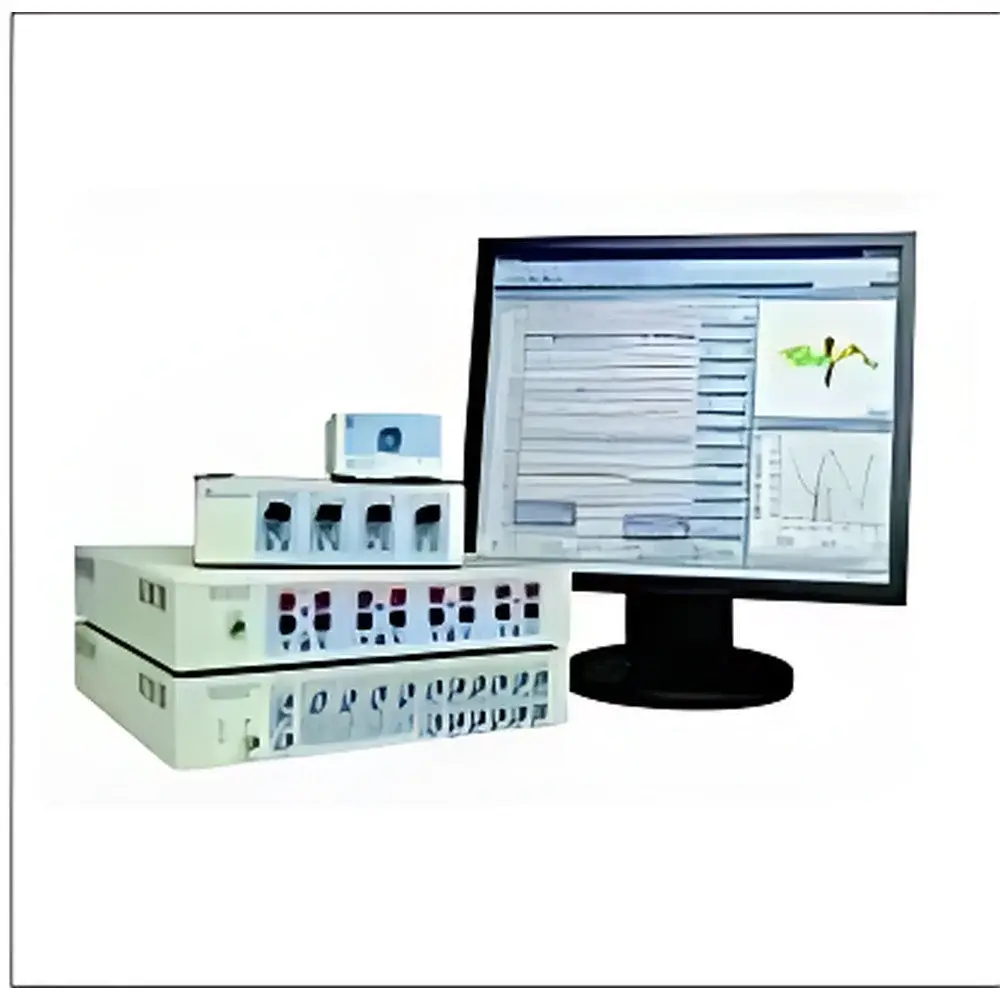
PowerLab ML880 Physiological Signal Acquisition and Analysis System
| Origin | USA |
|---|---|
| Manufacturer Type | Authorized Distributor |
| Origin Category | Imported |
| Model | ML880 |
| Pricing | Available Upon Request |
Overview
The PowerLab ML880 is a high-fidelity, research-grade physiological signal acquisition and analysis system engineered for precision in life sciences laboratories. Built on ADInstruments’ proven hardware architecture, the ML880 employs 16-bit analog-to-digital conversion with simultaneous sampling across all channels, ensuring temporal alignment and phase coherence critical for multi-parameter physiological experiments. It operates on the principle of real-time digitization of low-amplitude, low-frequency biological signals—such as action potentials, pressure transients, and impedance-based flow waveforms—using calibrated input conditioning (gain, filtering, offset control) and synchronized trigger logic. Designed specifically for integration into complex experimental workflows—including Langendorff perfusion, wire myography, laser Doppler flowmetry, and conscious animal telemetry—the ML880 serves as a central hub for acquiring, visualizing, and post-processing dynamic physiological data under controlled or naturalistic conditions.
Key Features
- Simultaneous 8-channel analog input with programmable gain (×1 to ×10,000), high-pass/low-pass digital filtering (0.1 Hz – 10 kHz), and 16-bit resolution at up to 400 kS/s aggregate sampling rate
- Integrated isolated stimulator output (±10 V, 100 mA max) for evoked response protocols, compatible with Grass, World Precision Instruments, and other third-party stimulators
- Dedicated digital I/O lines for TTL synchronization with external devices (e.g., video capture systems, ventilators, pressure controllers)
- USB 3.0 interface with plug-and-play driver support on Windows 10/11 and macOS 12+, certified for continuous acquisition over 72-hour sessions without buffer dropouts
- Hardware-level anti-aliasing filters and galvanic isolation (≥5000 VDC) between inputs and host PC, meeting IEC 61000-4-5 surge immunity standards
Sample Compatibility & Compliance
The ML880 supports direct interfacing with a broad spectrum of physiological transducers and amplifiers—including differential AC/DC-coupled bioamplifiers, bridge-based pressure transducers (e.g., Millar Mikro-Tip®), thermistors, Clark-type O2 electrodes, CO2 infrared sensors, and optical plethysmography modules. When paired with appropriate front-end hardware (e.g., FE132 ECG Amplifier, FE136 EMG Amplifier, or FE225 Isolated Bio Amp), it acquires compliant signals per ISO 10993-1 (biocompatibility), ASTM F2119 (MRI safety of monitoring equipment), and IEC 60601-1 (medical electrical equipment safety). All LabChart Pro analysis modules are validated for use in GLP-compliant environments; audit trails, user access controls, and electronic signatures align with FDA 21 CFR Part 11 requirements when deployed with appropriate IT infrastructure.
Software & Data Management
The ML880 is exclusively operated via LabChart software (v8.2+), available in Standard and Pro editions. LabChart Pro includes validated, peer-reviewed analysis modules: ECG morphology detection (QT interval, R-R variability), metabolic gas exchange calculations (VO2, VCO2, RER), pressure-volume loop derivation (ESPVR, EDPVR), spike sorting for multi-unit neural discharge, and time-synchronized video overlay (H.264/MPEG-4 encoded). Data files are stored in proprietary .adicht format—losslessly compressible, timestamp-accurate to 1 µs—and exportable to MATLAB (.mat), HDF5, CSV, and TDMS for cross-platform statistical modeling. Batch processing scripts support automated peak detection, baseline correction, and ANOVA-ready table generation. All processing steps are fully traceable via embedded metadata (hardware configuration, filter settings, calibration coefficients).
Applications
- Hemodynamic assessment in isolated heart preparations (Langendorff, working heart) and in vivo rodent models
- Vascular reactivity studies using wire or pressure myographs, including concentration-response curve fitting (pD2, Emax)
- Microcirculatory flow quantification via laser Doppler perfusion imaging (LDPI) and sidestream dark field (SDF) video analysis
- Intracellular and extracellular electrophysiology—patch-clamp, sharp electrode, and field potential recordings—with stimulus artifact rejection
- Non-invasive cardiopulmonary profiling in human subjects: finger-cuff BP, impedance cardiography (ICG), pulse contour analysis
- Circadian rhythm monitoring via synchronized core temperature, activity, and respiratory gas exchange metrics
- Neuropsychophysiological paradigms combining EEG, EOG, EMG, and GSR during cognitive task performance
FAQ
Is the ML880 suitable for regulatory submissions (e.g., FDA IND/IDE)?
Yes—when configured with LabChart Pro and deployed under documented SOPs, the system meets data integrity requirements outlined in FDA Guidance for Industry: Computerized Systems Used in Clinical Investigations (2023) and ISO/IEC 17025:2017 Annex A.2.
Can the ML880 interface with third-party DAQ hardware or custom Python/MATLAB scripts?
The ML880 does not support direct hardware-level API access; however, LabChart’s “Export to File” and “Live Data Feed” (via TCP/IP socket) enable real-time streaming to external applications for hybrid analysis pipelines.
What is the recommended maintenance schedule for calibration verification?
ADInstruments recommends annual traceable calibration using NIST-traceable reference sources (e.g., Fluke 5500A calibrator); internal self-test routines verify ADC linearity, noise floor (< 1.2 µV RMS), and timing jitter (< 50 ns) prior to each experimental session.