
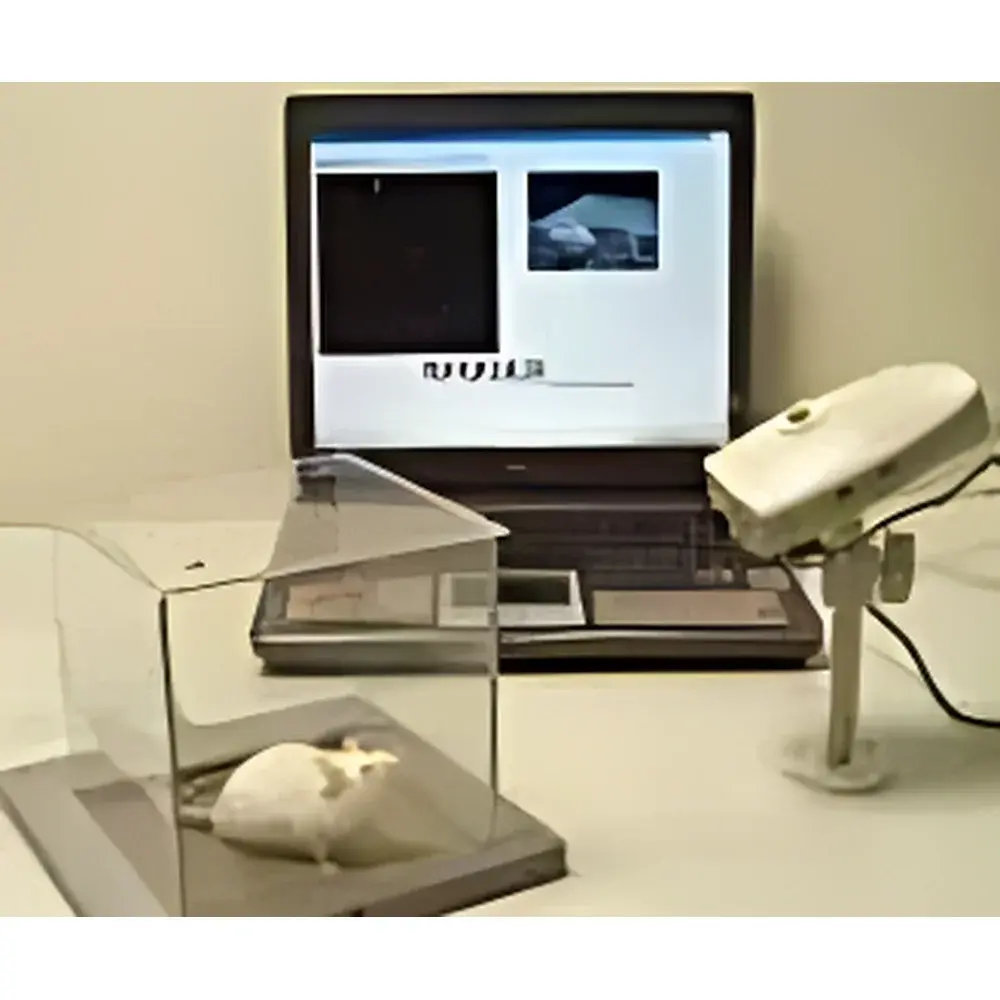
Bioseb BIO-KWB Kinetic Weight Bearing Gait Analysis System
| Brand | Harvard Apparatus |
|---|---|
| Origin | USA |
| Manufacturer Type | Authorized Distributor |
| Origin Category | Imported |
| Model | BIO-KWB |
| Price Range | USD 1,400 – 7,000 |
| Footprint (Rat System) | 130 × 50 × 45 cm |
| Footprint (Mouse System) | 80 × 40 × 30 cm |
| Camera Resolution | 640 × 480 |
| Camera Frame Rate | 30 Hz |
| Force Sensor Sampling Rate | 100 Hz |
| Software | KWB Full-Function License (Unlimited Replay Mode, Unlimited PC Installations) |
| OS Compatibility | Windows 7 or later |
| Minimum CPU | Intel Core i5 or equivalent |
| Minimum RAM | 4 GB |
Overview
The Bioseb BIO-KWB Kinetic Weight Bearing (KWB) Gait Analysis System is a validated, high-temporal-resolution instrument engineered for quantitative assessment of dynamic weight distribution and locomotor biomechanics in rodent models. It operates on the principle of synchronized force-sensing and video-based motion tracking: an array of calibrated piezoresistive sensors embedded beneath a transparent walkway captures vertical ground reaction forces (GRFs) at 100 Hz, while a synchronized USB-connected HD camera (640 × 480 @ 30 fps) records spatial footfall patterns in real time. Unlike static posture or open-field assays, the BIO-KWB quantifies *kinetic* parameters—i.e., force generation, timing, and spatial coordination—during voluntary, unimpeded locomotion. This enables objective evaluation of motor asymmetry, compensatory loading, gait cycle phase disruption, and dynamic center-of-mass shifts—critical endpoints in preclinical studies of neurodegeneration, sensorimotor integration, and musculoskeletal pathology.
Key Features
- Simultaneous dual-modality acquisition: High-fidelity force data (100 Hz) time-locked to video (30 Hz) with hardware-triggered synchronization.
- Modular walkway design: Interchangeable platforms optimized for mice (80 × 40 × 30 cm) and rats (130 × 50 × 45 cm), ensuring species-appropriate stride length and behavioral validity.
- Comprehensive gait parameter extraction: Automated calculation of step count per limb, inter-limb coordination indices, stance/swing phase duration, peak vertical force (% body weight), force-time integral (peak area), propulsion impulse, and toe-off latency.
- KWB software with full replay functionality: Enables retrospective re-analysis of raw sensor and video streams without data reacquisition; supports frame-by-frame force overlay and temporal event marking.
- Unrestricted deployment: Full-feature software license permits installation on unlimited Windows workstations (Windows 7+, Intel Core i5+, 4 GB RAM minimum), facilitating multi-user labs and cross-platform data harmonization.
Sample Compatibility & Compliance
The BIO-KWB system is validated for use with C57BL/6, BALB/c, Sprague-Dawley, and Wistar rodents across standard preclinical age ranges (6–24 weeks). Its non-invasive, voluntary-run paradigm eliminates stress-induced confounds common in forced treadmill protocols. Data output conforms to FAIR principles (Findable, Accessible, Interoperable, Reusable) and supports audit-ready export in CSV and HDF5 formats. While not a medical device, the system’s measurement traceability aligns with ISO/IEC 17025 guidelines for laboratory competence when used within GLP-compliant research environments. All hardware components meet CE marking requirements for electromagnetic compatibility (EMC Directive 2014/30/EU) and low-voltage safety (LVD Directive 2014/35/EU).
Software & Data Management
The KWB software provides a deterministic, timestamp-synchronized data pipeline from acquisition to analysis. Raw sensor voltage signals are converted to calibrated force units (N) using factory-applied polynomial coefficients stored in non-volatile memory. Video frames are indexed to microsecond-precision timestamps via USB 2.0 isochronous transfer. The software implements standardized gait event detection algorithms (e.g., initial contact defined as >5% peak force threshold; toe-off as <2% sustained force for ≥20 ms), ensuring reproducibility across operators and sites. Export modules generate structured datasets compatible with MATLAB, Python (via Pandas), and statistical platforms (SPSS, GraphPad Prism). Audit trails—including user login, analysis parameter changes, and export timestamps—are logged in accordance with ALCOA+ principles for regulatory submissions.
Applications
The BIO-KWB is routinely deployed in translational neuroscience and orthopedic pharmacology studies. Key application domains include longitudinal monitoring of motor deficits in MPTP- or 6-OHDA-induced Parkinsonian mice; quantification of asymmetric weight bearing following unilateral cortical stroke (MCAO model); evaluation of load redistribution in collagen-induced arthritis (CIA) rats; functional recovery assessment post-spinal cord injury (SCI); and phenotyping of genetic models of cerebellar ataxia (e.g., Lurcher, SCA1 transgenic lines). Its sensitivity to subtle kinetic asymmetries makes it suitable for dose-response characterization of neuroprotective or myorelaxant compounds where traditional rotarod or grip strength assays lack discriminative power.
FAQ
What is the minimum required computer specification to run KWB software?
Windows 7 or newer, Intel Core i5 (or equivalent AMD processor), 4 GB RAM, and a USB 2.0 port for camera and sensor interface.
Can the same software license be used on multiple computers simultaneously?
Yes—the full-function license permits installation and concurrent use on any number of Windows PCs without activation limits.
Does the system require calibration before each experiment?
No—factory calibration is retained in non-volatile memory; only periodic verification using certified test weights (recommended every 6 months) is required per ISO 9001 maintenance protocols.
Is real-time feedback available during data acquisition?
Yes—live force traces per limb and real-time gait cycle segmentation are displayed during recording, enabling immediate assessment of animal compliance and data quality.
How is foot placement spatially registered relative to force measurements?
The transparent walkway integrates optical fiducial markers visible to the camera; software performs sub-pixel registration between video-derived paw centroid coordinates and corresponding sensor array coordinates via geometric transformation matrices.
Related Products



