
Harvard Apparatus P1500 Peristaltic Pump
| Brand | Harvard Apparatus |
|---|---|
| Origin | USA |
| Model | P1500 |
| Flow Rate Range | 0.01–1,500 mL/min |
| Maximum Speed | 235 rpm |
| Drive Motor Compatibility | Interchangeable P-70 / P-230 / P-1500 Modules |
| Display | Full-color LCD touchscreen interface |
| Control Interfaces | USB, RS-485, 15-pin digital I/O, analog input, footswitch port |
| Operating Modes | Constant Flow, Flow Ramp, Stepped, Pulsatile, Concentration-based dosing |
| Calibration Support | User-defined tubing ID/ID-OD, automatic flow calibration per tube type |
| Compliance | Designed for GLP/GMP-aligned lab environments |
Overview
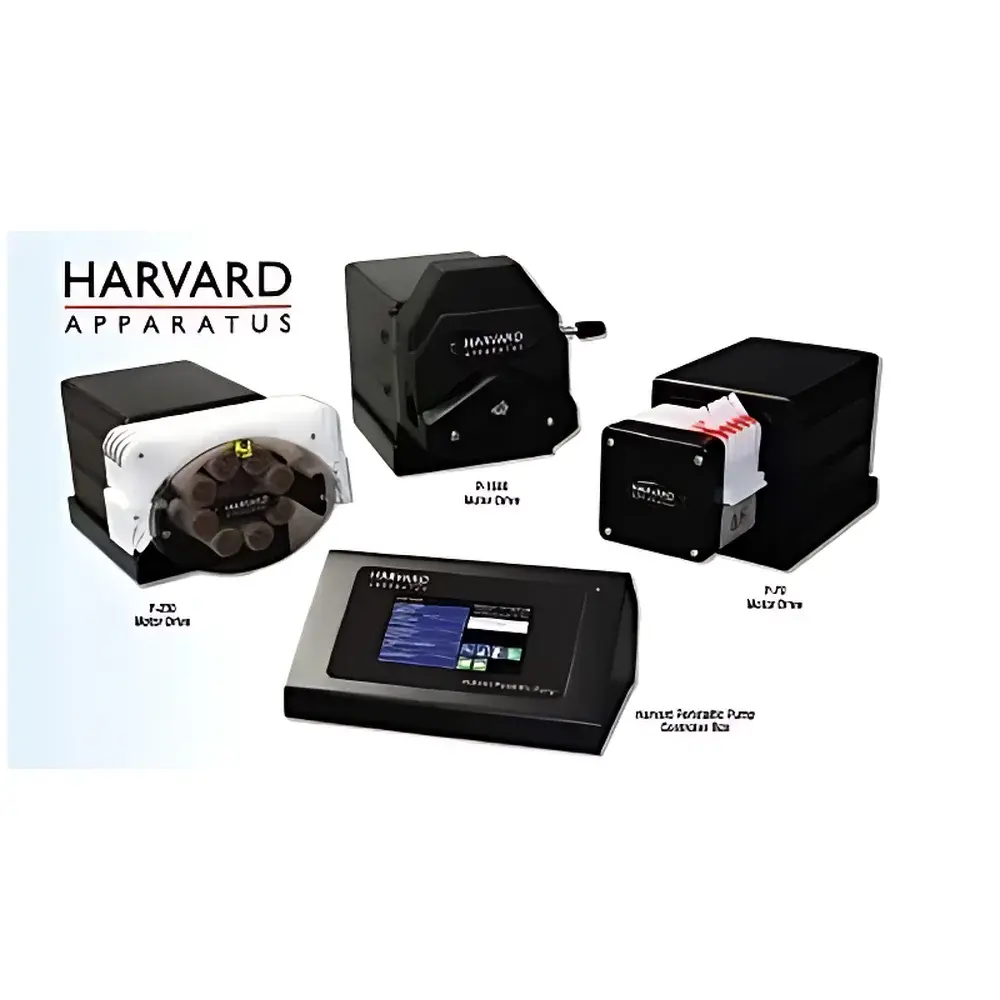
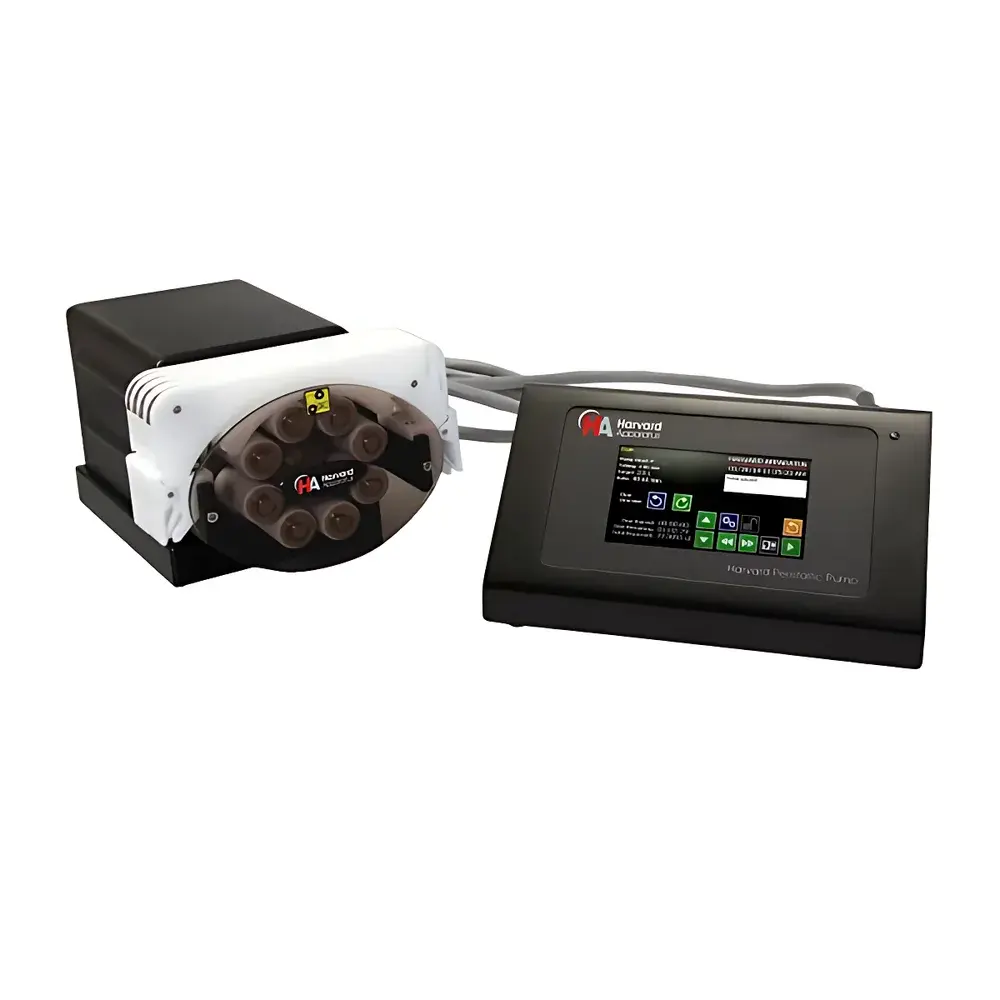
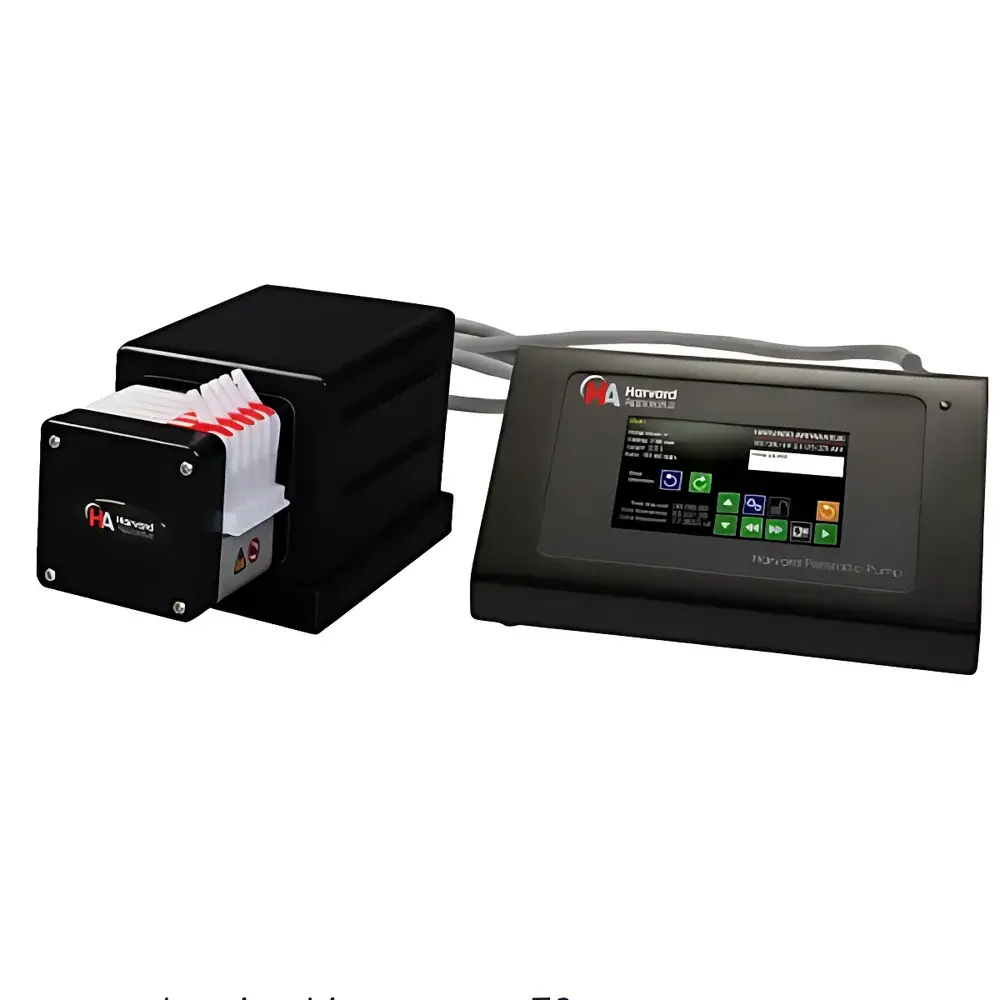
The Harvard Apparatus P1500 Peristaltic Pump is a precision-engineered, modular peristaltic delivery system designed for demanding laboratory, preclinical, and process development applications where accurate, reproducible, and programmable fluid handling is critical. Based on the principle of positive displacement through occlusion—where rollers compress flexible tubing against a curved housing to generate unidirectional flow—the P1500 delivers high-fidelity volumetric control without fluid contact with internal pump mechanisms. Its architecture separates the drive motor from the control unit, minimizing footprint and enabling flexible integration into hoods, biosafety cabinets, or automated workstations. The system supports three interchangeable motor modules (P-70, P-230, P-1500), allowing users to select the optimal torque-speed profile for their specific flow range and tubing configuration—ensuring mechanical stability and long-term repeatability across diverse viscosities and backpressures.
Key Features
- Full-color LCD touchscreen interface with intuitive icon-driven navigation and real-time graphical feedback of flow parameters
- Modular motor design: Interchangeable P-1500 drive module enables flow rates from 0.01 to 1,500 mL/min at up to 235 rpm, with optional P-70/P-230 modules for ultra-low-flow or mid-range applications
- Built-in tubing database supporting over 50 standard peristaltic tubing types (e.g., PharMed BPT, Tygon, Norprene); user-customizable entries for non-standard or proprietary tubing
- Multi-mode programmability: Constant Flow, Linear Ramp (accelerating/decelerating flow), Stepped (discrete flow rate transitions), Pulsatile (cyclic on/off or variable-rate pulses), and Concentration Mode (dosing calibrated in mg/kg or µg/mL based on target mass and compound concentration)
- Comprehensive connectivity suite: USB 2.0 host/device port for PC-based control and firmware updates; RS-485 for daisy-chained multi-pump networks; 15-pin digital I/O for TTL-compatible start/stop, pause/resume, and status signaling; analog voltage input (0–10 V) for external flow rate modulation
- Onboard memory stores up to 100 user-defined protocols with timestamps, parameter sets, and calibration history—enabling traceable operation under GLP or GMP conditions
Sample Compatibility & Compliance
The P1500 accommodates standard peristaltic tubing sizes from 0.1 mm to 6.4 mm inner diameter, including chemically resistant, USP Class VI-certified, and sterile-grade options. Tubing selection directly influences maximum pressure tolerance (up to 3 bar typical), pulsation amplitude, and long-term fatigue life—parameters automatically accounted for during calibration routines. The pump complies with IEC 61000-6-3 (EMC emissions) and IEC 61000-6-2 (immunity) standards. Its software architecture supports 21 CFR Part 11-compliant operation when paired with validated third-party control platforms, including electronic signature capability, audit trail generation, and role-based access control for protocol editing and execution.
Software & Data Management
Harvard Apparatus provides PumpWare™ PC software (Windows-compatible) for advanced protocol development, remote monitoring, and batch data export in CSV or XML format. All pump operations—including mode selection, ramp duration, step intervals, pulse duty cycles, and concentration calculations—are fully scriptable and exportable. Internal logging captures timestamped event records (start/stop, error codes, mode changes, calibration events), facilitating retrospective analysis and regulatory documentation. USB-connected operation allows direct firmware updates and secure backup/restore of configuration files. Optional LabVIEW™ and MATLAB® drivers enable seamless integration into custom automation frameworks.
Applications
The P1500 serves as a core fluid-handling component in pharmacokinetic infusion studies, cell culture media perfusion, chromatography fraction collection, bioreactor feed control, microfluidic priming, and environmental sampling systems. Its programmable pulsatility supports cardiovascular modeling; Concentration Mode enables precise drug dosing in rodent IV infusions calibrated to body weight; Stepped and Ramp profiles facilitate gradient elution in preparative HPLC or controlled reagent addition in synthetic chemistry workflows. The gang-mode capability allows synchronized multi-channel operation for parallelized assays or dual-syringe titration setups.
FAQ
Can the P1500 be operated without a computer?
Yes—the pump functions autonomously using its onboard touchscreen interface and stored protocols.
Does it support calibration with custom tubing not listed in the database?
Yes—users can define inner/outer diameter, wall thickness, and material elasticity parameters to generate accurate flow models.
What safety features prevent tubing failure during extended operation?
Real-time motor current monitoring triggers automatic shutdown if occlusion or tubing slippage is detected; visual and audible alerts precede fault escalation.
Is remote start/stop possible via TTL signal?
Yes—via the 15-pin digital I/O port, with configurable polarity and debounce timing.
How is flow accuracy maintained across varying ambient temperatures?
The pump does not incorporate active temperature compensation; users are advised to perform calibration at operational temperature and document thermal drift characteristics for critical applications.



