
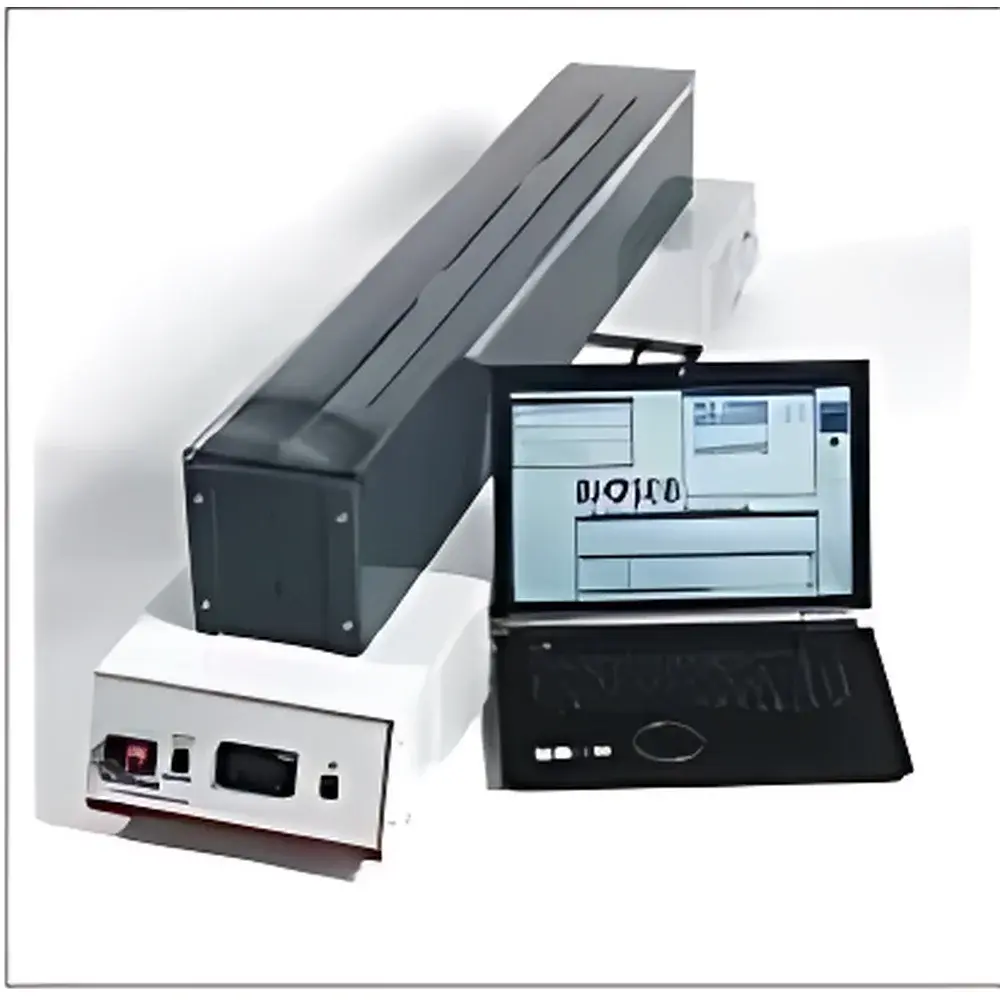
BIO-TGT2 Thermal Gradient Test System for Nociception Assessment
| Origin | Italy |
|---|---|
| Manufacturer Type | Authorized Distributor |
| Origin Category | Imported Instrument |
| Model | BIO-TGT2 |
| Pricing | Upon Request |
Overview
The BIO-TGT2 Thermal Gradient Test System is a precision-engineered, fully automated platform designed for objective, quantitative assessment of thermal nociception and thermosensory preference in rodent models. Developed by Bioseb (France) and manufactured under strict quality control in Italy, the system implements a continuous linear thermal gradient across a 120 cm heated floor, enabling high-resolution behavioral mapping of temperature-dependent avoidance, preference, and threshold responses. Unlike static hot/cold plate assays, the BIO-TGT2 operates on the principle of spontaneous thermotaxis—allowing unrestrained animals to freely explore a spatially varying thermal field while generating temporally resolved, location-synchronized thermal exposure data. This approach aligns with contemporary translational pain research paradigms that emphasize ethologically relevant behavior over reflexive withdrawal endpoints. The system is calibrated for stable operation within ambient laboratory conditions (20–25 °C, 45–55% RH), maintaining thermal uniformity ±1 °C across the entire gradient range (5–55 °C), thereby ensuring reproducible stimulus delivery and minimizing environmental confounding.
Key Features
- Linear thermal gradient generation across a 120 cm PTFE-coated aluminum floor, programmable from 5 °C to 55 °C with ±1 °C spatial and temporal stability
- Simultaneous dual-subject capability: supports concurrent testing of two mice or one rat, each tracked independently via high-resolution video and thermal overlay
- Integrated HD camera system with synchronized timestamped video recording, fully encrypted and GLP-compliant storage
- Real-time acquisition of multi-parameter behavioral metrics: total session duration, dwell time per 0.5 °C bin (up to 20 discrete thermal zones), cumulative locomotor distance, velocity profiles, and zone transition frequency
- Modular software architecture supporting automated calibration routines, user-defined zone segmentation, and export of raw data in CSV and HDF5 formats for downstream statistical analysis (e.g., MATLAB, R, Python)
- Compliance-ready design: audit trail logging, electronic signature support, and full traceability of instrument settings, operator ID, and environmental metadata per test session
Sample Compatibility & Compliance
The BIO-TGT2 is validated for use with adult Sprague-Dawley and Wistar rats (200–350 g) and C57BL/6, BALB/c, and CD-1 mice (18–30 g). Its non-invasive, non-restrictive paradigm eliminates handling stress artifacts commonly associated with tail-flick or paw-withdrawal assays. All hardware and firmware comply with IEC 61000-6-3 (EMC emission standards) and IEC 61010-1 (safety requirements for laboratory equipment). Data management protocols meet FDA 21 CFR Part 11 requirements for electronic records and signatures, including role-based access control, immutable audit logs, and cryptographic hash verification of stored video and thermal datasets. The system is routinely deployed in GLP-certified preclinical contract research organizations (CROs) conducting regulatory submissions under EMA and PMDA guidelines.
Software & Data Management
Bioseb’s proprietary TGT-Soft v4.x provides a validated, installable desktop application for experiment configuration, real-time monitoring, and post-hoc behavioral quantification. The software features an intuitive graphical interface for defining thermal ramp profiles, setting exclusion criteria (e.g., immobility thresholds), and applying motion correction algorithms to compensate for minor camera drift. All acquired data—including synchronized thermal maps, pixel-level animal coordinates, and frame-by-frame temperature interpolation—are stored in a relational SQLite database with automatic backup scheduling. Export modules support ISO/IEC 17025-aligned reporting templates, and raw binary files retain full fidelity for third-party algorithm integration. Software validation documentation (IQ/OQ/PQ reports) and source code traceability matrices are available upon request for GxP-regulated environments.
Applications
- Pharmacological evaluation of centrally and peripherally acting analgesics (e.g., TRPV1 antagonists, Nav1.7 inhibitors, opioid receptor modulators)
- Characterization of thermal hypersensitivity in neuropathic (CCI, SNI), inflammatory (CFA), and chemotherapy-induced (paclitaxel, oxaliplatin) pain models
- Genetic screening of thermosensory phenotypes in transgenic and knockout mouse lines
- Longitudinal assessment of thermal allodynia progression and treatment response with minimal inter-test variability
- Validation of novel biomaterials and drug delivery systems targeting dorsal root ganglia or spinal cord microenvironments
FAQ
What is the minimum and maximum recommended body weight for subjects tested on the BIO-TGT2?
The system is optimized for mice weighing 18–30 g and rats weighing 200–350 g. Testing outside this range may compromise thermal coupling efficiency and tracking accuracy.
Can the thermal gradient slope be customized beyond the default linear profile?
Yes—TGT-Soft supports user-defined non-linear gradients (e.g., exponential, stepwise, or segmented ramps) via script-based configuration using Python-compatible API hooks.
Is video data stored locally only, or does the system support network-attached storage (NAS) or LIMS integration?
Both options are supported: local SSD storage (included) and optional SMB/NFS mount for centralized archiving; LIMS integration is enabled via HL7 and RESTful webhooks for metadata exchange.
Does the system require external calibration certification for GLP audits?
No—the BIO-TGT2 includes an embedded NIST-traceable PT1000 sensor array and auto-calibration routine verified annually against ISO/IEC 17025-accredited reference standards; full calibration certificates are generated per session.
How is animal identity managed during multi-subject sessions?
Each subject is assigned a unique RFID tag (optional accessory) or manually labeled ID at session initiation; software enforces independent trajectory reconstruction and prevents cross-contamination of behavioral metrics.





