
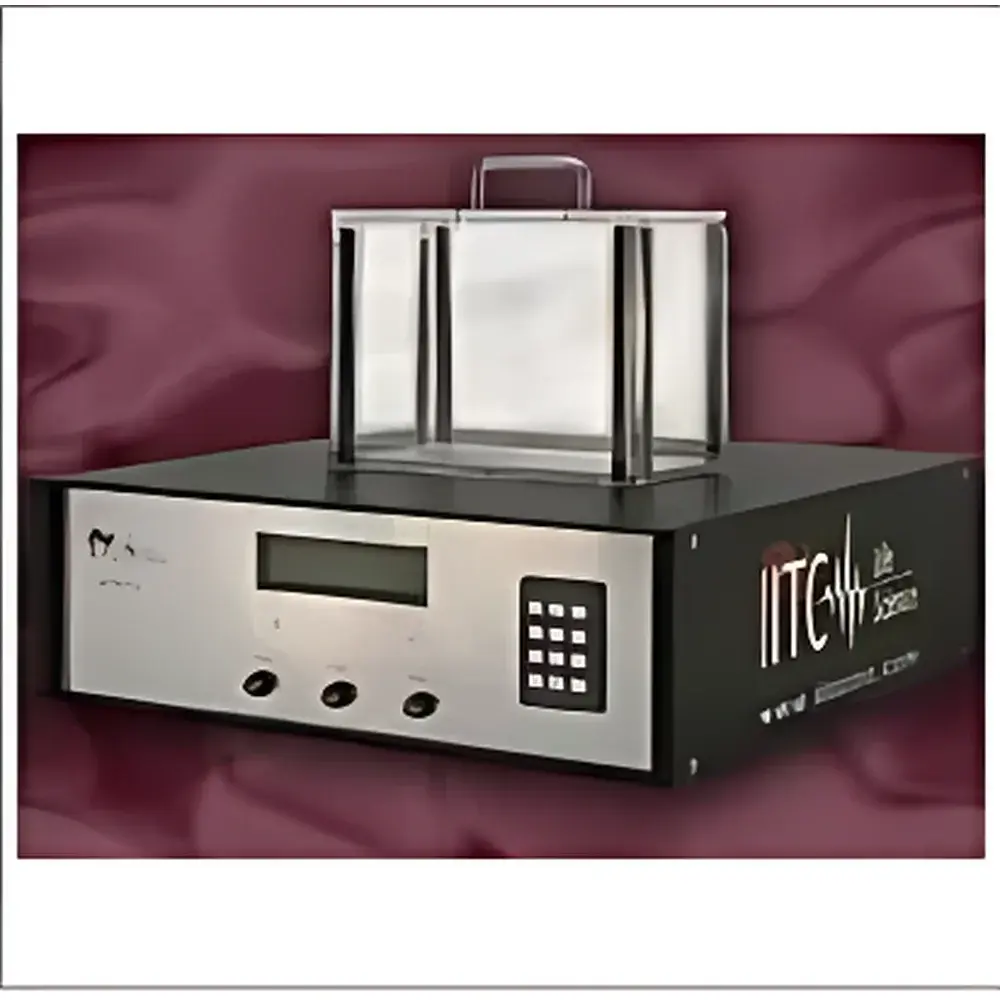
IITC PE34 Cold/Hot Plate Nociception Analyzer
| Brand | IITC |
|---|---|
| Origin | USA |
| Model | PE34 |
| Temperature Range | 0–70 °C |
| Temperature Resolution | 0.1 °C |
| Ramp Rate | 1–10 °C/min |
| Temperature Stability | ±0.1 °C |
| Plate Dimensions | 4" × 8" (10.2 cm × 20.3 cm) |
| Display Resolution | Time to 0.01 s |
| Interface | RS-232 (standard), USB (optional), Footswitch, Printer Output |
| Enclosure | Transparent Animal Restraint Chamber |
| Control | Front-panel Programmable Digital Microprocessor |
| Standby Recovery | Automatic Return to Pre-set Idle Temperature |
Overview
The IITC PE34 Cold/Hot Plate Nociception Analyzer is a microprocessor-controlled, dual-mode thermal stimulation platform engineered for precise, reproducible quantification of thermal nociceptive thresholds in rodents. It operates on the principle of dynamic thermal ramping—applying controlled, linearly increasing or decreasing surface temperatures to the plantar surface of unrestrained or lightly restrained animals, thereby eliciting quantifiable withdrawal responses (e.g., paw lifting, licking, or jumping). Unlike conventional static hot-plate assays limited to suprathreshold fixed-temperature paradigms, the PE34 enables graded, time-resolved assessment of both heat hyperalgesia and cold allodynia—critical endpoints in preclinical analgesic pharmacology. Its design supports validated models referenced in peer-reviewed literature, including resiniferatoxin-induced heat allodynia (British Journal of Pharmacology, 2003; 139:49–58), where subtle shifts in nociceptive threshold temperature reflect compound efficacy with high assay sensitivity.
Key Features
- Dual-range thermal control: Programmable operation from 0 °C to 70 °C with 0.1 °C resolution and ±0.1 °C stability over full range.
- Adjustable ramp rate: Linear heating or cooling at user-defined rates between 1 and 10 °C per minute—enabling protocol customization for acute vs. sensitized states.
- Real-time digital display: Front-panel LCD shows elapsed time (to 0.01 s), current plate temperature, setpoint, ramp direction, and animal ID counter.
- Automated endpoint detection: Integrated footswitch input allows manual response logging; optional software enables automated video-synchronized event tagging.
- Thermal recovery logic: After each trial, the plate automatically returns to a user-defined standby temperature—minimizing inter-animal thermal carryover and ensuring baseline consistency.
- Modular interface suite: Standard RS-232 serial output for data export and instrument control; optional USB adapter for direct PC integration; parallel printer port for hard-copy session logs.
Sample Compatibility & Compliance
The PE34 accommodates mice (18–35 g) and rats (150–300 g) using a transparent polycarbonate restraint chamber (4″ × 8″ footprint), permitting unobstructed behavioral observation and minimizing stress-related confounds. The system meets core requirements for GLP-compliant preclinical pain studies: traceable temperature calibration (NIST-traceable thermistor), audit-ready parameter logging (date/time stamp, operator ID, animal number, start/stop temps, latency), and deterministic stimulus delivery. While not FDA-cleared as a medical device, its operational parameters align with ASTM F2796 (Standard Guide for Preclinical Evaluation of Analgesics) and ISO 10993-1 (biocompatibility of contact surfaces). All thermal protocols adhere to NIH and AAALAC International guidelines for humane endpoints and thermal stimulus limits.
Software & Data Management
The PE34 supports both standalone operation and computer-assisted acquisition. With optional USB interface and dedicated acquisition software, users can configure multi-step thermal protocols (e.g., preconditioning hold → ramp → plateau → cooldown), export timestamped CSV files containing temperature vs. time series and response latencies, and generate batch reports compliant with 21 CFR Part 11 requirements—including electronic signatures, audit trails, and user-access controls. Raw thermal data are stored with metadata (operator, date, ambient conditions), enabling retrospective analysis of thermal drift or inter-session variability. Exported datasets integrate seamlessly with statistical platforms (GraphPad Prism, R, Python pandas) for dose–response curve fitting and ANOVA-based group comparisons.
Applications
- Pharmacodynamic profiling of opioid and non-opioid analgesics (e.g., NSAIDs, TRPV1 antagonists, sodium channel blockers).
- Characterization of neuropathic pain models: CCI, SNI, STZ-induced diabetic neuropathy, and chemotherapy-induced peripheral neuropathy (CIPN).
- Evaluation of cold allodynia in inflammatory (CFA) and autoimmune (EAE) models via sub-zero ramping capability.
- Validation of genetic knockouts or transgenic lines exhibiting altered thermal sensitivity (e.g., TRPM8⁻/⁻, TRPA1⁻/⁻).
- Quality control of compound batches in contract research organizations (CROs) conducting IND-enabling toxicology and efficacy studies.
FAQ
Can the PE34 be used for both heat and cold allodynia testing?
Yes—the instrument supports continuous ramping across the full 0–70 °C range, enabling bidirectional thermal challenge protocols validated for both heat hyperalgesia and cold allodynia assessment.
Is calibration traceable to national standards?
The integrated thermistor sensor is factory-calibrated against NIST-traceable reference standards; users may perform field verification using certified PT100 probes.
Does the system support automated response detection?
The base unit requires manual footswitch activation; however, optional video-tracking add-ons (e.g., EthoVision XT integration) enable algorithmic paw-lift detection synchronized with thermal data streams.
What safety features prevent tissue damage during testing?
Hardware-enforced upper/lower temperature limits, maximum exposure duration cutoffs, and mandatory operator confirmation for >55 °C or <5 °C protocols ensure compliance with institutional animal care committee (IACUC) thermal safety thresholds.
Is the enclosure compatible with standard vivarium caging systems?
The transparent restraint chamber is designed for benchtop use and integrates with common rodent handling workflows; dimensions allow placement inside laminar flow hoods or fume cabinets for odor-sensitive assays.






