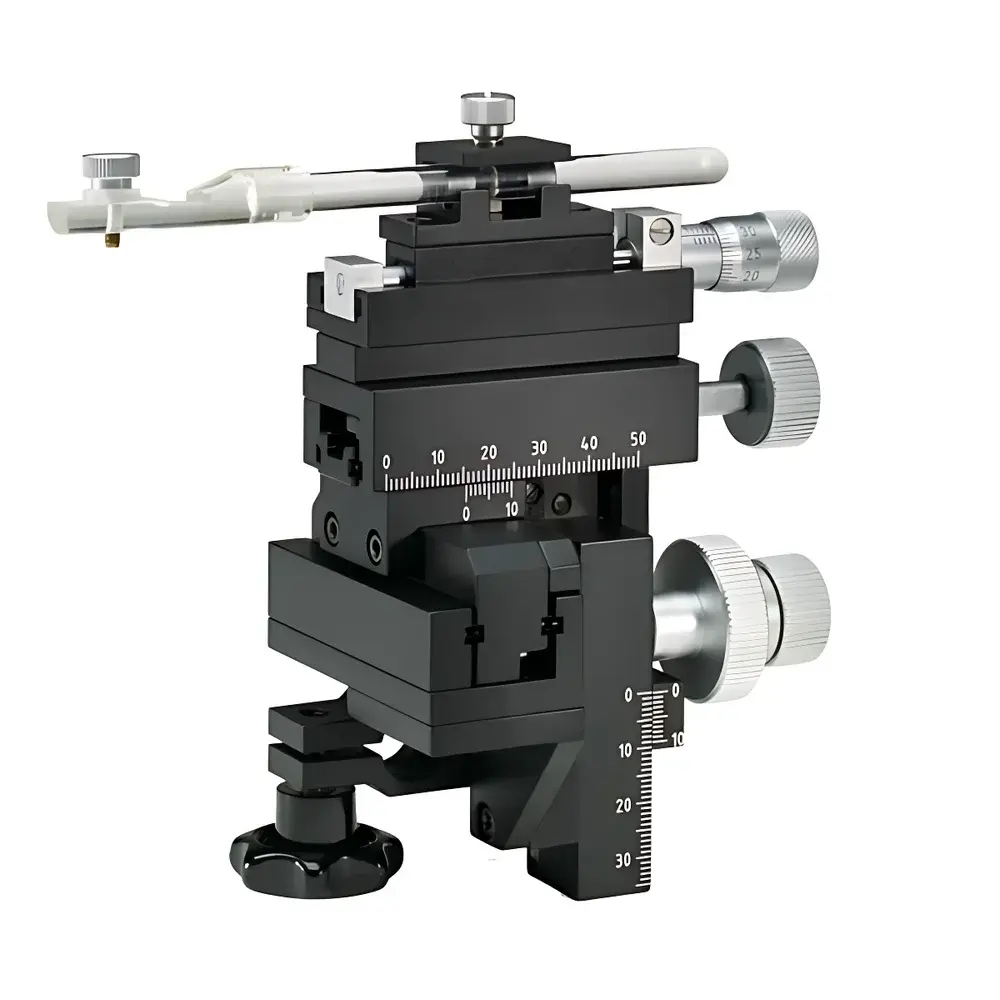
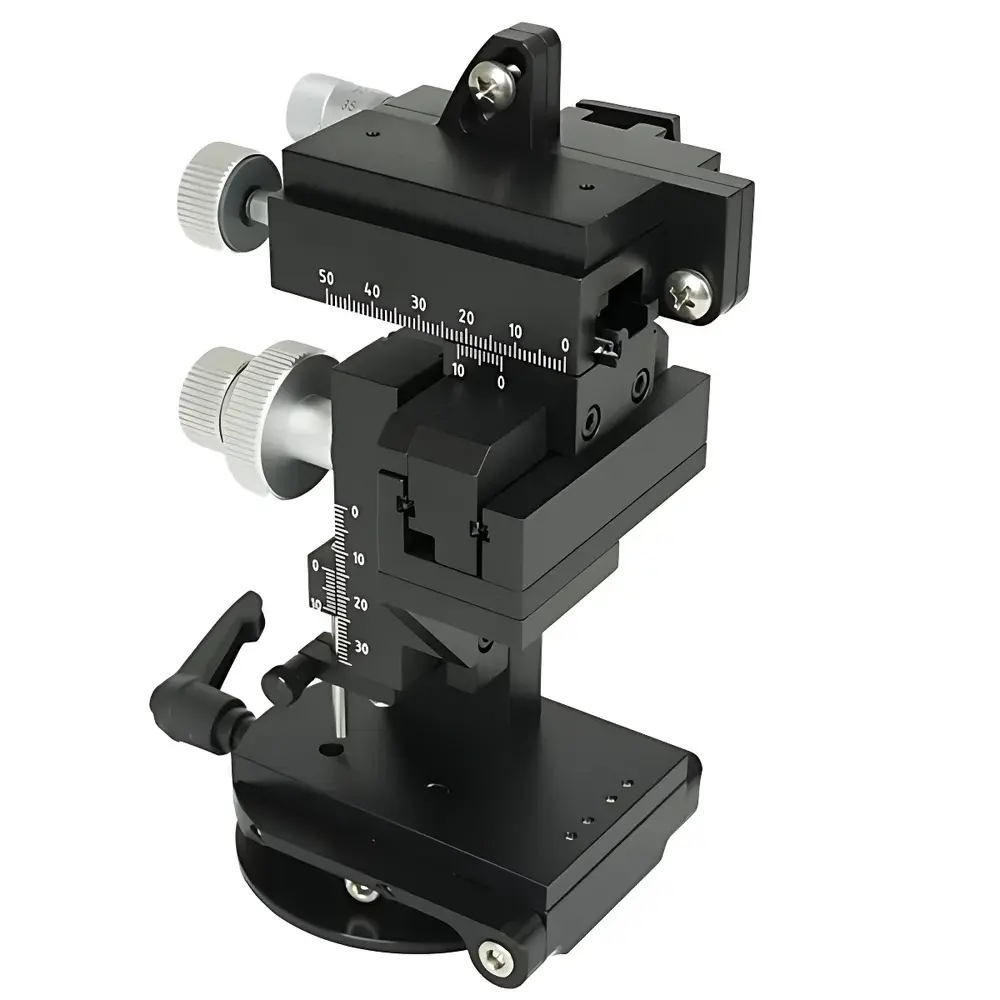
Sutter MM-33 Manual Micromanipulator
| Brand | Sutter |
|---|---|
| Origin | USA |
| Model | MM-33 |
| Control Type | Manual |
| Coarse Adjustment Range (X/Y/Z) | 37 mm / 20 mm / 20 mm |
| Coarse Resolution | 0.1 mm per axis |
| Fine Adjustment Range (X) | 10 mm |
| Fine Resolution | 0.01 mm |
| Rotational Base | Lockable, Dual-Axis (Horizontal & Vertical) |
| Mounting Compatibility | Magnetic base, standard dovetail or clamp-style stage adapters |
| Intended Use | Electrophysiology, patch-clamp, microinjection, and extracellular stimulation |
Overview
The Sutter MM-33 Manual Micromanipulator is a precision-engineered mechanical positioning system designed for stable, repeatable, and intuitive manipulation of micropipettes, electrodes, and other fine probes in electrophysiological and neurophysiological applications. Built upon Sutter Instrument’s legacy of reliability in life science instrumentation, the MM-33 operates on a dual-stage mechanical principle: coarse positioning via calibrated rack-and-pinion translation stages, followed by high-resolution fine adjustment using a precision micrometer-driven mechanism. Unlike motorized or hydraulic alternatives, the MM-33 delivers direct tactile feedback and zero electronic latency—critical for real-time coordination during patch-clamp recordings, focal drug application, or intracellular microinjection. Its rigid aluminum alloy frame, low-profile design, and vibration-damped construction minimize thermal drift and mechanical creep, ensuring positional stability over extended recording sessions. The device is not intended for automated or programmable operation but excels in settings where manual dexterity, ergonomic control, and cost-effective setup are prioritized—particularly in teaching laboratories, core electrophysiology facilities, and early-stage research environments.
Key Features
- Dual-range mechanical actuation: Independent coarse and fine motion controls for X, Y, and Z axes—enabling rapid repositioning followed by sub-10 µm final placement.
- Precision micrometer fine adjustment on the X-axis with 0.01 mm resolution (10 µm per division), optimized for precise electrode advancement during seal formation or drug ejection.
- Coarse travel ranges of 37 mm (X), 20 mm (Y), and 20 mm (Z), accommodating diverse microscope stage configurations and multi-electrode setups.
- Lockable dual-axis rotational base allowing ±90° horizontal (azimuthal) and ±45° vertical (elevation) orientation adjustments—essential for aligning pipettes relative to cell morphology or tissue planes.
- Standardized mounting interface compatible with Sutter magnetic bases (e.g., MB-1), dovetail rails, and universal clamping systems for integration onto upright, inverted, or fixed-stage microscopes.
- No power supply or software dependency—reducing electromagnetic interference (EMI) and simplifying compliance with GLP/GMP lab infrastructure requirements.
Sample Compatibility & Compliance
The MM-33 supports glass micropipettes (1.0–1.5 mm OD), metal electrodes (e.g., tungsten or platinum-iridium), and custom-fabricated probes mounted via standard 3/8″-24 threaded adapters. It is routinely deployed in ISO 13485-aligned electrophysiology labs and complies with general electrical safety standards (IEC 61010-1) for laboratory equipment. While not certified for clinical diagnostic use under FDA 21 CFR Part 860 or IVDR, its mechanical design conforms to ASTM E2919-21 guidelines for manual micromanipulation devices used in preclinical neuropharmacology studies. All adjustment mechanisms undergo factory calibration verification; users are advised to perform periodic mechanical zero-checks per institutional SOPs.
Software & Data Management
The MM-33 operates independently of software control and does not generate digital data streams. As a purely mechanical instrument, it requires no drivers, firmware updates, or cybersecurity protocols. This architecture inherently satisfies audit-trail simplicity requirements under GLP and GMP frameworks—no electronic records, no 21 CFR Part 11 validation burden. Integration with acquisition systems (e.g., Axon pCLAMP, HEKA PatchMaster) is achieved solely through physical probe coordination; position metadata must be manually annotated in experiment logs or synchronized via external trigger signals from auxiliary hardware.
Applications
- Patch-clamp electrophysiology: Positioning patch pipettes for whole-cell, cell-attached, or perforated configurations; coordinating left-hand drug application via multi-barrel pipettes.
- Extracellular field potential recording: Precise placement of stimulating and recording electrodes in brain slice or cultured neuron preparations.
- Intracellular dye injection and neuroanatomical tracing: Controlled advancement of sharp electrodes into neuronal somata with minimal membrane damage.
- Developmental biology: Targeted microinjection of morpholinos, CRISPR components, or fluorescent tracers into zebrafish or Xenopus embryos.
- Teaching laboratories: Low-cost, robust platform for training students in fundamental micromanipulation techniques without software abstraction layers.
FAQ
Is the MM-33 compatible with inverted microscopes?
Yes—the compact footprint and adjustable base orientation allow secure mounting on most inverted microscope stages using optional dovetail adapters or magnetic bases.
Can the MM-33 be used for simultaneous dual-pipette recordings?
It supports single-pipette operation per unit; dual-pipette configurations require two MM-33 units or integration with a multi-axis manipulator such as the Sutter MP-285.
Does Sutter provide calibration documentation for the MM-33?
Each unit ships with a factory verification sheet confirming mechanical travel range and resolution tolerances; NIST-traceable recalibration services are available through authorized Sutter service centers.
What maintenance is required?
Periodic cleaning of micrometer threads with isopropyl alcohol and light lubrication with silicone-free instrument grease every 6–12 months—per Sutter Technical Bulletin TB-MM-002.
Is the rotation base compatible with third-party rotation encoders?
The base includes tapped 4-40 mounting holes for aftermarket encoder brackets, though Sutter does not validate or support integration with non-Sutter electronic add-ons.