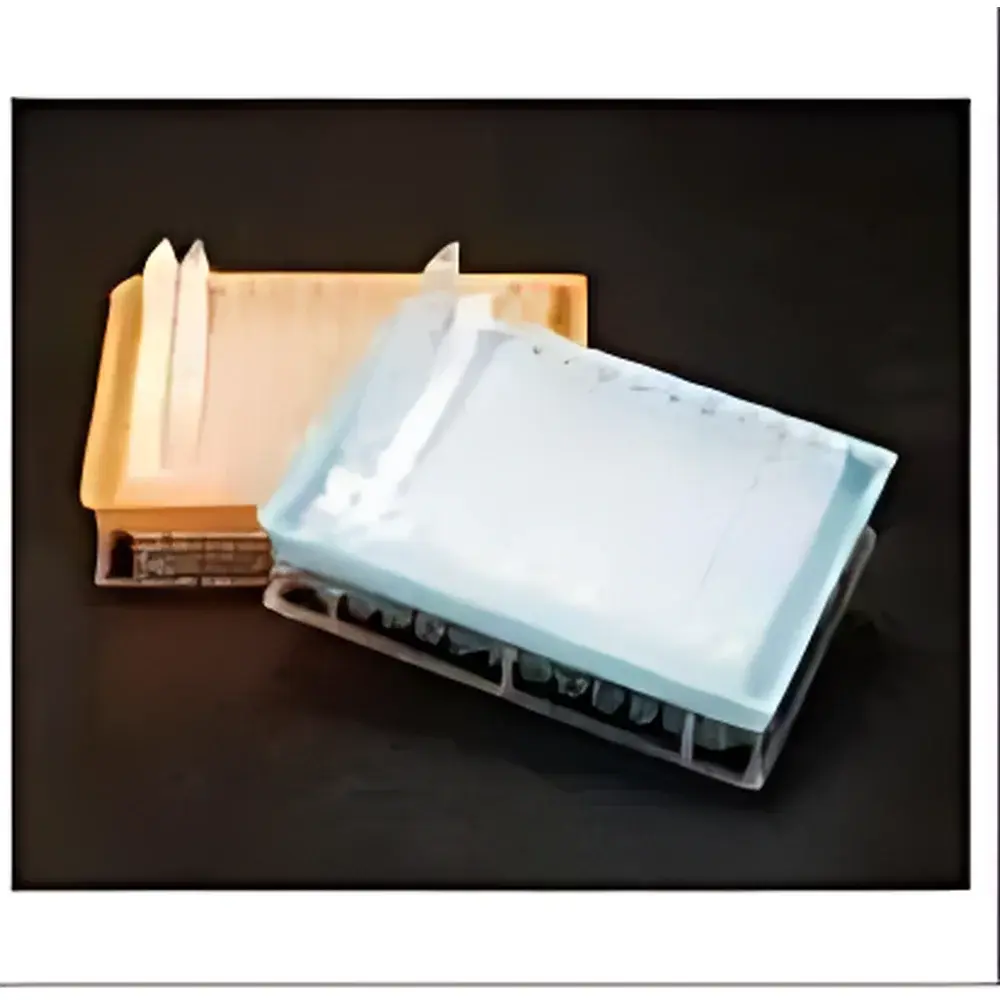
96-well Equilibrium DIALYZERTM by Harvard Apparatus
| Origin | USA |
|---|---|
| Manufacturer Type | Authorized Distributor |
| Import Status | Imported |
| Model | 96-well Equilibrium DIALYZERTM |
| Pricing | Upon Request |
Overview
The 96-well Equilibrium DIALYZERTM is a high-throughput, single-use microplate-based dialysis system engineered for rapid, parallel equilibrium dialysis studies in drug discovery and pharmacokinetic profiling. Unlike conventional stirred or static dialysis methods, this device operates on the principle of passive diffusion across semi-permeable membranes under thermodynamic equilibrium conditions—enabling accurate measurement of unbound (free) drug fraction (fu) in plasma, serum, or other biological matrices. Its 96-well format supports systematic evaluation of compound binding across diverse protein concentrations, pH gradients, or matrix formulations—critical for early-stage ADME (Absorption, Distribution, Metabolism, Excretion) assessment. The system requires no specialized instrumentation beyond standard orbital shakers and incubators, making it compatible with existing laboratory automation workflows and GLP-compliant assay environments.
Key Features
- High-throughput 96-well plate format enables simultaneous equilibrium dialysis of up to 96 samples per run—reducing inter-assay variability and accelerating data generation.
- Prefitted regenerated cellulose dialysis membranes (typically 10–12 kDa MWCO) are pre-assembled into each well, eliminating membrane handling, hydration, and mounting steps that introduce user error and contamination risk.
- Optimized well geometry ensures consistent sample-to-buffer volume ratio and uniform membrane exposure surface area—critical for reproducible mass transfer kinetics and equilibrium attainment within standard incubation periods (typically 4–24 h at 37 °C).
- Each well accommodates 50–200 µL sample volume, supporting low-volume bioanalytical workflows compatible with LC-MS/MS quantification without dilution or reconstitution.
- Plate is constructed from medical-grade polystyrene with UV-transparent lid options—facilitating real-time monitoring of buffer evaporation and enabling optional spectrophotometric verification of membrane integrity.
- Designed for compatibility with standard microplate handlers, centrifuges (up to 3,000 × g), and liquid handlers—supporting integration into automated screening platforms compliant with ISO/IEC 17025 and FDA 21 CFR Part 11 requirements when paired with validated software.
Sample Compatibility & Compliance
The 96-well Equilibrium DIALYZERTM is validated for use with human and animal plasma, serum, cerebrospinal fluid (CSF), and tissue homogenates. It maintains performance across physiologically relevant pH ranges (6.5–8.5) and temperatures (4 °C to 37 °C). Membrane integrity and non-specific binding characteristics have been assessed per ASTM E2987-21 guidelines for in vitro binding assay systems. The device meets ISO 13485 manufacturing controls for in vitro diagnostic ancillary devices and is supplied with CoA (Certificate of Analysis) and biocompatibility documentation per ISO 10993-5. All components are sterile-filtered and certified endotoxin-free (<0.5 EU/mL), suitable for assays requiring low background interference.
Software & Data Management
While the DIALYZERTM itself is hardware-only, its output integrates seamlessly with industry-standard bioanalysis software including Watson LIMS, Thermo Fisher Chromeleon, and Sciex MultiQuant. When used with calibrated LC-MS/MS or HPLC-UV systems, raw concentration data can be imported directly for free fraction calculation (fu = [unbound]/[total]) using built-in templates aligned with USP Analytical Instrument Qualification protocols. Audit trails, electronic signatures, and version-controlled method files are supported when deployed within validated LIMS or ELN environments adhering to 21 CFR Part 11 Annex 11 requirements.
Applications
- Determination of plasma protein binding (PPB) for small-molecule drug candidates during lead optimization.
- Comparative fu assessment across species (human, rat, dog, monkey) to inform interspecies scaling and PK/PD modeling.
- Evaluation of binding displacement interactions in combination therapy screening (e.g., co-incubation with warfarin or ibuprofen as probe competitors).
- Stability assessment of labile compounds under dialysis conditions—leveraging short incubation times and minimal shear stress.
- Supporting regulatory submissions to FDA, EMA, and PMDA where equilibrium dialysis remains the reference method for unbound drug quantification per ICH M3(R2) and S6(R1) guidance documents.
FAQ
What is the typical equilibration time required for reliable fu determination?
Equilibration time depends on compound diffusivity, temperature, and membrane thickness—but most small molecules reach ≥95% equilibrium within 4–6 h at 37 °C; full 24-h incubations are recommended for highly protein-bound or large-molecular-weight compounds.
Can the plate be reused after a single run?
No. The 96-well Equilibrium DIALYZERTM is designed as a single-use, disposable device to prevent carryover, membrane fouling, and inter-well cross-contamination—consistent with CLSI EP25-A validation principles for binding assays.
Is the membrane compatible with organic solvents such as DMSO or acetonitrile?
The regenerated cellulose membrane tolerates ≤5% v/v DMSO in aqueous buffers; higher concentrations may compromise membrane integrity and require empirical validation per ASTM D570-20.
How is buffer depletion addressed during extended incubations?
The sealed lid design minimizes evaporation; however, for >12-h runs, inclusion of humidified chambers or mineral oil overlay is recommended to maintain volume integrity—validated per USP Microplate-Based Assay Performance.