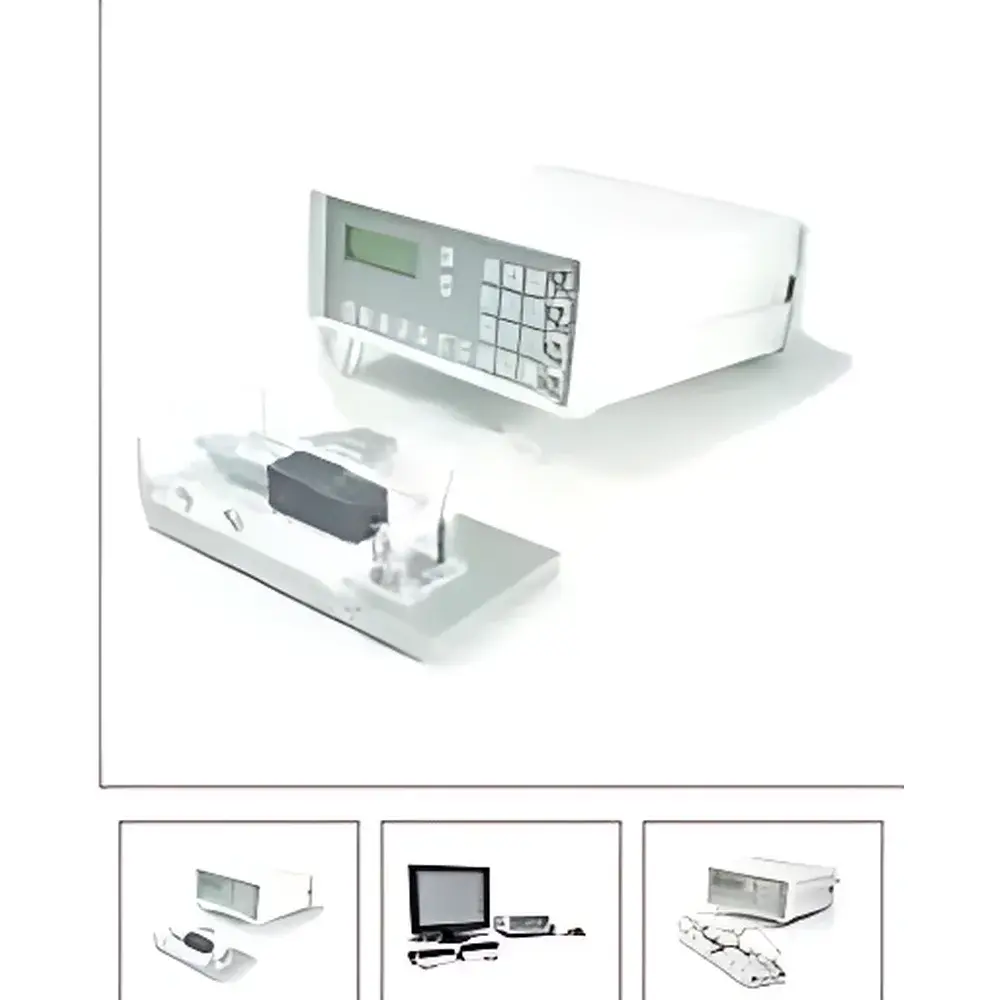
DMT Multi-Channel Microvascular Myograph Systems 310A / 410A / 510A
| Origin | USA |
|---|---|
| Manufacturer Type | Authorized Distributor |
| Origin Category | Imported |
| Model | 310A / 410A / 510A |
| Pricing | Upon Request |
Overview
The DMT Multi-Channel Microvascular Myograph Systems (Models 310A, 410A, and 510A) are precision-engineered platforms for quantitative assessment of vascular smooth muscle contractility and endothelial function in isolated microvessels. Based on the wire myography principle—where vessel segments are mounted between two parallel stainless-steel wires under controlled isometric tension—the systems enable high-fidelity measurement of active and passive mechanical responses to pharmacological, electrical, or physiological stimuli. Designed for ex vivo studies of resistance arteries and arterioles (60 µm to 3 mm internal diameter), these instruments support physiologically relevant experimental conditions: vessels remain viable for ≥12 hours in temperature- and pH-controlled acid-resistant stainless-steel organ baths perfused with oxygenated physiological salt solution (e.g., Krebs-Henseleit buffer). The 310A serves as a single-channel configuration ideal for method development and standardized vessel characterization; the 410A and 510A extend throughput via dual independent measurement channels—enabling paired experimental designs (e.g., control vs. treated, wild-type vs. knockout) while maintaining full parameter independence per channel.
Key Features
- Stainless-steel wire-based mounting architecture with calibrated force transduction (full-scale range compatible with 0.1–20 mN forces typical of microvessels)
- Adjustable stainless-steel clamp-style vessel holders with micrometer-driven positioning for precise lumen diameter normalization
- Acid-resistant 316 stainless-steel organ baths equipped with integrated temperature control (±0.1 °C), gas inlet ports (95% O₂/5% CO₂), and pH monitoring interfaces
- Modular bath design: 410A and 510A feature physically partitioned dual-chamber baths with optically transparent sapphire or quartz bottom windows for concurrent brightfield/fluorescence imaging
- Vessel standardization module compliant with established protocols (e.g., Mulvany-Halpern normalization) to compute optimal pre-tension based on passive diameter–tension relationships
- Electrophysiology-ready interface: dedicated ports for intracellular microelectrode insertion to simultaneously record membrane potential during tension measurement
- Model-specific actuation: 410A employs manual micromanipulators; 510A integrates motorized, software-synchronized micropositioners with sub-micron resolution for automated pre-tension ramping and stepwise length adjustments
Sample Compatibility & Compliance
The systems accommodate native or enzymatically isolated arterial and venous microvessels—including mesenteric, cerebral, coronary, renal, and pulmonary resistance vessels—from human surgical specimens, rodent models (mouse, rat, guinea pig), and larger mammals (porcine, canine). Vessel viability is maintained through continuous superfusion with oxygenated, ion-balanced solutions regulated to 37 °C and pH 7.4. All hardware components meet ISO 13485:2016 requirements for medical device manufacturing environments. Data acquisition workflows align with GLP-compliant documentation practices, and optional audit-trail-enabled software modules support 21 CFR Part 11 compliance for regulated preclinical studies. Bath materials comply with ASTM F899 for corrosion resistance in biological saline environments.
Software & Data Management
Control and analysis are performed via DMT’s proprietary MyoView™ software suite (v6.x), validated for Windows 10/11 (64-bit). The platform supports real-time acquisition at up to 1 kHz sampling rate, synchronized multi-parameter logging (tension, temperature, pH, gas concentration), and time-stamped event annotation. Built-in analysis tools include dose–response curve fitting (log[agonist] vs. % maximal response), Emax/EC50 calculation using nonlinear regression (four-parameter logistic model), and passive mechanical parameter derivation (elastic modulus, incremental stiffness). Raw data export is available in CSV, HDF5, and MATLAB-compatible formats. Software validation documentation (IQ/OQ/PQ summaries) and electronic signature capability are provided for GxP-regulated laboratories.
Applications
- Characterization of vasoactive drug mechanisms (e.g., calcium channel blockers, Rho-kinase inhibitors, NO donors)
- Endothelial-dependent and -independent vasoreactivity profiling in hypertension, diabetes, and atherosclerosis models
- Functional phenotyping of genetically modified vessels (e.g., eNOS⁻/⁻, TRPV4-KO)
- Assessment of vascular remodeling following chronic exposure to shear stress or inflammatory cytokines
- Correlative functional–structural studies via simultaneous tension recording and confocal/epifluorescence imaging of Ca²⁺ dynamics, ROS production, or endothelial junction integrity
- Preclinical safety pharmacology evaluation per ICH S7B and regulatory guidance on vascular reactivity
FAQ
What vessel size ranges are supported?
Vessels with internal diameters from 60 µm to 3 mm can be reliably mounted and normalized across all models.
Can the system integrate with third-party imaging platforms?
Yes—bath bottom windows (standard 25 mm diameter, 0.17 mm thickness) are optimized for high-NA objectives and compatible with inverted microscopes from Nikon, Zeiss, and Olympus.
Is calibration traceable to NIST standards?
Force transducers are factory-calibrated using NIST-traceable deadweight standards; users receive calibration certificates with uncertainty budgets.
Does the 510A support programmable tension protocols?
Yes—the motorized positioners enable user-defined tension ramps, oscillatory loading profiles, and automated normalization sequences via scriptable protocol editor.
Are replacement parts and service available globally?
DMT-certified field service engineers and authorized distributors provide preventive maintenance, transducer recalibration, and bath refurbishment under extended warranty and service contracts.