
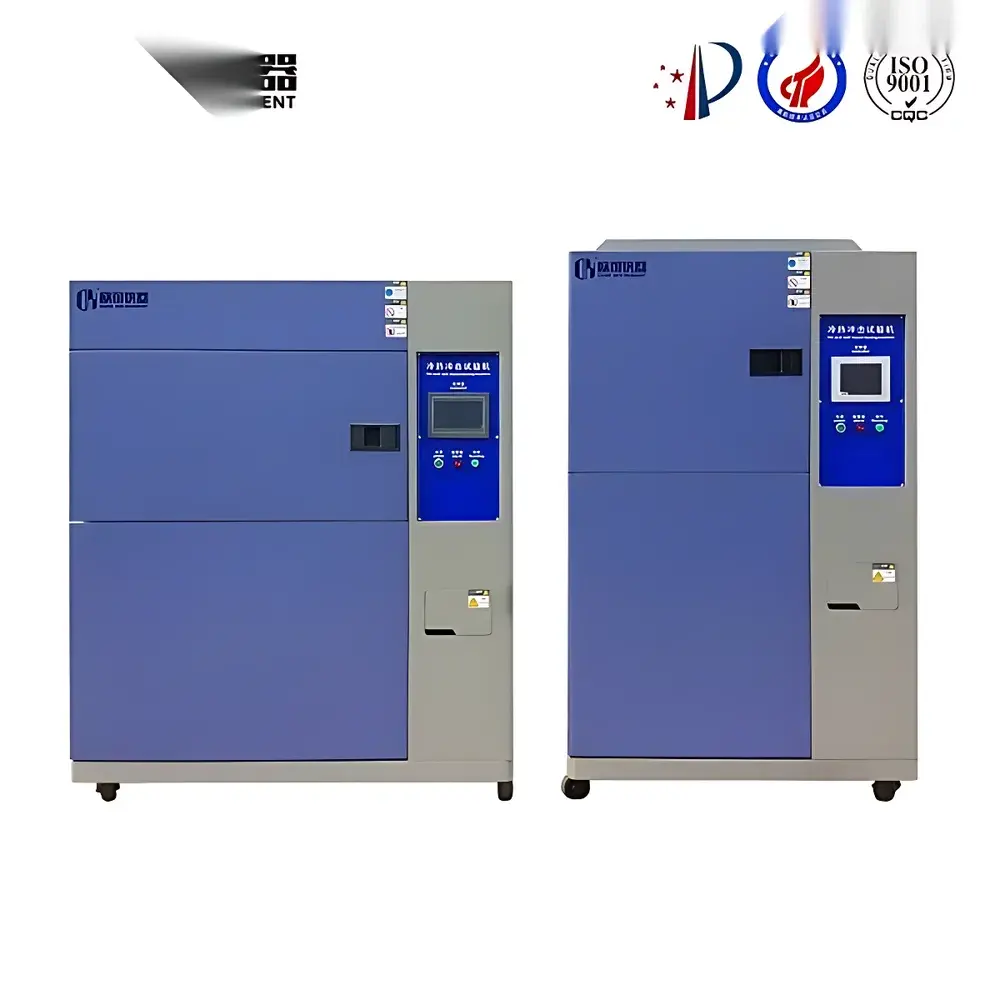
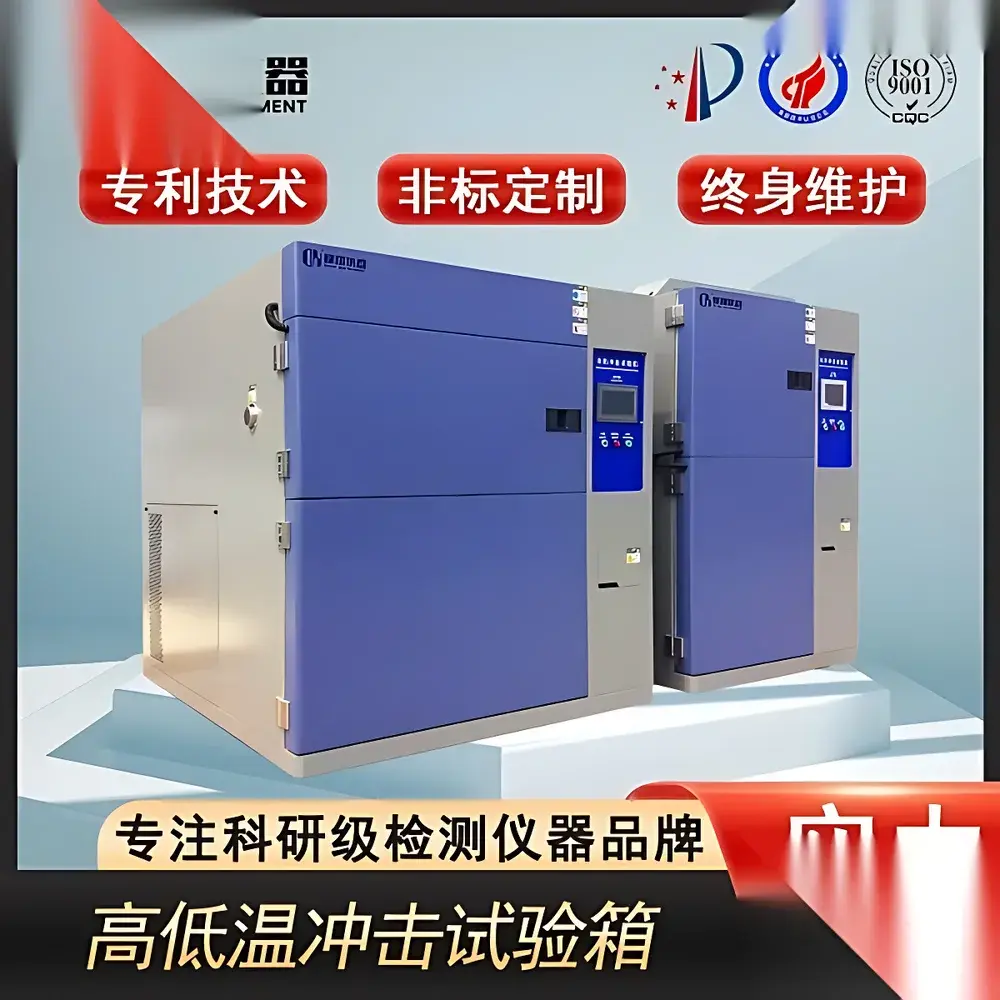
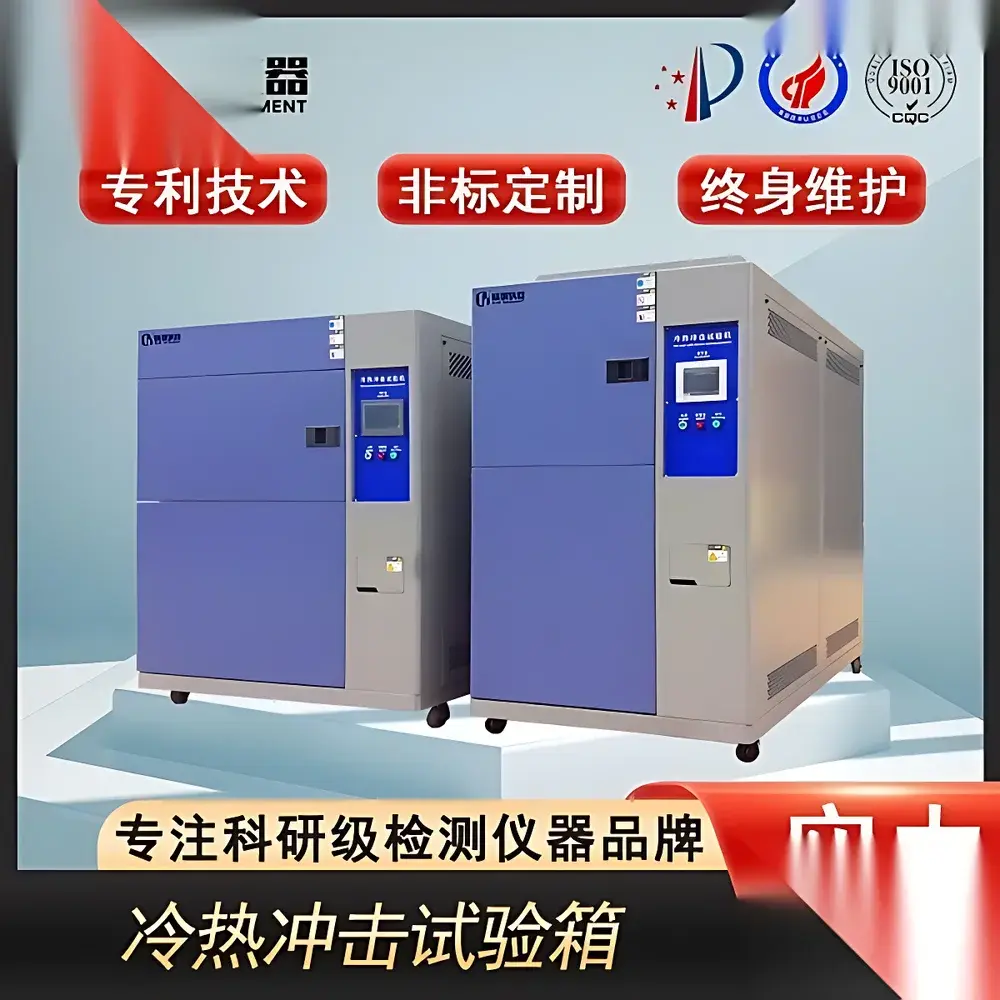
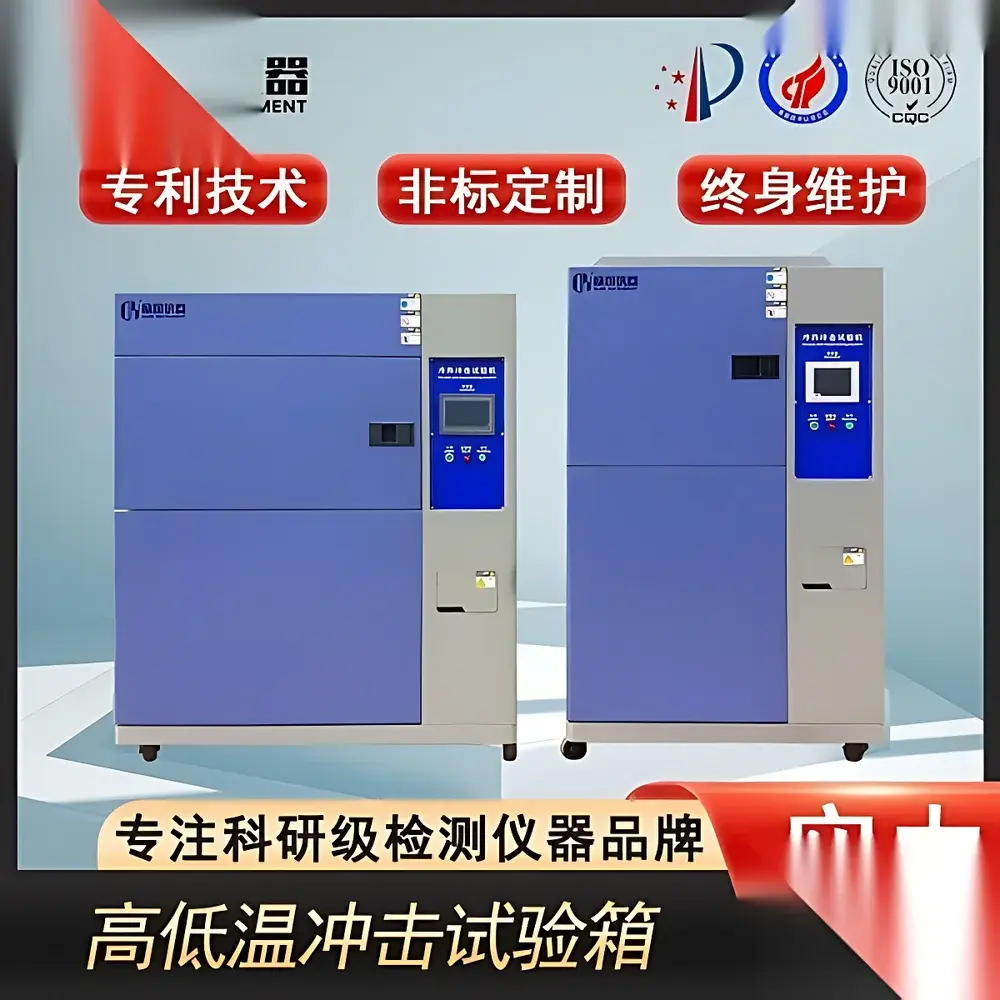
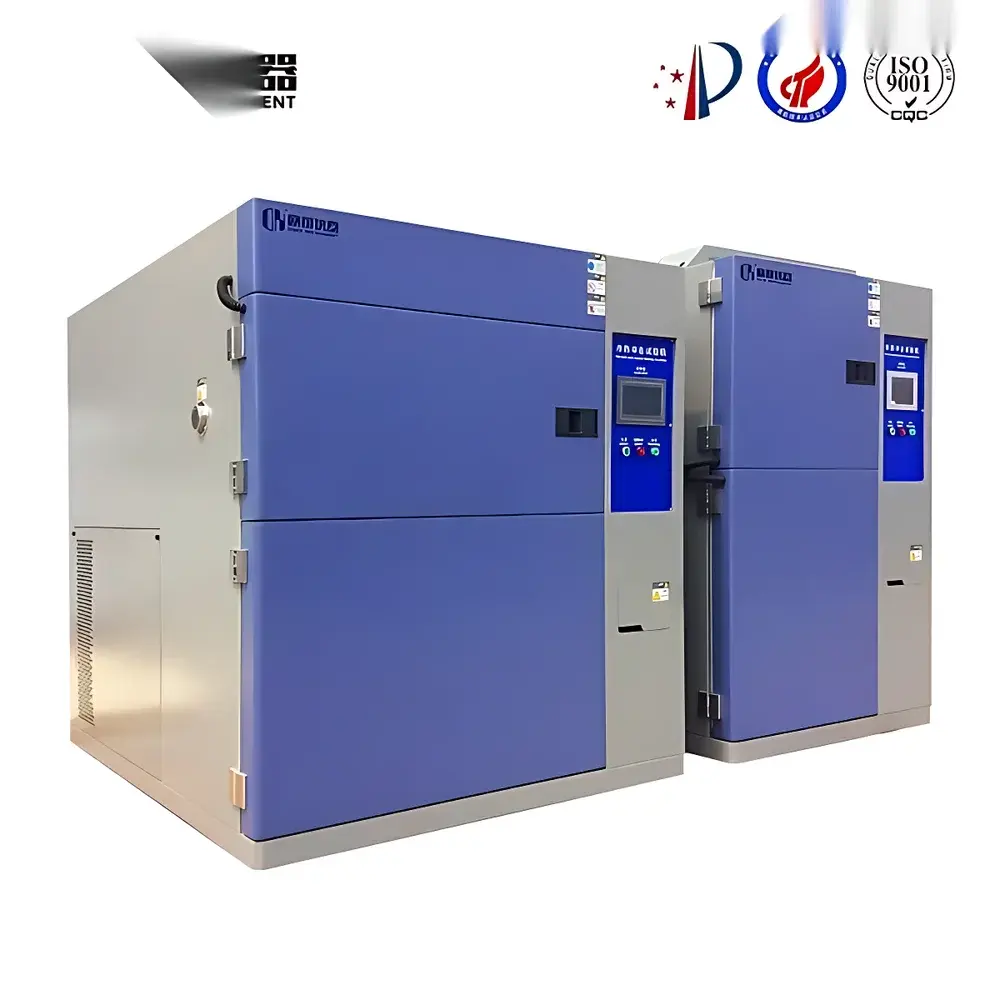
Thermal Shock Test Chamber – Three-Zone Advanced Rapid Temperature Transition System
| Brand | OEM / Custom Brand |
|---|---|
| Origin | Imported |
| Manufacturer Type | Authorized Distributor |
| Price | USD 11,200 (FOB) |
| Temperature Range | −70°C to +180°C |
| Thermal Transition Time (50°C to −50°C or vice versa) | ≤5 min |
| Cycle Count Setting Range | 1–999 cycles |
| Soak Time per Zone | 0–999 h 59 min |
| Test Port | Ø50 mm on left side |
| Control Interface | 7″ Full-Color TFT LCD Touchscreen Controller (English/Chinese) |
| Compliance | ASTM D5229, IEC 60068-2-14, MIL-STD-810H Method 503.5, JIS Z 8707 |
Overview
The Thermal Shock Test Chamber – Three-Zone Advanced Rapid Temperature Transition System is an engineered environmental test solution designed to evaluate material and component reliability under extreme, rapid thermal cycling conditions. Based on the principle of *dual- or triple-zone thermal storage and pneumatic air-path switching*, this chamber separates high-temperature (up to +180°C), low-temperature (down to −70°C), and test zones to eliminate mechanical movement of specimens—ensuring zero vibration-induced artifacts during qualification testing. Unlike single-chamber ramp-based systems, its thermally isolated chambers maintain stable soak temperatures while enabling sub-5-minute transitions between extremes via precisely actuated damper-controlled airflow routing. This architecture delivers high reproducibility in thermal shock profiles required for aerospace electronics, automotive ECUs, PCB assemblies, and medical device packaging validation.
Key Features
- Triple-zone configuration (hot zone, cold zone, test zone) with independent PID-controlled heating and refrigeration circuits
- Pneumatically actuated damper system (Parker Hannifin or equivalent) for <5-second air-path switching and ≤5-minute temperature recovery
- High-efficiency dual-stage cascade refrigeration using R507/R23 (zero ozone depletion potential, HFC-based)
- Stainless steel 304 interior (1.0 mm thickness) and insulated construction: high-temp zone with 24k glass wool; low-temp zone with polyurethane rigid foam + glass wool
- Two independent centrifugal circulation fans with stainless steel extended shafts and SIROCCO impellers for uniform airflow and ±0.5°C temperature uniformity (ASTM E145 Class A)
- Intelligent BTC (Balance Temperature Control) algorithm dynamically matches heating output to thermal load, reducing energy consumption by ~30% versus ON/OFF control
- Integrated safety suite: over-temperature cutoff, compressor high-pressure/low-pressure shutdown, phase failure detection, ground fault interruption, and emergency power-off circuit
- Configurable defrost cycle (automatic or manual), programmable cycle count, and soak time per thermal phase
Sample Compatibility & Compliance
This chamber accommodates standard industrial test specimens up to 500 × 500 × 500 mm (W×D×H) with optional custom internal dimensions. The Ø50 mm left-side test port supports real-time electrical load monitoring, sensor feedthroughs, or external power conditioning during operation. It meets critical international standards for thermal shock qualification including ASTM D5229 (composite materials), IEC 60068-2-14 (environmental testing — Test N: Change of temperature), MIL-STD-810H Method 503.5 (temperature shock), and JIS Z 8707 (Japanese industrial standard for thermal cycling). All control logic complies with IEC 61508 SIL 2 functional safety requirements, and hardware design supports GLP/GMP audit readiness per FDA 21 CFR Part 11 when paired with validated software.
Software & Data Management
The embedded controller (TIME880 or OYO8226 platform) features a 7-inch capacitive touchscreen with bilingual (English/Chinese) GUI, supporting up to 96 independent test profiles. Each profile includes programmable dwell times, transition rates, cycle counts, and alarm thresholds. Real-time curve display shows actual vs. setpoint temperature trajectories across all three zones simultaneously. RS-232/RS-485 interfaces enable direct connection to PC-based data acquisition systems; included Windows-compatible software allows remote program editing, live data logging (CSV export), historical trend analysis, and electronic signature-capable report generation. Audit trail functionality records operator ID, parameter changes, start/stop events, and fault logs with timestamps—fully traceable for regulatory submissions.
Applications
This system is routinely deployed in R&D labs and QC departments for accelerated life testing of solder joints, conformal coatings, MEMS devices, lithium-ion battery modules, optical sensors, and hermetically sealed enclosures. Its precise thermal inertia management makes it suitable for qualifying plastic housings against warpage, validating adhesive bond integrity under cyclic stress, and screening semiconductor packaging for delamination risk. In automotive Tier-1 supplier environments, it supports ISO/TS 16949-compliant thermal shock validation per GM W3177 and Ford CETP 00.00-L-467 specifications. Universities and national metrology institutes utilize it for inter-laboratory round-robin studies on thermal expansion coefficient repeatability.
FAQ
What is the difference between two-zone and three-zone thermal shock configurations?
A two-zone system alternates between hot and cold chambers only, requiring specimen transfer or air mixing; the three-zone design maintains static test samples while independently controlling hot/cold reservoirs and test space—eliminating mechanical wear and improving measurement fidelity.
Can this chamber be integrated into an automated test line?
Yes. Digital I/O ports and Modbus RTU protocol support allow seamless integration with PLC-based manufacturing execution systems (MES) and robotic handling platforms.
Is remote monitoring supported without proprietary software?
The controller provides raw ASCII data stream via serial interface, enabling custom SCADA integration using standard Modbus mapping tables—no vendor lock-in required.
How is calibration traceability maintained?
Internal PT100 sensors are calibrated per ISO/IEC 17025 requirements; optional NIST-traceable external probe kits (with certificate) are available for periodic verification.
What maintenance intervals are recommended for the refrigeration system?
Compressor oil and filter driers require replacement every 24 months under continuous operation; condenser coils must be cleaned quarterly in dust-prone environments per manufacturer’s service manual.



