
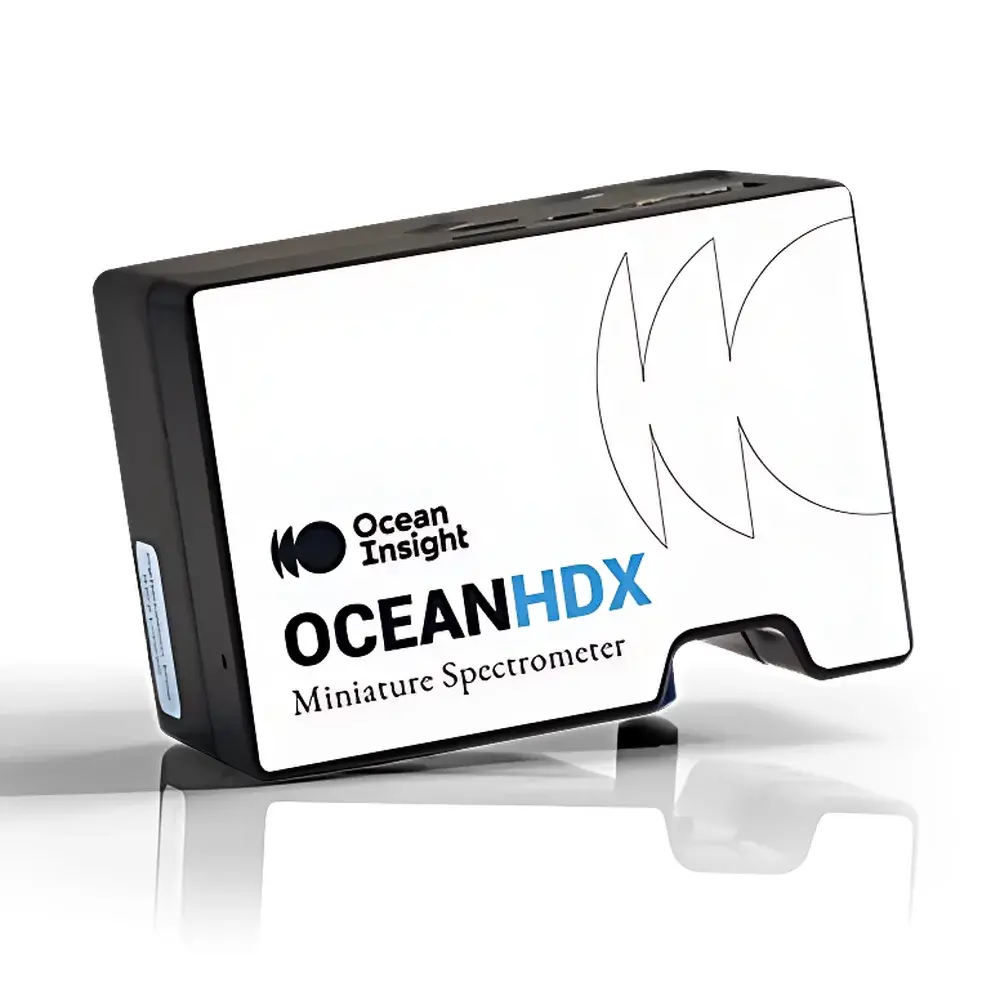
Ocean Optics HDX High-Sensitivity Spectrometer
| Brand | Ocean Optics |
|---|---|
| Origin | USA |
| Model | HDX |
| Wavelength Range (HDX-UV-VIS) | 200–800 nm |
| Wavelength Range (HDX-VIS-NIR) | 350–925 nm |
| Wavelength Range (HDX-XR) | 200–1100 nm |
| Optical Resolution (FWHM) | ~0.73 nm (UV-VIS), ~0.7 nm (VIS-NIR), ~1.1 nm (XR) |
| Slit Options (HDX-Raman) | 25 µm, 50 µm |
| Raman Shift Range | 150–3400 cm⁻¹ |
| Optical Resolution (Raman) | 9 cm⁻¹ (25 µm), 12 cm⁻¹ (50 µm) |
| Integration Time | 6 ms – 10 s |
| Dynamic Range | 12,000:1 |
| SNR | 400:1 |
| Operating Temperature | 0–40 °C |
| Storage Temperature | −30–70 °C |
| Dimensions | 88.9 × 63.5 × 52.4 mm³ |
| Weight | 400 g |
| Interface Options | USB 2.0, Gigabit Ethernet, RS-232, AP Wi-Fi |
| Onboard Memory | Up to 50,000 spectra |
| Detector | Back-illuminated CCD |
| Platform | X-Platform electronics |
Overview
The Ocean Optics HDX High-Sensitivity Spectrometer is an engineered solution for precision optical spectroscopy across UV-Vis, Vis-NIR, and extended-range (200–1100 nm) configurations. Built upon Ocean Insight’s legacy as the pioneer of miniature fiber-optic spectrometers, the HDX integrates a thermally stabilized optical bench, high-efficiency back-illuminated CCD detector, and X-Platform electronics to deliver robust performance in demanding environments. Its measurement principle relies on dispersive spectroscopy using a high-fidelity holographic grating and optimized optical path design—enabling accurate quantification of absorbance, transmittance, reflectance, fluorescence, and Raman scattering. The HDX platform supports both broadband spectral acquisition and targeted Raman analysis (via dedicated HDX-Raman variants), making it suitable for laboratory research, inline process monitoring, field-deployable instrumentation, and OEM integration where reproducibility, thermal stability, and compact form factor are critical.
Key Features
- High-definition optics: Engineered for superior peak symmetry and optical resolution—up to ~0.7 nm FWHM—essential for elemental line identification, plasma endpoint detection, and narrow-band spectral feature discrimination.
- High optical throughput: Optimized optical coupling and quantum efficiency enable reliable signal capture under low-light conditions, including fluorescence, bioluminescence, and phosphorescence measurements.
- Low stray light performance: Achieves <0.05% relative stray light, supporting accurate photometric analysis of high-optical-density samples such as dyes, inks, and concentrated solutions.
- Thermal and mechanical stability: Monolithic optical bench construction minimizes wavelength drift (<0.02 nm/°C typical), ensuring long-term calibration integrity without active thermal control.
- Onboard intelligence: Embedded processing enables real-time spectral averaging, dark correction, and storage of up to 50,000 spectra—reducing host dependency and enabling autonomous operation.
- Multi-interface connectivity: Standard support for USB 2.0, Gigabit Ethernet, RS-232, and optional AP Wi-Fi ensures compatibility with industrial PLCs, SCADA systems, and laboratory automation frameworks.
Sample Compatibility & Compliance
The HDX spectrometer accommodates diverse sampling modalities through standardized SMA 905 fiber inputs and compatibility with Ocean Insight’s full ecosystem of probes, cuvette holders, integrating spheres, and Raman accessories. For regulatory-sensitive applications—including pharmaceutical QC, environmental compliance testing, and food safety screening—the HDX supports audit-ready data workflows when paired with OceanView or OceanInsight’s SDK-enabled software platforms. While the spectrometer itself is not certified as standalone medical or diagnostic equipment, its hardware architecture complies with IEC 61326-1 (EMC for laboratory equipment) and RoHS directives. When integrated into validated systems, it meets foundational requirements for GLP and GMP-aligned spectral data acquisition—particularly when configured with timestamped spectral logging, user-access controls, and 21 CFR Part 11–compliant electronic signatures via supported software modules.
Software & Data Management
Ocean Insight provides comprehensive software support across development and deployment stages. OceanView offers intuitive GUI-based instrument control, real-time spectral visualization, and export to CSV, TXT, or HDF5 formats. For automated or embedded use, the OceanHDx SDK delivers cross-platform C/C++, Python, MATLAB, and LabVIEW APIs—enabling direct memory-mapped access to onboard storage and programmable trigger logic. All firmware updates and calibration files are digitally signed and version-controlled. Spectral metadata—including integration time, detector temperature, lamp reference status, and user-defined annotations—is embedded in every saved spectrum. Batch processing tools support baseline correction, peak integration, multivariate regression (PLS, PCA), and custom algorithm injection—facilitating method transfer from R&D to production environments.
Applications
- Process analytical technology (PAT): Real-time monitoring of chemical reactions, crystallization endpoints, and coating thickness via UV-Vis absorbance trends.
- Raman spectroscopy: HDX-Raman variants support non-destructive identification of polymers, pharmaceutical actives, illicit substances (e.g., ethanol adulterants, cannabinoid profiling), and battery electrolyte degradation products.
- Environmental sensing: Field-deployable water quality assessment (COD, nitrate, chlorophyll-a) using LED-based absorption or fluorescence excitation.
- Materials characterization: Thin-film interference analysis, solar cell QE mapping, and OLED emission profiling leveraging high-resolution Vis-NIR response.
- Biomedical research: Label-free tissue differentiation, hemoglobin oxygen saturation estimation, and microplate-based assay readouts using fiber-coupled probe geometries.
FAQ
What calibration standards are provided with the HDX spectrometer?
Each HDX unit ships with NIST-traceable radiometric and wavelength calibration data, delivered as factory-applied coefficients stored in non-volatile memory. Optional recalibration services—including irradiance, absorbance, and Raman shift validation—are available through Ocean Insight’s ISO/IEC 17025-accredited lab.
Can the HDX operate in continuous acquisition mode at maximum frame rate?
Yes—the onboard processor supports streaming at up to 1,000 spectra per second (depending on integration time and ROI configuration), with real-time averaging and buffer management to prevent data loss over USB or Ethernet interfaces.
Is the HDX compatible with third-party lasers and optical components?
Absolutely. The spectrometer accepts standard 400 µm core multimode fibers and features SMA 905 input ports. It is routinely integrated with external 785 nm diode lasers, notch filters, and collimating optics for Raman setups, and with deuterium-halogen sources for UV-Vis-NIR absorbance.
How is thermal drift managed during extended measurements?
The HDX employs passive thermal stabilization via aluminum housing and symmetric optical layout, achieving <±0.1 nm wavelength shift over 0–40 °C ambient range. For sub-pixel stability in high-precision applications, optional Peltier-cooled versions (HDX-TC) are available.
Does the HDX support synchronization with external triggers or clocks?
Yes—hardware TTL trigger input/output lines enable precise synchronization with pulsed light sources, motorized stages, or other instruments in multi-sensor arrays, with jitter <1 µs.






