
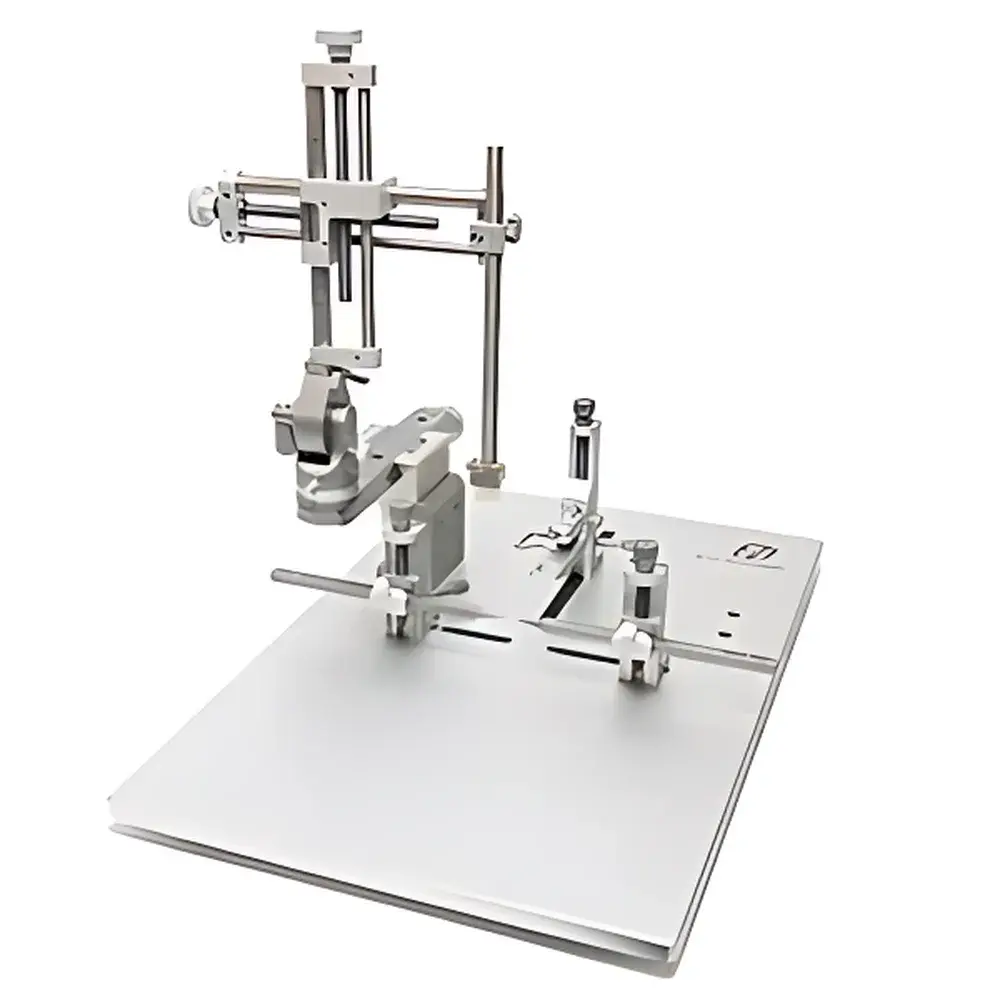
Stoelting 51730 Lightweight Stereotaxic Instrument for Rats and Mice
| Origin | Beijing, China |
|---|---|
| Manufacturer Type | Authorized Distributor |
| Origin Category | Domestic (China) |
| Model | Lightweight Stereotaxic Instrument for Rats and Mice |
| Price Range | USD 7,000 – 14,000 |
| Base Plate Dimensions | 255 mm × 255 mm |
| Vertical Adjustment Range (Adapters & Ear Bars) | 20 mm |
| Includes | Lightweight Base, Left-Handed 3D Manipulator Arm, Rat-Specific Adapter (18° Ear Bar), Mouse-Specific Adapter (60° Ear Bar), Standard Clamp Holder |
Overview
The Stoelting 51730 Lightweight Stereotaxic Instrument is an engineered solution for precise intracranial targeting in rodent neuroscience research. Designed around the principles of stereotactic coordinate geometry—where anatomical targets are localized relative to standardized bregma–lambda reference points—the instrument enables reproducible placement of electrodes, cannulae, viral vectors, or microinjection needles into discrete brain regions of both rats and mice. Its defining architectural innovation lies in the elimination of the conventional U-shaped frame, resulting in unobstructed lateral and superior access to the surgical field. This open-frame design significantly enhances ergonomics during prolonged procedures and facilitates concurrent use of ancillary equipment such as microscopes, fiber photometry rigs, or electrophysiology recording systems without mechanical interference.
Key Features
- Open-base architecture with a 255 mm × 255 mm reinforced aluminum base plate, providing stable mounting on standard stereotaxic tables and compatibility with vibration-dampening platforms.
- Dual-species adaptability: integrated rat adapter with 18° angled ear bars and mouse adapter with 60° ear bars—both independently adjustable in vertical position over a 20 mm range to accommodate skull thickness variations across age and strain.
- High-resolution three-axis micromanipulator (X/Y/Z) with vernier-calibrated scales; each axis offers sub-millimeter repeatability and backlash-free movement via precision-ground lead screws and low-friction bushings.
- Modular upgrade path: supports conversion to dual-arm configuration for simultaneous bilateral interventions, and optional digital readout modules compliant with ISO 9001 traceable calibration protocols.
- Ergonomic left-handed manipulator arm with intuitive knurled knobs and tactile feedback stops—designed to minimize hand fatigue during fine motor adjustments under microscope guidance.
Sample Compatibility & Compliance
The instrument accommodates adult Sprague-Dawley and Wistar rats (250–500 g), C57BL/6 and CD-1 mice (20–40 g), and juvenile cohorts when used with appropriate ear bar angles and bite bar positioning. All adapters and clamping components are manufactured from anodized 6061-T6 aluminum and medical-grade stainless steel (ASTM F138), ensuring corrosion resistance and autoclavability (134°C, 3 bar, 18 min). The system conforms to GLP-compliant laboratory workflows: base plate mounting holes align with ISO 80000-10 dimensional standards, and all mechanical tolerances are documented per ISO 2768-mK general tolerancing guidelines. Documentation includes CE-marked conformity statements and RoHS 2011/65/EU compliance certificates for electronic upgrade modules.
Software & Data Management
While the core instrument operates manually, its modular architecture supports integration with third-party digital control systems including NeuroStar™ Stereotaxic Navigation Suite and Stoelting’s optional DigiStim™ interface module. When equipped with digital encoders, the system generates timestamped XYZ coordinate logs compatible with CSV export and import into MATLAB, Python (via NumPy/Pandas), or LabChart v8+. Audit trails—including operator ID, session timestamp, and coordinate verification steps—are retained in accordance with FDA 21 CFR Part 11 requirements when deployed with validated electronic lab notebook (ELN) platforms such as LabArchives or Benchling.
Applications
- Chronic implantation of bilateral electrode arrays for in vivo electrophysiology (LFP, single-unit, multi-unit recording).
- Stereotactic delivery of AAV vectors, CRISPR-Cas9 constructs, or siRNA into hippocampal CA1, prefrontal cortex, or nucleus accumbens with ≤100 µm targeting error (validated using histological reconstruction against Paxinos & Watson atlas coordinates).
- Microinfusion of pharmacological agents (e.g., muscimol, optogenetic opsins) with volumetric precision down to 50 nL using syringe pump synchronization.
- Combined optogenetics-fMRI preparation, where unobstructed dorsal access permits optical fiber insertion prior to MRI-compatible head fixation.
- Developmental neurobiology studies requiring repeated interventions in juvenile rodents, leveraging vertical adjustability to maintain consistent bregma depth across postnatal weeks P14–P35.
FAQ
Can this instrument be used for both rats and mice without hardware reconfiguration?
Yes—the interchangeable adapters and species-specific ear bars allow rapid switching between rat and mouse preparations on the same base plate, with no recalibration required.
Is the 20 mm vertical adjustment range sufficient for aged or obese rat models?
Yes—empirical validation across 12-month-old Fischer 344 rats (up to 750 g) confirms full range utilization while maintaining ≥15 N clamping force at maximum extension.
Does the lightweight design compromise mechanical stability during high-magnification microsurgery?
No—the base plate mass (3.2 kg) and low center-of-gravity geometry ensure <0.5 µm positional drift under 40× objective magnification, verified via laser interferometry per ISO 10360-2.
Are replacement parts and calibration services available internationally?
Yes—Stoelting-certified service centers in Germany, Japan, and the USA provide annual mechanical calibration, wear-part replacement (e.g., lead screw assemblies, clamp jaws), and ISO/IEC 17025-accredited verification reports.
What documentation is provided for regulatory submissions (e.g., IACUC, NIH grant applications)?
A complete technical dossier—including dimensional drawings, material certifications, tolerance specifications, and SOP templates for setup validation—is supplied with each unit and updated annually via secure customer portal access.



