
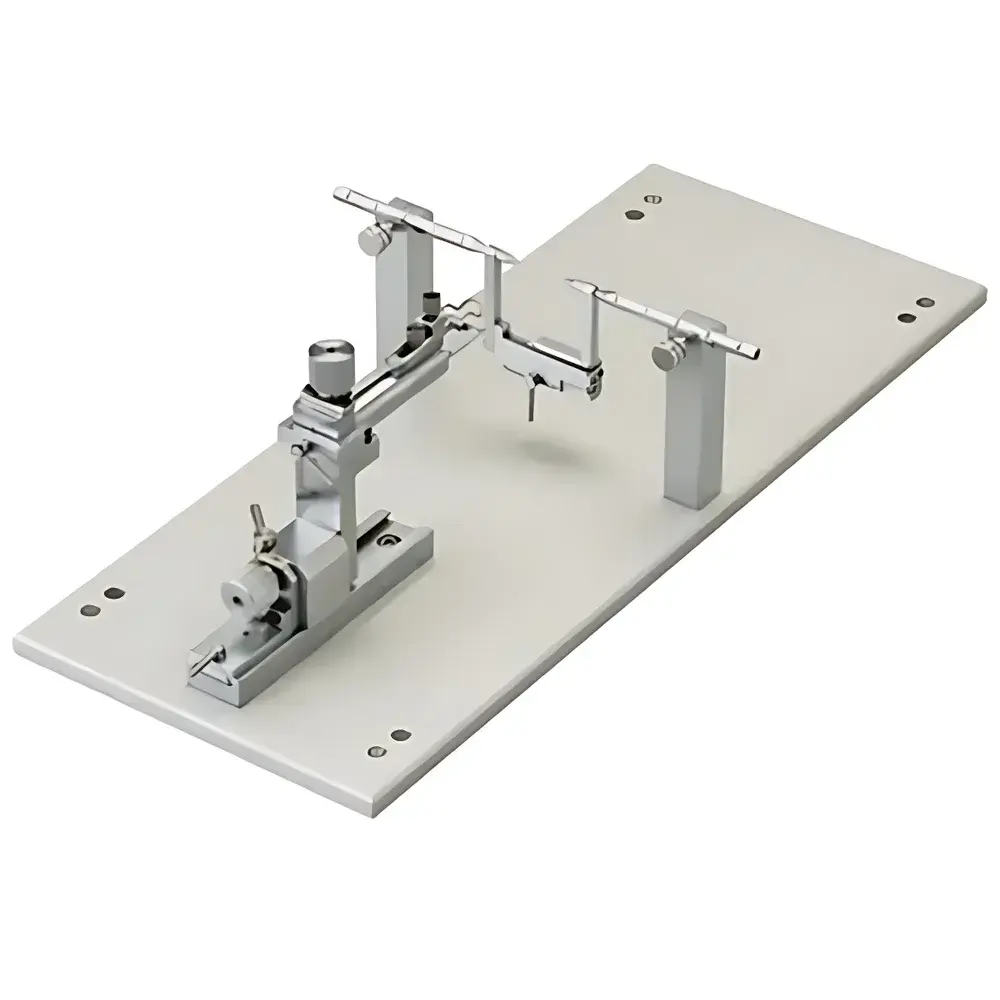
Narishige SRS-A Neonatal Rat Spinal Clamp for SR Series Stereotactic Frames
| Origin | Japan |
|---|---|
| Manufacturer Type | Authorized Distributor |
| Origin Category | Imported Instrument |
| Model | SRS-A |
| Pricing | Available Upon Request |
Overview
The Narishige SRS-A Neonatal Rat Spinal Clamp is a precision-engineered mechanical fixation accessory designed exclusively for integration with Narishige’s SR-series stereotactic frames (e.g., SR-1R, SR-5R, SR-8R). It enables stable, reproducible immobilization of the cervical or thoracic spinal region in neonatal rodents—primarily postnatal day 0–7 rats and adult mice—during microsurgical, electrophysiological, or intraspinal injection procedures. The device operates on a rigid mechanical clamping principle: bilateral lateral compression applied via calibrated thumb screws engages the vertebral spinous processes and paravertebral musculature, minimizing axial displacement without compromising respiratory or cardiovascular function. Its design conforms to standard neurosurgical ergonomics for dorsal laminectomy access and avoids direct neural compression, preserving tissue integrity during prolonged experimental sessions.
Key Features
- Optimized geometry for neonatal rat anatomy: accommodates incomplete ossification of cervical vertebrae and shallow intervertebral spacing typical in P0–P7 Sprague-Dawley or Wistar pups.
- Dedicated auxiliary ear bars included: precisely machined stainless-steel rods with tapered tips for secure, low-pressure engagement of the external auditory meatus—compatible only with fully canal-developed mice and neonatal rats exhibiting complete auricular cartilage maturation.
- Integrated hex-key wrench (2.0 mm) and locking installation knob ensure tool-free repositioning and torque-consistent tightening across repeated setups.
- Compact footprint (W300 × D120 × H77 mm) and balanced mass distribution (2.1 kg) minimize frame vibration transmission and enhance stability under high-magnification microscopy or micromanipulator operation.
- Non-magnetic, autoclavable construction: anodized aluminum body with medical-grade stainless-steel fasteners supports sterile surgical workflows and compliance with ISO 13485 cleanroom handling protocols.
Sample Compatibility & Compliance
The SRS-A clamp is validated for use with Sprague-Dawley, Wistar, and C57BL/6 mice (adult, 18–25 g) and neonatal rats aged P0–P7 (body weight 5–12 g). It is not compatible with GM-3 or GM-4 gas anesthesia face masks due to spatial interference with the clamp’s posterior support arms and ear bar mounting interface. Users must employ alternative anesthesia delivery methods—such as nose-cone systems mounted on independent articulating arms or subcutaneous ketamine/xylazine regimens—prior to clamp application. The device meets mechanical safety requirements outlined in ISO 14971:2019 (Risk Management for Medical Devices) for laboratory research instrumentation and supports GLP-compliant documentation when used within validated SOPs for spinal surgery models.
Software & Data Management
As a purely mechanical fixation tool, the SRS-A requires no embedded firmware, drivers, or software integration. All positioning parameters—including lateral screw torque (recommended range: 0.3–0.5 N·m), ear bar insertion depth (1.2–1.8 mm into external auditory canal), and dorsoventral clamp height—are manually recorded in lab notebooks or electronic lab notebooks (ELNs) per institutional GLP/GCP guidelines. For traceability, users are advised to log batch-specific calibration verification data (e.g., torque wrench certification date, ear bar dimensional inspection reports) alongside experimental metadata in systems compliant with 21 CFR Part 11 audit trail requirements.
Applications
- Intraspinal stem cell transplantation in neonatal rat models of spinal cord injury (SCI).
- Microinjection of AAV vectors into thoracic spinal segments for circuit mapping studies.
- Ex vivo electrophysiological recording from isolated spinal cord preparations following acute dissection.
- Real-time two-photon imaging of dorsal horn neuronal activity during peripheral stimulation.
- Validation of biomechanical spinal stabilization protocols prior to laminectomy or hemisection surgery.
FAQ
Can the SRS-A be used with adult rats?
No—the clamp’s ear bar geometry and inter-rod spacing are optimized for neonatal rat head dimensions and immature auditory canal morphology; adult rats require the SRS-B or SRS-C variants.
Is sterilization possible between uses?
Yes—autoclaving at 121°C, 15 psi for 20 minutes is validated for all metallic components; avoid prolonged exposure to caustic disinfectants that may degrade anodized surfaces.
Does it integrate with Narishige’s MO-10 micromanipulators?
Yes—its standardized SR-series mounting interface ensures full compatibility with MO-10, MN-151, and MP-285 manipulators when installed on SR frames equipped with dual-side rail adapters.
What is the maximum recommended duration of clamp application during survival surgery?
Based on histopathological assessment in peer-reviewed rodent models, continuous application should not exceed 90 minutes to prevent localized soft-tissue ischemia or pressure-induced neural edema.





