
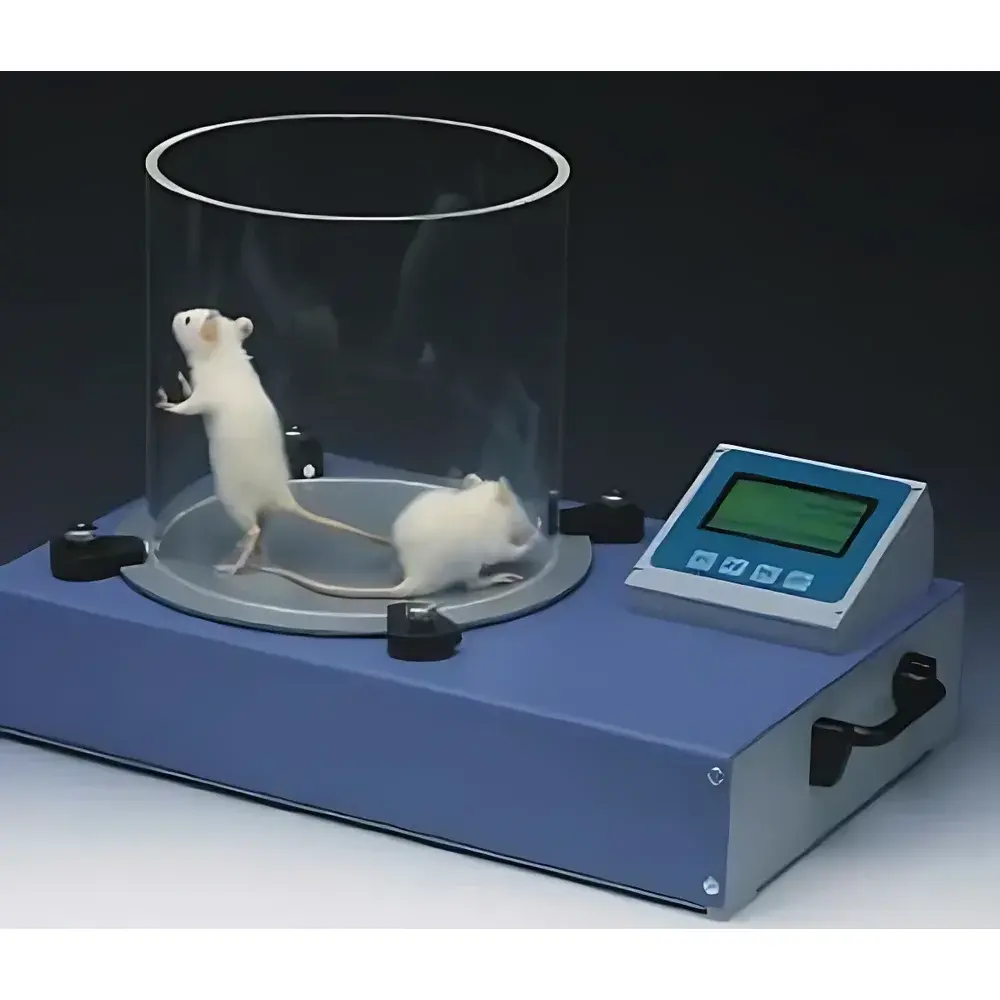
Bioserve 7280 Hot Plate Analgesia Tester
| Origin | France |
|---|---|
| Manufacturer Type | Authorized Distributor |
| Origin Category | Imported |
| Model | 7280 |
| Pricing | Upon Request |
Overview
The Bioserve 7280 Hot Plate Analgesia Tester is a precision-engineered thermal nociception assay system designed for objective, reproducible quantification of antinociceptive responses in rodents—primarily mice and rats. It operates on the principle of radiant thermal stimulation applied to the plantar surface of unrestrained animals, triggering a nocifensive withdrawal reflex (e.g., hind-paw licking, shaking, or jumping) when tissue temperature exceeds the nociceptive threshold. The device measures latency-to-response—the time elapsed between initiation of thermal stimulus and the first unambiguous pain-related behavior—as a validated end-point biomarker for central and peripheral analgesic activity. This paradigm is widely accepted in preclinical pharmacology for rapid screening of opioid and non-opioid analgesics, including NSAIDs and novel CNS-targeted compounds. Its design adheres to internationally recognized guidelines for ethical rodent behavioral testing, incorporating built-in safety thresholds and operator-independent activation to minimize handling stress and experimenter bias.
Key Features
- Thermally stable aluminum heating plate (220 × 220 mm) with ±0.1 °C temperature uniformity across the entire surface, ensuring consistent stimulus delivery independent of animal positioning.
- Adjustable thermal range from 45 °C to 65 °C in 0.1 °C increments, programmable via intuitive front-panel interface with real-time LED display of setpoint and actual plate temperature.
- High-resolution reaction timer with 0.01-second resolution and automatic cutoff at 30 seconds to prevent tissue injury—compliant with IACUC and EU Directive 2010/63/EU welfare safeguards.
- Footswitch-activated start/stop functionality eliminates manual interaction during testing, reducing operator-induced variability and enabling hands-free operation during multi-animal protocols.
- Ergonomic modular housing: base dimensions 220 × 280 × 90 mm (W × D × H); interchangeable cylindrical enclosures—200 mm diameter × 150 mm height for mice; 200 mm diameter × 250 mm height for rats—designed to restrict lateral movement without physical restraint.
- No animal fixation required: subjects remain freely mobile within the enclosure, preserving natural posture and minimizing stress-induced hyperalgesia or false-negative latency shifts.
Sample Compatibility & Compliance
The 7280 supports standardized testing of adult C57BL/6, BALB/c, Sprague-Dawley, and Wistar strains under controlled ambient conditions (20–24 °C, 40–60% RH). It is compatible with common analgesic dose-response paradigms, including acute single-dose administration (i.p., s.c., oral) and chronic dosing regimens. All operational parameters meet requirements for GLP-compliant preclinical studies. Data acquisition satisfies FDA 21 CFR Part 11 readiness when used with SEDACOM software (via RS232 serial interface), supporting audit trails, electronic signatures, and secure data export in CSV and Excel formats. The system conforms to ASTM E2912-21 (Standard Guide for Preclinical Pain Research Models) and aligns with NIH Office of Laboratory Animal Welfare (OLAW) recommendations for humane endpoint definition.
Software & Data Management
Integrated RS232 communication enables bidirectional control and real-time data streaming to the proprietary SEDACOM acquisition platform. SEDACOM provides timestamped session logging, automated latency calculation, group-wise statistical summary (mean ± SEM, ANOVA-ready export), and customizable reporting templates compliant with journal submission standards (e.g., *Pain*, *Neuropharmacology*). Raw data files are stored with metadata tags—including operator ID, animal ID, dose, timepoint, and environmental log—ensuring full traceability for regulatory audits. Software validation documentation (IQ/OQ/PQ summaries) is available upon request for GCP/GMP-aligned laboratories.
Applications
- Primary screening of novel analgesic candidates targeting μ-opioid, TRPV1, COX-2, or NMDA receptors.
- Pharmacodynamic profiling of dose–response relationships and time–effect curves.
- Assessment of tolerance development following repeated drug administration.
- Investigation of sex- or age-dependent differences in thermal nociception thresholds.
- Validation of genetic knockouts or transgenic models exhibiting altered pain sensitivity.
- Supporting IND-enabling toxicology and safety pharmacology studies per ICH S7A guidelines.
FAQ
What species and strains are validated for use with the 7280?
The system is optimized for mice (20–30 g) and rats (180–300 g), including C57BL/6, BALB/c, Sprague-Dawley, and Wistar strains. Strain-specific baseline latencies should be established during protocol qualification.
Is calibration traceable to national standards?
Yes—temperature sensors are NIST-traceable platinum RTDs; annual recalibration service includes certificate of conformity and uncertainty budget per ISO/IEC 17025.
Can the 7280 be integrated into automated behavioral phenotyping platforms?
While standalone operation is standard, OEM-level API access and TTL-compatible trigger I/O ports are available under NDA for integration with third-party automation systems.
Does the system support dual-plate configurations for parallel testing?
No—the 7280 is a single-plate unit; however, Bioserve offers synchronized multi-unit deployments with centralized SEDACOM server management for high-throughput labs.
How is animal welfare ensured during prolonged assay sessions?
The 30-second automatic shutoff, combined with pre-test acclimatization protocols and post-test thermal recovery monitoring, meets AAALAC International accreditation criteria for thermal nociception assays.



