
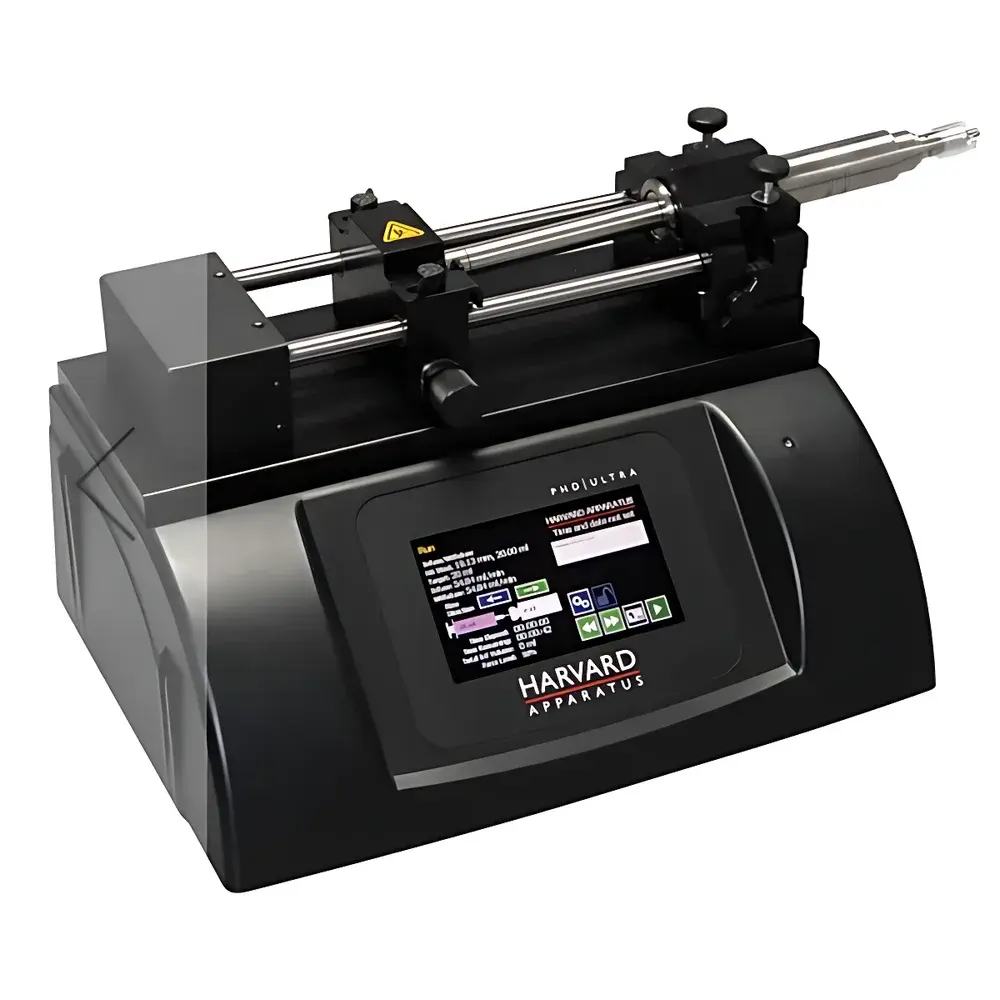
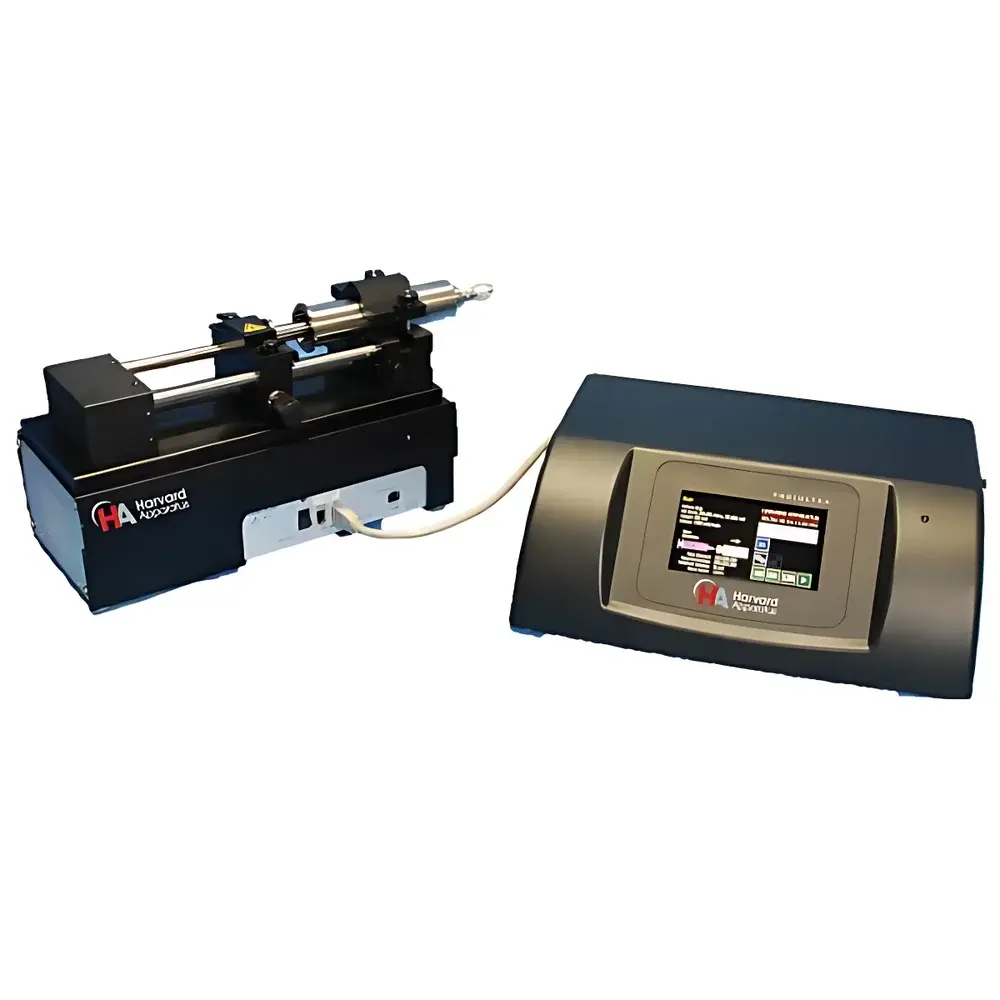
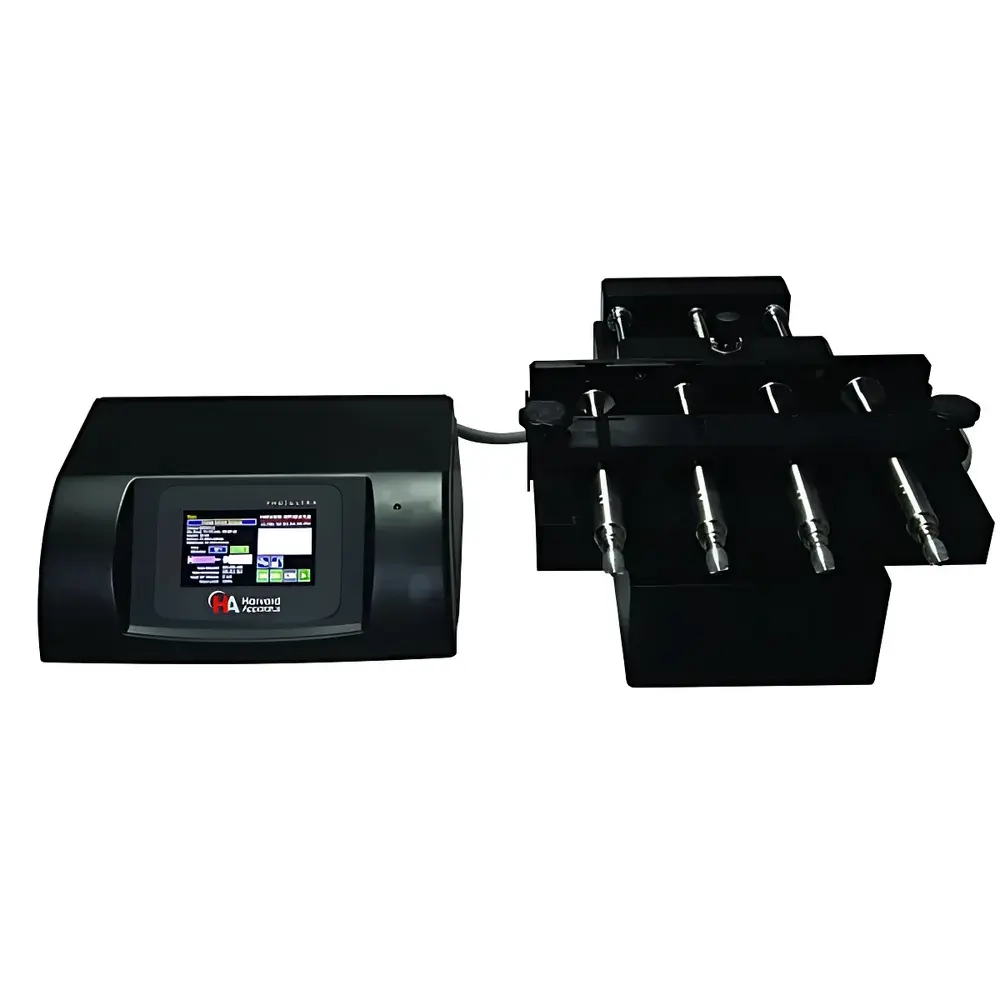
Harvard Apparatus PHD ULTRA 4400 High-Pressure Syringe Pump
| Brand | Harvard Apparatus |
|---|---|
| Origin | USA |
| Model | PHD ULTRA 4400 |
| Flow Rate | 3.06 pL/min to 215.8 mL/min |
| Accuracy | ±0.25% |
| Repeatability | ±0.05% |
| Linear Force | 91 kg (200 lbf) |
| Injector Compatibility | 0.5 µL–140 mL stainless steel syringes |
| Control Interfaces | RS-232, RS-485, IEEE-1394 (FireWire), USB Type-B, TTL I/O (15-pin D-Sub) |
| Power | 100–240 VAC, 50/60 Hz, 50 W |
| Dimensions (Standalone) | 30.48 × 21.59 × 18.4 cm |
| Weight (Standalone) | 5.5 kg |
Overview
The Harvard Apparatus PHD ULTRA 4400 is a microprocessor-controlled, single-channel high-pressure syringe pump engineered for precision fluid delivery in demanding laboratory and preclinical applications. Operating on a robust linear stepper motor drive (1.8° step angle) with force feedback control, it delivers consistent, programmable infusion and withdrawal across an exceptionally wide dynamic flow range—from femtoliter-scale microinjection (3.06 pL/min) to high-volume perfusion (215.8 mL/min). Its core design centers on mechanical integrity: a hardened stainless-steel lead screw and precision-ground carriage generate up to 91 kg (200 lbf) of linear thrust—enabling reliable operation with viscous, particulate-laden, or high-backpressure fluids commonly encountered in electrophysiology, microfluidics, chromatography sample loading, and neuropharmacology infusion studies. Unlike entry-level syringe pumps, the PHD ULTRA 4400 maintains metrological stability under sustained load, making it suitable for GLP-compliant long-duration experiments where flow drift must remain below ±0.05% over hours or days.
Key Features
- High-force linear actuation (91 kg / 200 lbf) optimized for stainless-steel syringes from 0.5 µL to 140 mL capacity
- True standalone operation: full programmability via front-panel keypad and LCD—no PC required for basic or multi-step protocols
- Dual operating modes: Stand-Alone unit (integrated controller) and Remote configuration (separate control box + pump head for rack-mount or confined-space integration)
- Multi-interface connectivity: RS-232 (9-pin D-Sub), RS-485, IEEE-1394 (FireWire), USB Type-B, and TTL I/O (15-pin D-Sub) for synchronization with DAQ systems, stimulus isolators, or imaging platforms
- Regulatory-ready firmware architecture supporting audit trail logging and user-access levels—facilitating alignment with FDA 21 CFR Part 11 requirements when deployed in regulated environments
- Thermally stable power supply (100–240 VAC, 50/60 Hz) with low-noise 50 W output and internal fuse protection
Sample Compatibility & Compliance
The PHD ULTRA 4400 is validated exclusively for use with medical-grade stainless-steel syringes—ensuring compatibility with aggressive solvents (e.g., DMSO, acetonitrile), biological buffers, and suspensions containing microbeads or cells. Its rigid frame and zero-backlash drive train eliminate syringe barrel flex and plunger slippage, critical for reproducible dosing in quantitative pharmacokinetic modeling or closed-loop infusion systems. The pump complies with IEC 61010-1:2010 for electrical safety in laboratory equipment and meets EMC standards per FCC Part 15 Class B and CISPR 11 Group 1, Class A. When integrated into validated workflows, it supports adherence to ISO/IEC 17025 calibration traceability and ASTM E2656-20 (Standard Guide for Syringe Pump Performance Verification).
Software & Data Management
Harvard Apparatus provides the optional PHD ULTRA Control Software (v5.x), a Windows-based application enabling graphical protocol building, real-time flow monitoring, and export of timestamped CSV data logs with millisecond resolution. The software supports automated method validation—including linearity checks across 10+ flow decades—and integrates with third-party platforms via ActiveX and LabVIEW drivers. All firmware updates are digitally signed and delivered through Harvard’s secure support portal. For GxP environments, the system supports configurable electronic signatures, session locking, and immutable audit trails—meeting baseline expectations for 21 CFR Part 11 Subpart C (electronic records and signatures) when paired with appropriate IT infrastructure controls.
Applications
- Chronic intracerebral or intrathecal drug delivery in rodent models requiring sub-nanoliter precision over 72+ hour infusions
- High-pressure loading of HPLC/UHPLC autosamplers and preparative chromatography columns
- Synchronized multi-pump perfusion in organ-on-chip systems with pressure-regulated microchannel networks
- Calibration of flow sensors and pressure transducers using NIST-traceable volumetric standards
- Controlled reagent addition in automated synthesis reactors where solvent viscosity varies significantly across reaction phases
FAQ
Can the PHD ULTRA 4400 operate with glass or plastic syringes?
No. It is mechanically and thermally optimized for stainless-steel syringes only; non-metallic barrels may deform under 91 kg thrust, compromising accuracy and safety.
What is the minimum syringe volume supported for stable low-flow operation?
The system achieves stable flow down to 3.06 pL/min using a 0.5 µL syringe with appropriate calibration and low-drift tubing (e.g., fused silica capillary); performance is verified per ASTM E2656 Annex A3.
Is remote firmware update capability available over RS-232 or USB?
Yes—firmware upgrades are performed via USB Type-B using Harvard’s certified updater utility; RS-232 supports command-driven operation but not binary firmware transfer.
Does the pump include built-in flow verification or calibration routines?
It does not include onboard gravimetric or optical flow sensing; however, the control software includes guided calibration workflows compliant with USP <1057> for pump performance qualification.
How is force selection implemented during protocol execution?
Force is set as a fixed parameter per program step—not dynamically adjusted mid-infusion—to maintain deterministic mechanical response and avoid resonance-induced flow oscillation.



