
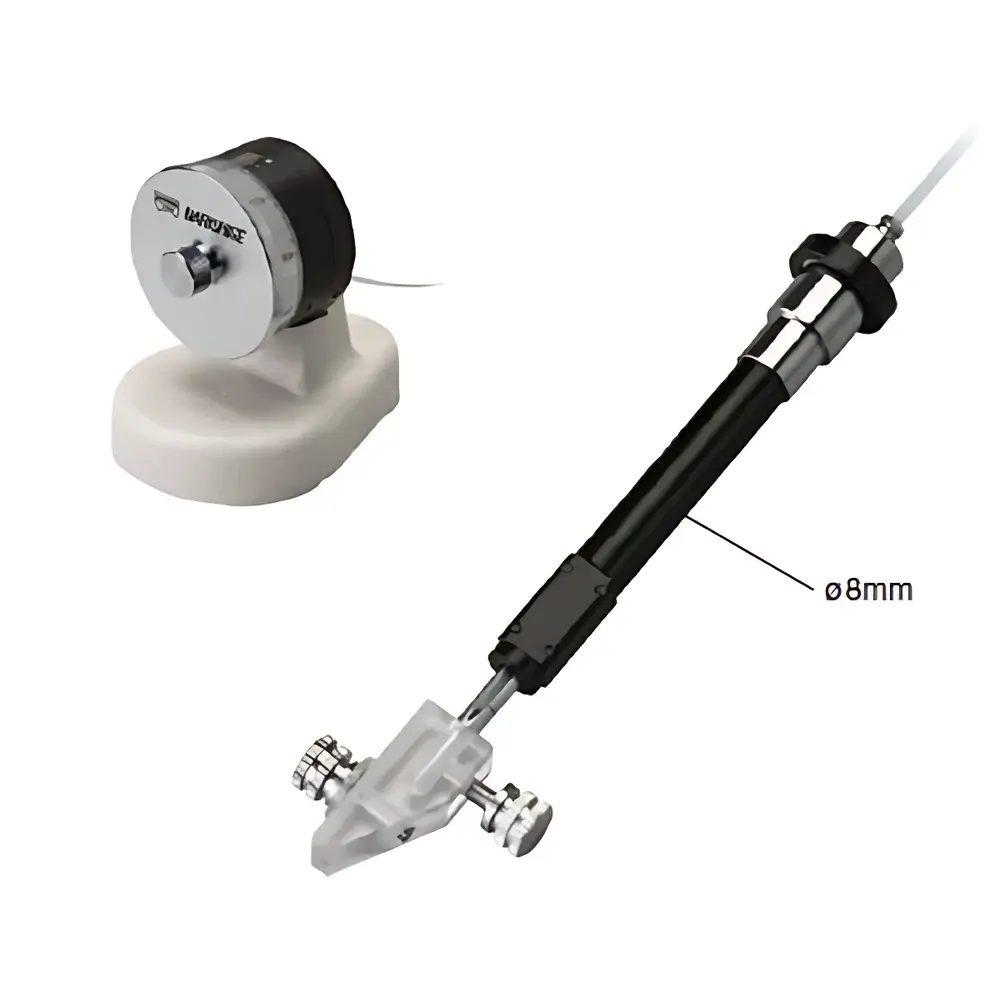
Narishige MO-10 Single-Axis Hydraulic Micromanipulator
| Origin | Japan |
|---|---|
| Manufacturer Type | Authorized Distributor |
| Origin Category | Imported Instrument |
| Model | MO-10 |
| Pricing | Available Upon Request |
| Fine Adjustment Travel | 10 mm |
| Micrometer Step per Revolution | 500 µm |
| Graduation Resolution | 2 µm |
| Joystick X–Y Planar Travel | 2 mm |
| Control Unit Dimensions (W×D×H) | 70 × 115 × 100 mm, 1.15 kg |
| Drive Unit Dimensions (W×D×H) | 30 × 20 × 125 mm, 50 g |
| Hydraulic Tubing Length | 1.5 m |
Overview
The Narishige MO-10 Single-Axis Hydraulic Micromanipulator is a precision-engineered, pencil-style manual micromanipulation tool designed for integration with three-axis mechanical or motorized manipulators in electrophysiology, microinjection, patch-clamp, and intracellular recording applications. Its core operating principle relies on oil-filled hydraulic transmission—providing smooth, backlash-free, and highly damped motion without mechanical gear play or stick-slip artifacts. Unlike screw-driven or piezoelectric alternatives, the MO-10 delivers continuous analog control with inherent force buffering, making it especially suitable for delicate probe positioning near live cells or fragile tissue preparations. The compact drive unit mounts directly to standard microscope stages or multi-axis platforms via standardized 3/8″-16 UNC threads, while the ergonomic control module enables intuitive single-hand operation through a rotating drum and joystick interface.
Key Features
- Hydraulic actuation system ensures vibration-damped, jerk-free linear displacement with zero hysteresis—critical for stable electrode approach during high-magnification visual targeting.
- Drum-type micrometer with 2 µm scale graduation and 500 µm per revolution resolution allows precise subcellular positioning; total fine adjustment range of 10 mm supports both coarse approach and nanoscale refinement.
- Integrated X–Y planar joystick provides 2 mm of orthogonal lateral travel for rapid repositioning without compromising Z-axis stability—ideal for serial targeting across multi-well dishes or tissue sections.
- Modular architecture: Drive unit (50 g) decouples from control unit (1.15 kg), minimizing stage loading and enabling flexible mounting configurations—including inverted, upright, or oblique microscope setups.
- 1.5-meter reinforced hydraulic tubing permits separation of operator workspace from vibration-sensitive imaging zones, supporting compliance with ISO 14644-1 Class 5 cleanroom-compatible lab layouts.
Sample Compatibility & Compliance
The MO-10 is routinely deployed in GLP-compliant electrophysiology suites and academic core facilities performing USP compliant cell-based assays. It interfaces seamlessly with Narishige’s MO-8HL fixed-angle electrode holder (sold separately), extending effective working distance when target depth exceeds the native 10 mm fine-travel limit. Compatible with glass micropipettes (OD ≤ 1.5 mm), tungsten electrodes, and borosilicate capillaries used in whole-cell patch clamp (ISO 15197:2013), intracytoplasmic sperm injection (ICSI), and Ca²⁺ imaging probe delivery. All wetted components comply with USP Class VI biocompatibility standards; hydraulic fluid meets ISO 6743-4 HV classification for low-volatility, non-corrosive mineral oil systems.
Software & Data Management
As a fully manual, analog device, the MO-10 operates independently of software control—eliminating driver dependencies, firmware updates, or cybersecurity vulnerabilities associated with connected instrumentation. This design aligns with FDA 21 CFR Part 11 requirements for audit-trail-free operation in validated workflows where procedural consistency is documented via SOP-controlled calibration logs rather than digital timestamps. Users maintain traceability through physical calibration records referencing Narishige’s factory-certified micrometer linearity verification (±0.5% full-scale error, NIST-traceable at time of shipment). Optional integration with third-party motion-tracking systems (e.g., ASI MP-285 or Sutter MP-285 controllers) is supported via mechanical coupling adapters—not electronic interfacing.
Applications
- Single-cell electrophysiology: Stable electrode positioning for voltage-clamp and current-clamp recordings in brain slice, dissociated neuron, and stem-cell-derived cardiomyocyte preparations.
- Microinjection: Controlled delivery of CRISPR/Cas9 ribonucleoproteins, fluorescent dextrans, or morpholinos into zebrafish embryos, Xenopus oocytes, or mouse zygotes.
- Optogenetics probe placement: Accurate insertion of optrodes or fiber photometry cannulas within stereotaxic coordinates verified by post-hoc histology.
- Microdissection support: Coordinated use with stereo-microscope-mounted needle holders for laser-capture microdissection pre-alignment and tissue isolation.
- Teaching laboratories: Durable, low-maintenance platform for undergraduate neuroscience and developmental biology curricula emphasizing tactile feedback and spatial reasoning in micromanipulation.
FAQ
Is the MO-10 compatible with inverted microscopes?
Yes—the low-profile drive unit (125 mm height) and flexible 1.5 m hydraulic line allow unobstructed installation beneath inverted stands, including Nikon Eclipse Ti and Zeiss Axio Observer configurations.
What electrode holders can be attached to the MO-10?
The MO-10 accepts standard 3/8″-16 threaded accessories; Narishige MO-8HL is recommended for fixed-angle glass pipette clamping. Custom adapters are available for World Precision Instruments (WPI) or Sutter Instrument holders.
Does the hydraulic system require periodic maintenance or fluid replacement?
No—sealed-for-life hydraulic circuitry eliminates routine servicing; Narishige specifies 10-year operational integrity under laboratory conditions per IEC 61000-4-2 ESD immunity testing.
Can the MO-10 be used in laminar flow hoods or biosafety cabinets?
Yes—its passive mechanical design generates no electromagnetic emissions or heat dissipation, satisfying EN 14644-1 airborne particle class requirements for Class II A2 cabinet integration.
Is calibration documentation provided with shipment?
Each unit ships with a factory calibration certificate listing micrometer linearity deviation, hydraulic response latency (<12 ms step response), and dimensional conformity to JIS B 7021:2018 tolerances.





