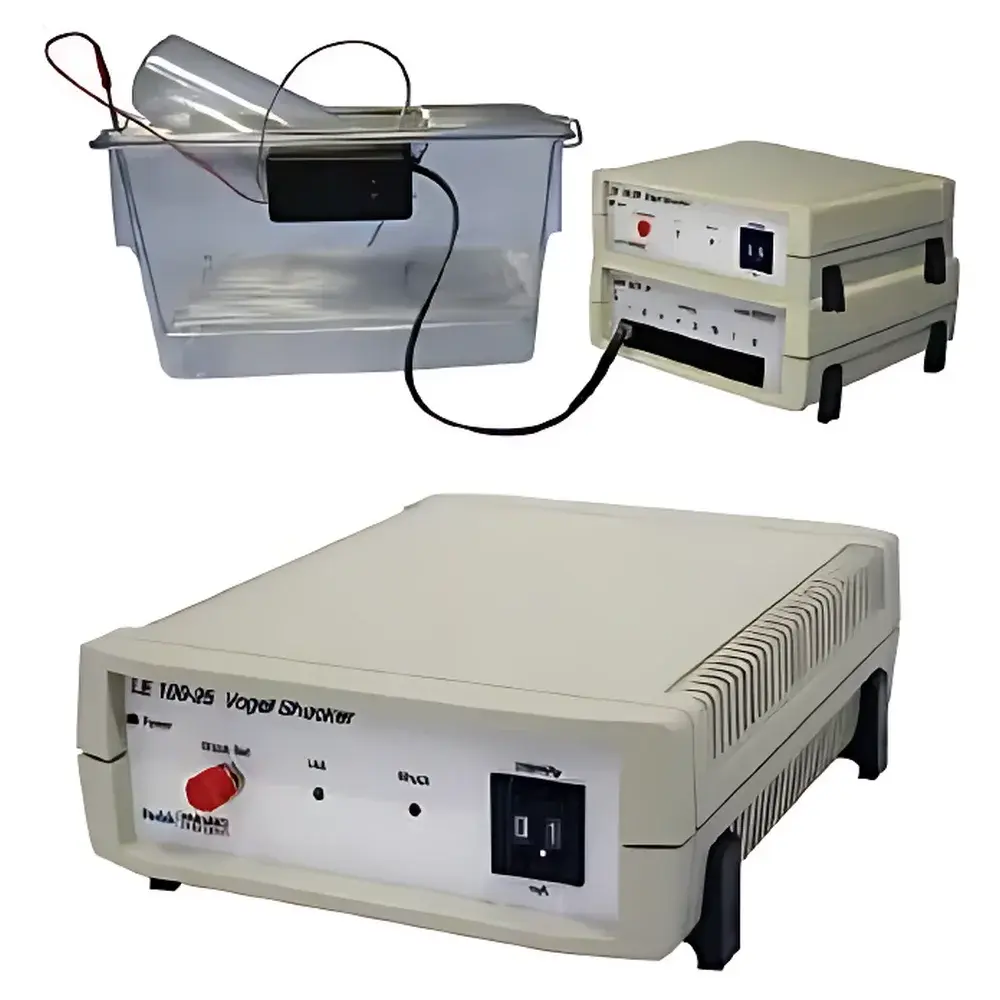
Panlab Drink-Electrode Anxiety Test System (LE862/LE865)
| Brand | Harvard Apparatus |
|---|---|
| Origin | USA |
| Model | LE862 / LE865 |
| Stimulus Range | 0.1–2 mA (LE10025 Electrode Stimulator), Pulse Duration: 0.1–10 s |
| Detection Resolution | Single-lick resolution via patented sipper-tube sensor |
| Cage Capacity | Up to 32 cages per PC (with PACKWIN software) |
| Onboard Memory | 99 drinking events per detector |
| Compliance | Designed for GLP-aligned behavioral phenotyping workflows |
Overview
The Panlab Drink-Electrode Anxiety Test System (LE862/LE865), distributed by Harvard Apparatus, is a standardized, ethologically grounded platform for assessing anxiety-like behavior in rodents through the well-validated water-restriction–based conflict paradigm. This system implements the classic “drinking-in-the-dark” or “punished drinking” protocol—where animals must initiate voluntary licking at a sipper tube to access water while facing intermittent, controllable foot-shock stimuli. The paradigm exploits the natural drive to hydrate versus the aversion to electric shock, generating quantifiable behavioral inhibition that correlates strongly with anxiolytic drug efficacy. Engineered for precision and reproducibility, the system employs a patented sipper-tube transducer capable of discriminating true licks from non-consumptive contact (e.g., grooming, cage exploration), thereby eliminating false-positive detection—a critical requirement for high-fidelity behavioral scoring in preclinical pharmacology and translational neuroscience studies.
Key Features
- Patented sipper-tube sensor with micro-switch actuation and analog signal conditioning ensures single-lick detection fidelity and rejection of non-ingestive oral contacts.
- Modular architecture: Each LE862/LE865 cage integrates a calibrated lick detector, shock grid, and fluid delivery interface—designed for direct mounting on standard rodent housing without structural modification.
- LE10025 programmable stimulator delivers biphasic, constant-current shocks (0.1–2 mA, 0.1–10 s duration) with built-in scrambler circuitry to prevent habituation and minimize stimulus predictability.
- LinkBox data hub supports up to 8 cages per unit; multiple LinkBoxes can be daisy-chained to scale to 32 cages under unified PACKWIN control.
- On-device memory stores up to 99 complete drinking episodes (including lick timestamps, inter-lick intervals, and concurrent shock delivery logs) for offline validation and audit trail integrity.
- Hardware-level synchronization ensures sub-millisecond alignment between lick onset, shock trigger, and timestamp logging—essential for temporal analysis of response latency and suppression ratio.
Sample Compatibility & Compliance
The system is validated for use with adult male and female Sprague-Dawley, Wistar, and C57BL/6 mice and rats (20–40 g mice; 200–400 g rats). Cage dimensions comply with NIH Guide for the Care and Use of Laboratory Animals and EU Directive 2010/63/EU housing standards. All electrical components meet IEC 61010-1 safety requirements for laboratory equipment. Data acquisition protocols support ALARA (As Low As Reasonably Achievable) shock dosing principles and are compatible with institutional IACUC-approved protocols requiring stimulus randomization, session blinding, and operator-independent parameter assignment. The system’s deterministic timing engine satisfies GLP documentation requirements for traceable stimulus-event correlation.
Software & Data Management
PACKWIN software serves as the central experimental orchestration environment. It provides a drag-and-drop interface for defining session parameters—including shock probability (fixed or variable-ratio schedules), inter-trial intervals, session duration, and lick-triggered contingency logic. All raw lick and shock event data are stored in HDF5 format with embedded metadata (animal ID, cage ID, date/time, operator ID, protocol version). Audit trails record all parameter changes with user login stamps and system timestamps. Export modules generate CSV-compatible reports aligned with FAIR data principles (Findable, Accessible, Interoperable, Reusable) and support integration with downstream statistical platforms (R, Python/Pandas, GraphPad Prism). Optional FDA 21 CFR Part 11 compliance package enables electronic signatures, role-based access control, and immutable log archiving.
Applications
- Preclinical screening of novel anxiolytic compounds (e.g., GABAA modulators, CRF antagonists, serotonergic agents) using suppression ratio, latency-to-first-lick, and total licks as primary endpoints.
- Genetic model phenotyping: Quantification of baseline anxiety differences in transgenic, knockout, or CRISPR-edited lines under standardized conflict conditions.
- Neurocircuitry validation: Combined use with optogenetics or chemogenetics to assess real-time modulation of amygdala–prefrontal–hypothalamic pathways during conflict decision-making.
- Toxicology assessment: Detection of anxiogenic side effects in CNS-active therapeutics across dose-response curves.
- Behavioral pharmacokinetic-pharmacodynamic (PK-PD) modeling: Temporal alignment of plasma drug concentrations with dynamic changes in lick suppression over repeated sessions.
FAQ
What is the minimum and maximum current output of the LE10025 stimulator?
The LE10025 delivers constant-current stimulation from 0.1 mA to 2.0 mA, adjustable in 0.1 mA increments.
Can the system differentiate between active licking and passive contact with the sipper tube?
Yes—the patented sipper-tube sensor uses mechanical hysteresis and analog threshold discrimination to reject non-ingestive contacts such as grooming or cage exploration.
Is PACKWIN software required to operate more than eight cages?
Yes—while a single LinkBox supports up to eight cages, scaling beyond that requires PACKWIN’s multi-LinkBox orchestration layer and synchronized timebase management.
Does the system support randomized shock delivery schedules?
Yes—PACKWIN allows specification of fixed-probability (e.g., 30% chance per lick) or pseudo-randomized variable-interval schedules, with full audit logging of each delivered shock.
How is data integrity maintained during power interruption?
Each detector retains the last 99 drinking events in non-volatile memory; PACKWIN also performs automatic checkpoint saves at configurable intervals to prevent data loss.