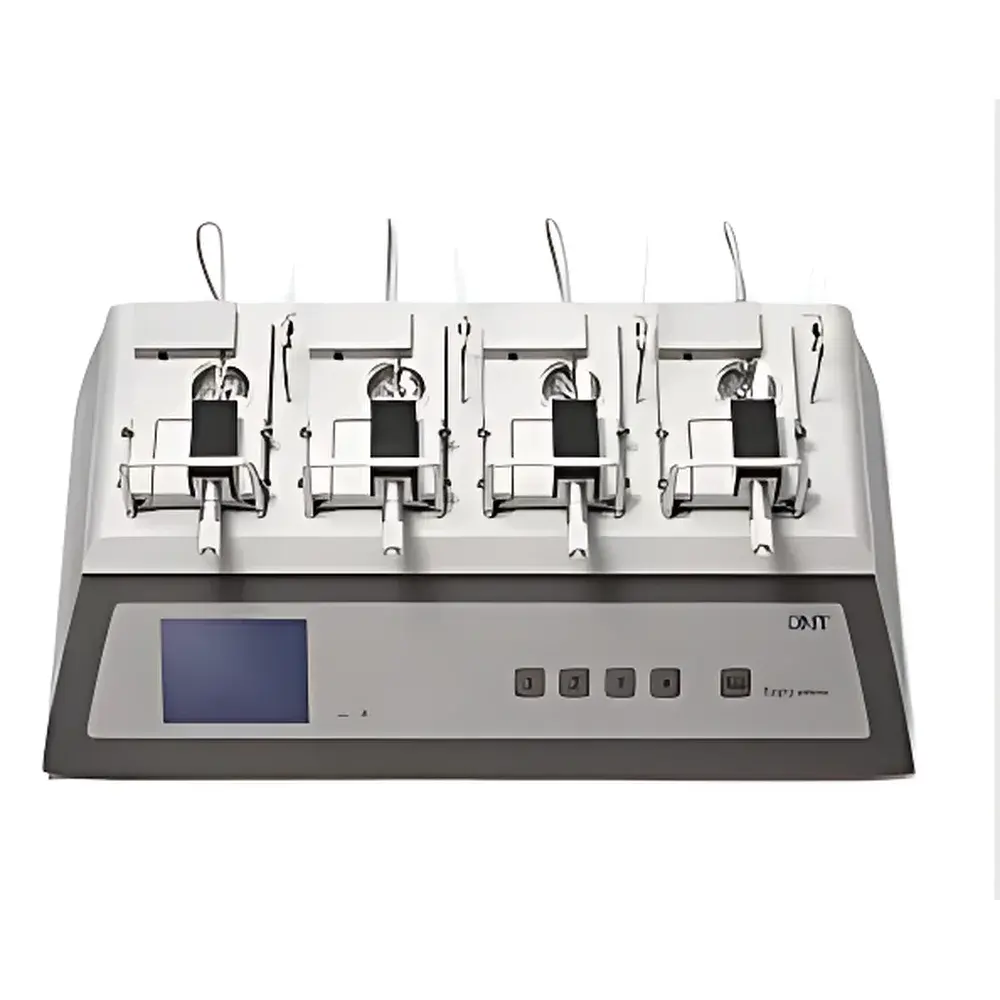
DMT 620M Vascular Myograph System
| Origin | Denmark |
|---|---|
| Manufacturer Type | Authorized Distributor |
| Origin Category | Imported |
| Model | DMT 620M |
| Price | Upon Request |
| Sample Diameter Range | 60 µm to 10 mm |
| Number of Baths | 4 independent stainless-steel baths |
| Bath Capacity | Up to 8 mL per bath |
| Tension Range Options | ±200 / ±400 / ±800 / ±1600 mN |
| Tension Resolution | 0.1 mN |
| Temperature Control Range | Ambient to 45 °C |
| Temperature Accuracy | ±0.1 °C |
| Heating System | Integrated electronic heating with independent bath temperature regulation |
| Bath Exhaust | Manual or programmable automatic aspiration |
| Gas Inlet | Individual needle-valve control per bath |
| Analog Output | 2.5 V full-scale, 4-channel isolated |
| Digital Interface | USB 2.0 |
| Power Supply | 100–240 V AC, 50/60 Hz |
| Operating Ambient | 15–30 °C |
| Calibration | Semi-automatic weight calibration |
| Positioning | Manual micrometer-driven micro-positioner |
Overview
The DMT 620M Vascular Myograph System is a fourth-generation, four-channel wire myograph platform engineered for high-fidelity, quantitative assessment of contractile and relaxant responses in isolated vascular and non-vascular smooth muscle tissues. Based on the well-established Couette-type mechanical principle, the system measures isometric tension generated by mounted tissue segments under controlled physiological conditions—specifically, in oxygenated physiological salt solution (PSS) maintained at precise temperature and pH. Unlike pressure myography, the DMT 620M employs dual-wire mounting (one fixed, one connected to a force transducer), enabling direct measurement of active wall tension without assumptions about vessel geometry or intraluminal pressure. This architecture delivers superior reproducibility for pharmacological dose–response profiling, receptor characterization, and mechanistic studies involving endothelial function, ion channel modulation, and signal transduction pathways.
Key Features
- Four independent, parallel myograph channels—each equipped with a calibrated force transducer, precision micro-positioner, and thermally regulated stainless-steel bath—support concurrent experiments across multiple tissue types or drug concentrations.
- Modular mounting hardware: clamp-style holders for microvessels (60–450 µm diameter) and pin-style holders for larger vessels (up to 10 mm external diameter), ensuring optimal mechanical coupling and minimal tissue distortion.
- Integrated thermal management: electronically controlled heating elements with real-time feedback from external platinum resistance thermometers (Pt100), delivering ±0.1 °C stability across the 15–45 °C operational range.
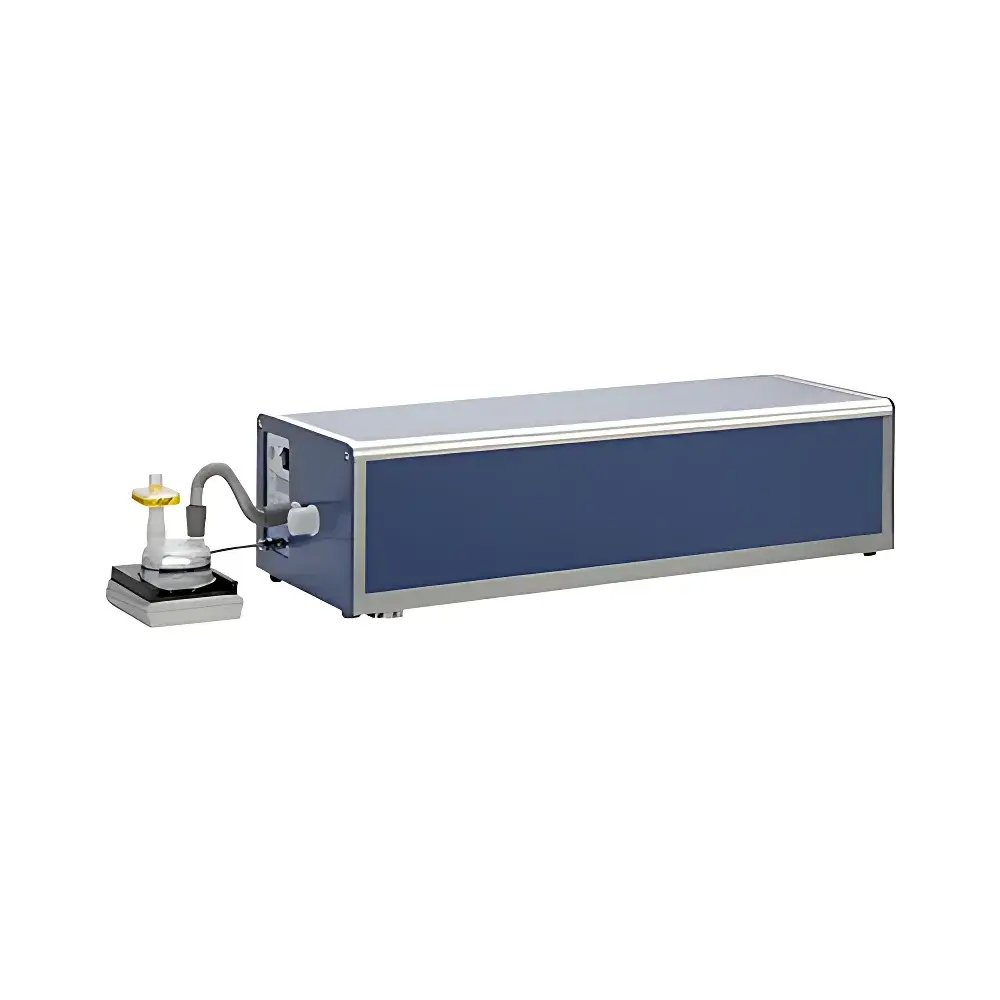
- Programmable fluid handling: optional 625FS buffer auto-filler enables synchronized, semi-automated perfusion of all four baths—reducing manual intervention and enhancing inter-bath consistency during long-duration assays (e.g., endothelial viability monitoring up to 12 hours).
- Dual gas control architecture: individual needle valves allow independent regulation of carbogen (95% O₂/5% CO₂) or nitrogen flow per bath, supporting normoxic, hypoxic, or pharmacologically induced metabolic stress protocols.
- Comprehensive analog and digital output: isolated 2.5 V full-scale analog signals per channel plus native USB 2.0 interface ensure compatibility with third-party data acquisition systems (e.g., ADInstruments PowerLab, National Instruments DAQ) and compliance with GLP/GMP-aligned timestamped acquisition workflows.
Sample Compatibility & Compliance
The DMT 620M accommodates a broad spectrum of excised biological specimens—including conduit arteries (e.g., rat aorta, human coronary), resistance arterioles (mesenteric, cerebral), bronchial rings, ileal segments, and uterine horns—with diameters spanning 60 µm to 10 mm. All stainless-steel bath components meet ASTM F899 surgical-grade corrosion resistance standards. The system supports experimental protocols aligned with ISO 10993-5 (biological evaluation of medical devices), USP environmental controls for sterile tissue handling, and FDA 21 CFR Part 11 requirements when paired with compliant software (e.g., DMT MyoView v5.x with audit trail and electronic signature modules). Bath geometry and fluid volume (≤8 mL) are optimized to minimize diffusion delays and maintain stable [Ca²⁺], [K⁺], and pH gradients during agonist/antagonist application—critical for kinetic fidelity in receptor-binding and ion channel studies.
Software & Data Management
Data acquisition and analysis are performed using DMT MyoView software—a validated, Windows-based platform designed for regulatory environments. It provides real-time visualization of tension traces, automated normalization to baseline or maximal response (e.g., KCl-induced contraction), and nonlinear regression fitting for EC₅₀/IC₅₀ determination (log[agonist] vs. response, variable slope model). Raw data are stored in HDF5 format with embedded metadata (operator ID, date/time, calibration constants, bath configuration), ensuring traceability. Audit trails record all user actions—including parameter edits, curve re-fits, and export events—with immutable timestamps. Export options include CSV, MATLAB .mat, and PDF reports compliant with journal submission standards (e.g., British Journal of Pharmacology, Arteriosclerosis, Thrombosis, and Vascular Biology). Integration with LIMS via ODBC is supported for enterprise-level sample tracking.
Applications
- Endothelium-dependent and -independent vasoreactivity: quantification of NO, prostacyclin, and EDHF-mediated relaxation; assessment of eNOS uncoupling in hypertension or diabetes models.
- Ion channel pharmacology: functional evaluation of voltage-gated Ca²⁺ (L-, T-type), K⁺ (Kv, KCa, KATP), and TRP channel modulators in vascular smooth muscle.
- G-protein-coupled receptor (GPCR) profiling: concentration–response analysis of α-adrenergic, angiotensin II, endothelin-1, serotonin, and purinergic receptors—including bias factor calculation using operational model fits.
- Pathophysiological modeling: comparative tension profiling in tissues from genetically modified animals, diet-induced metabolic syndrome models, or human biopsies (IRB-approved).
- Electrophysiology integration: synchronized recording of tension and intracellular Ca²⁺ (via fura-2 ratiometry) or membrane potential (using microelectrodes) in single-vessel preparations.
- High-throughput screening: validation of hit compounds from primary screens—particularly for antihypertensive, anti-atherosclerotic, or pulmonary arterial hypertension drug discovery pipelines.
FAQ
What tissue types are compatible with the DMT 620M?
The system supports isolated rings or segments of arteries, veins, bronchi, gastrointestinal tract, and uterus—provided the external diameter falls within 60 µm to 10 mm and the tissue remains viable under standard PSS perfusion.
Can the DMT 620M be used for pressure myography?
No. The DMT 620M is a wire myograph platform designed exclusively for isometric tension measurement. For intraluminal pressure–based studies, DMT offers the 620P Pressure Myograph System as a complementary platform.
Is temperature control independent per bath?
Yes—each of the four stainless-steel baths features its own PID-controlled heating element and dedicated Pt100 temperature sensor, allowing simultaneous operation at different setpoints (e.g., 37 °C for human tissue vs. 32 °C for murine cerebral arterioles).
How is calibration performed?
Semi-automatic calibration uses certified weights applied directly to each force transducer; software guides users through zero-balance and multi-point span verification, storing calibration coefficients with NIST-traceable uncertainty values.
Does the system support GLP-compliant data archiving?
When configured with MyoView’s 21 CFR Part 11 module—including role-based access control, electronic signatures, and immutable audit logs—the system meets core GLP documentation requirements for preclinical pharmacology studies.