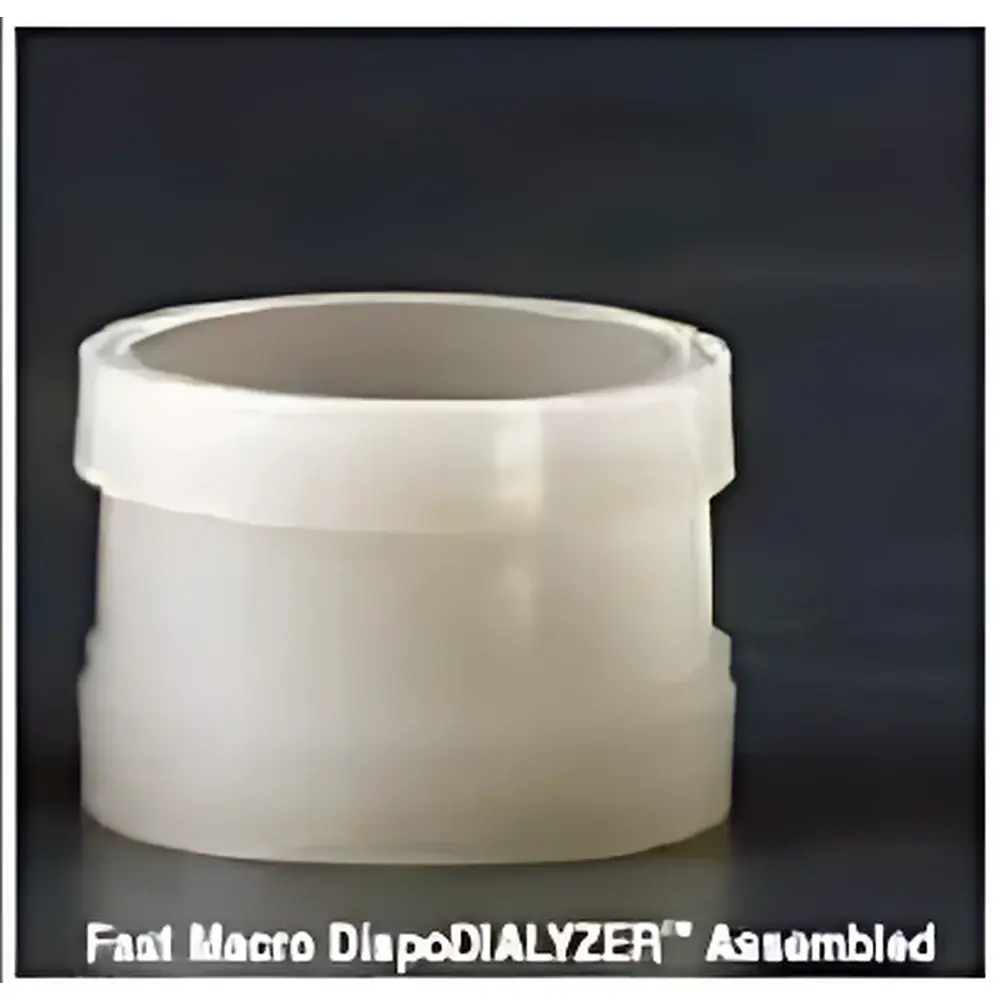
96-well Dispo DIALYZERTM High-Throughput Disposable Dialysis Plate
| Origin | USA |
|---|---|
| Manufacturer Type | Authorized Distributor |
| Origin Category | Imported |
| Model | 96-well Dispo DIALYZERTM |
| Pricing | Upon Request |
Overview
The 96-well Dispo DIALYZERTM is a single-use, high-throughput microplate-format dialysis device engineered for rapid equilibrium and kinetic dialysis studies in drug discovery, protein biochemistry, and metabolite binding assays. Based on classic membrane diffusion principles, it utilizes semi-permeable regenerated cellulose or polyethersulfone (PES) membranes with defined molecular weight cutoffs (typically 3.5–10 kDa) to enable selective solute exchange between sample and buffer compartments under controlled conditions. Each well operates as an independent dialysis unit, eliminating cross-contamination risks associated with multi-sample batch processing. Designed for compatibility with standard 96-well microplate handlers, orbital shakers, and incubators, the system supports automation-ready workflows without requiring specialized hardware or fluidic integration.
Key Features
- True 96-well parallel dialysis architecture—enables simultaneous processing of up to 96 samples per run, significantly reducing assay turnaround time compared to traditional capillary or stirred-cell methods.
- Pre-sterilized, individually sealed wells—guarantees endotoxin-free operation and eliminates cleaning validation requirements, supporting GLP-compliant laboratory environments.
- Optimized membrane surface-to-volume ratio—ensures efficient mass transfer kinetics for low-volume samples (25–300 µL), minimizing equilibration time while preserving analyte integrity.
- Integrated lid with vapor barrier seal—prevents evaporation during extended incubations (up to 72 h at 37°C), maintaining consistent sample concentration and osmotic balance.
- Chemical resistance to common organic solvents (e.g., DMSO, methanol, acetonitrile) and physiological buffers—validated for use in compound solubility screening and plasma protein binding studies.
- Compatible with downstream analytical platforms—including HPLC, LC-MS/MS, UV-Vis spectrophotometry, and fluorescence polarization—without need for sample transfer or dilution.
Sample Compatibility & Compliance
The 96-well Dispo DIALYZERTM accommodates diverse biological matrices including human serum, plasma, cerebrospinal fluid (CSF), cell lysates, and recombinant protein solutions. It has been validated per ISO 10993-5 (cytotoxicity) and USP (biological reactivity), and meets ASTM F2542-06 standards for in vitro dialysis performance testing. The device is manufactured under ISO 13485-certified quality management systems and supplied with full traceability documentation, including lot-specific membrane characterization reports (MWCO verification, pore size distribution, and extractables profiles). For regulated environments, the plate supports audit-ready workflows compliant with FDA 21 CFR Part 11 when used in conjunction with validated LIMS or ELN software.
Software & Data Management
While the Dispo DIALYZERTM is a passive, non-instrumented consumable, its design enables seamless integration into structured data capture ecosystems. Sample tracking templates (CSV/XLSX) are provided for metadata logging—including donor ID, incubation time/temperature, buffer composition, and membrane lot number—to ensure full experimental traceability. When paired with automated liquid handlers (e.g., Tecan Freedom EVO, Hamilton STAR), it interfaces with scheduling software that logs timestamps, plate positioning, and environmental parameters. All documentation packages comply with ALCOA+ principles (Attributable, Legible, Contemporaneous, Original, Accurate, Complete, Consistent, Enduring, Available), facilitating internal QA reviews and regulatory inspections.
Applications
- Plasma protein binding (PPB) assessment across lead optimization campaigns, supporting IC50 correction and free fraction estimation per ICH M3(R2) guidelines.
- Drug–target engagement kinetics using radiolabeled or fluorescent tracers in competitive dialysis formats.
- Metabolite dialysis profiling in ADME studies, particularly for labile conjugates (e.g., glucuronides, sulfates) requiring minimal handling.
- Buffer exchange and desalting of nanogram-scale antibody fragments prior to SPR or BLI analysis.
- High-throughput screening of formulation excipients for their impact on small-molecule membrane permeability and binding affinity.
FAQ
What membrane materials are available for the 96-well Dispo DIALYZERTM?
Standard configurations use regenerated cellulose (RC) with 3.5 kDa MWCO; custom orders support PES (10 kDa) and cellulose acetate (20 kDa) membranes upon request.
Can the plate be centrifuged after dialysis?
Yes—each well is rated for centrifugation at ≤3,000 × g for 5 minutes to recover retentate without membrane rupture or leakage.
Is pre-wetting required before use?
No—plates are pre-hydrated and sterilized; direct loading of samples is recommended to avoid variability from manual wetting steps.
How should spent plates be disposed of?
Treat as biohazardous waste per institutional biosafety protocols; RC membranes are biodegradable, but PES variants require incineration-compatible disposal pathways.
Are there lot-to-lot consistency data available?
Yes—certificate of analysis includes MWCO verification via dextran rejection testing, water flux rate, and endotoxin levels (<0.03 EU/mL).