
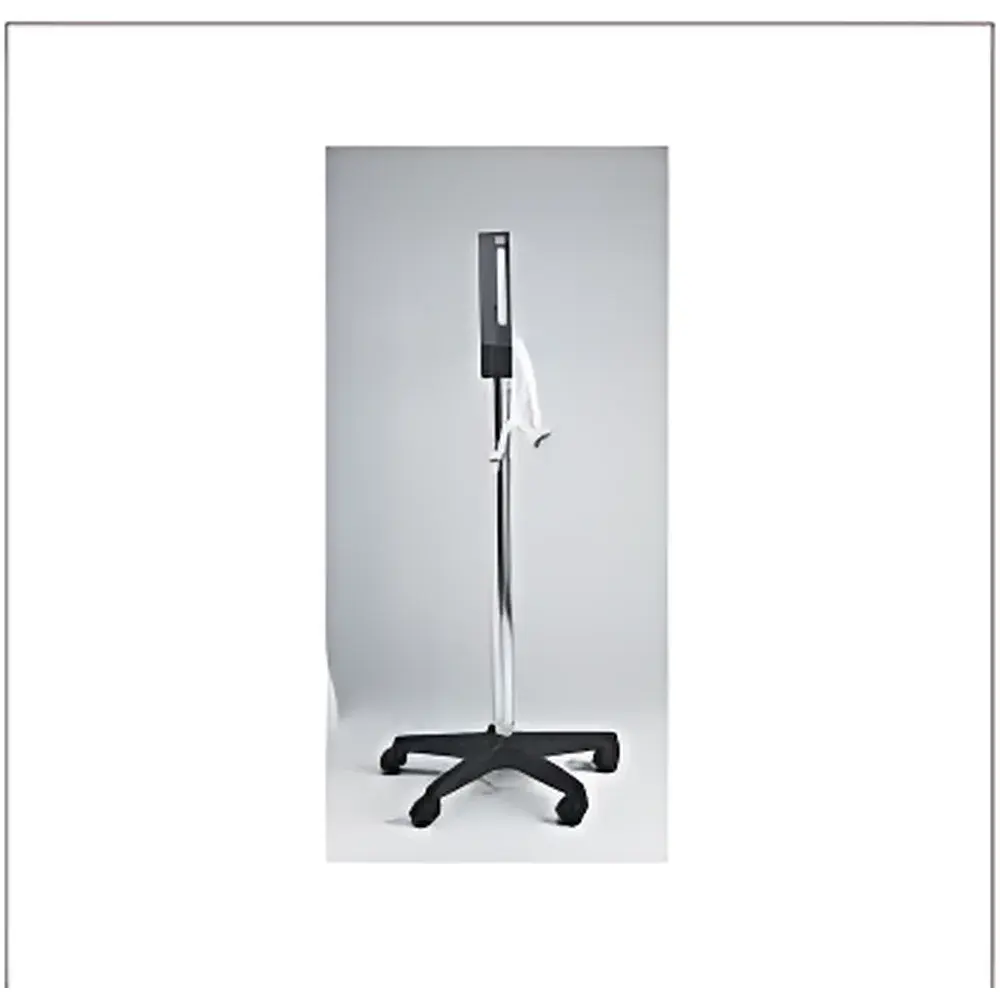
Harvard Apparatus Vaporstick Anesthesia Machine
| Brand | Harvard Apparatus |
|---|---|
| Origin | USA |
| Model | Vaporstick Anesthesia Machine |
| Flow Rate Range | 0.2–4 L/min (O₂) |
| Optional N₂O Flowmeter | Yes |
| Fail-Safe Valve | Included (Model 723009) |
| Mounting | Z-Bracket Universal Vaporizer Holder |
| Circuit Type | Non-rebreathing (Jackson-Rees, Mapleson D) |
| Upgradeable to Rebreathing | Yes (with external CO₂ absorber) |
| Frame | 5-Point Castor Base with MRI-Compatible Option |
| Construction | FDA-Approved Polymer Housing |
| Surface Finish | Electrostatic Powder Coating |
| Dimensions (H×W) | 134 cm × 152.4 mm |
| Weight Capacity | Up to 4.5 kg Animals |
| Exhaust Management | Active Scavenging-Compatible Pop-up Exhaust Valve |
| Fresh Gas Outlet | Dedicated Non-rebreathing Port |
| Absorber Design | Sealed Canister with Optimized Soda Lime Exposure Geometry |
Overview
The Harvard Apparatus Vaporstick Anesthesia Machine is a precision-engineered, compact veterinary anesthesia delivery system designed exclusively for small animal research applications—primarily rodents, rabbits, and avian models weighing up to 4.5 kg. It operates on the principle of non-rebreathing (semi-open) anesthetic circuitry, delivering precisely metered oxygen (and optionally nitrous oxide) directly to the subject without CO₂ re-inhalation. Unlike high-flow rebreathing systems requiring carbon dioxide scrubbing, the Vaporstick leverages low dead-space Jackson-Rees or Mapleson-D configurations, minimizing resistance and ensuring rapid anesthetic induction and recovery. Its core architecture integrates gas flow regulation, fail-safe pressure management, and active waste-gas scavenging compatibility—all within a rigid, electrostatically coated polymer chassis certified for long-term laboratory use under GLP-compliant environments.
Key Features
- Adjustable oxygen flow control from 0.2 to 4.0 L/min via calibrated rotameter, optimized for physiological demand in small mammals and birds.
- Dedicated O₂ flush valve enabling immediate high-flow oxygen delivery (≥10 L/min bypass) for emergency desaturation or circuit priming.
- Z-Bracket universal vaporizer mounting system—compatible with standard ISO 80601-compliant isoflurane, sevoflurane, and halothane vaporizers—ensuring mechanical stability and leak-free alignment.
- Pop-up exhaust valve integrated with active scavenging interfaces, maintaining consistent bag inflation while preventing barotrauma during spontaneous or assisted ventilation.
- FDA-approved polymer housing with powder-coated finish resists chemical degradation from anesthetic agents and facilitates decontamination between procedures.
- Five-point castor base with 152 mm diameter wheels provides maximum floor contact area and vibration-damped mobility—certified MRI-compatible in designated configurations.
- Modular upgrade path: addition of an external CO₂ absorption unit (e.g., Harvard Apparatus Absorbaire™) converts the system into a semi-closed rebreathing configuration per ISO 80601-2-13 requirements.
Sample Compatibility & Compliance
The Vaporstick supports non-rebreathing circuits for subjects ranging from neonatal mice (≥15 g) to adult New Zealand white rabbits (≤4.5 kg). It is validated for use with 0.5 L Jackson-Rees breathing bags (Cat. #32346B3), avian-specific 0.25 L circuits (Cat. #32359B2), and MJR non-rebreathing manifolds (Cat. #32359B6). All wetted components comply with USP Class VI biocompatibility standards; gas pathways meet ASTM F1877-22 specifications for anesthetic gas delivery integrity. The system conforms to IEC 60601-1 general safety requirements and carries CE marking for Class IIa medical devices. Optional fail-safe N₂O/O₂ dual flowmeter configuration (Model 723009) incorporates pressure-sensing interlocks compliant with ISO 80601-2-13 Annex BB for hypoxic guard functionality.
Software & Data Management
The Vaporstick is a hardware-only platform with no embedded microprocessor or digital interface—intentionally designed to eliminate software validation burdens in regulated preclinical studies. All operational parameters are manually set and visually verified via analog rotameters and mechanical pressure indicators. This architecture ensures full auditability under FDA 21 CFR Part 11 and EU Annex 11 frameworks: no electronic records require validation, no firmware updates necessitate requalification, and all user actions are directly traceable through procedural documentation. For labs requiring integration with digital monitoring ecosystems, analog pressure and flow outputs can be connected to third-party data acquisition systems (e.g., ADInstruments PowerLab) via 0–10 V or 4–20 mA transducers (sold separately).
Applications
- Induction and maintenance of inhalational anesthesia in longitudinal rodent neuroimaging studies (fMRI, PET, optical imaging).
- Surgical preparation for intracranial, thoracic, or orthopedic procedures in mice and rats under terminal or survival protocols.
- Avian respiratory physiology experiments requiring minimal circuit dead space and rapid gas exchange kinetics.
- Pharmacokinetic modeling of volatile anesthetics using controlled uptake and washout profiles.
- Training platforms for veterinary students in principles of anesthetic gas physics and circuit dynamics.
- GLP-compliant toxicology studies where hardware simplicity and regulatory transparency are prioritized over digital automation.
FAQ
Is the Vaporstick suitable for pediatric or neonatal rodent models?
Yes—when used with appropriately sized breathing circuits (e.g., 0.25 L avian bags or custom micro-bags), the 0.2 L/min minimum flow rate enables precise titration for animals as small as 15 g.
Can the Vaporstick be used inside MRI suites?
Select configurations (non-magnetic castors, brass-free flowmeters, and polymer housing) are certified MRI-compatible up to 3 Tesla; consult Harvard Apparatus Technical Bulletin TB-VAP-03 for full shielding specifications.
What vaporizers are compatible with the Z-Bracket mounting system?
All ISO 80601-2-13 compliant vaporizers with standard 22 mm male inlet/outlet ports, including Dräger Vapor 2000, Ohmeda Tec 7, and Penlon Sigma Delta units.
Does the system include CO₂ monitoring capability?
No—CO₂ capnography requires external analyzers (e.g., Harvard Apparatus CapnoScan™); the Vaporstick’s non-rebreathing design inherently eliminates CO₂ rebreathing, making real-time monitoring optional rather than mandatory.
How is calibration performed and documented?
Rotameters are factory-calibrated per ISO 80601-2-13 Annex J; users perform annual verification using NIST-traceable flow meters—records maintained per GLP §58.130(c) as part of facility SOPs.




