
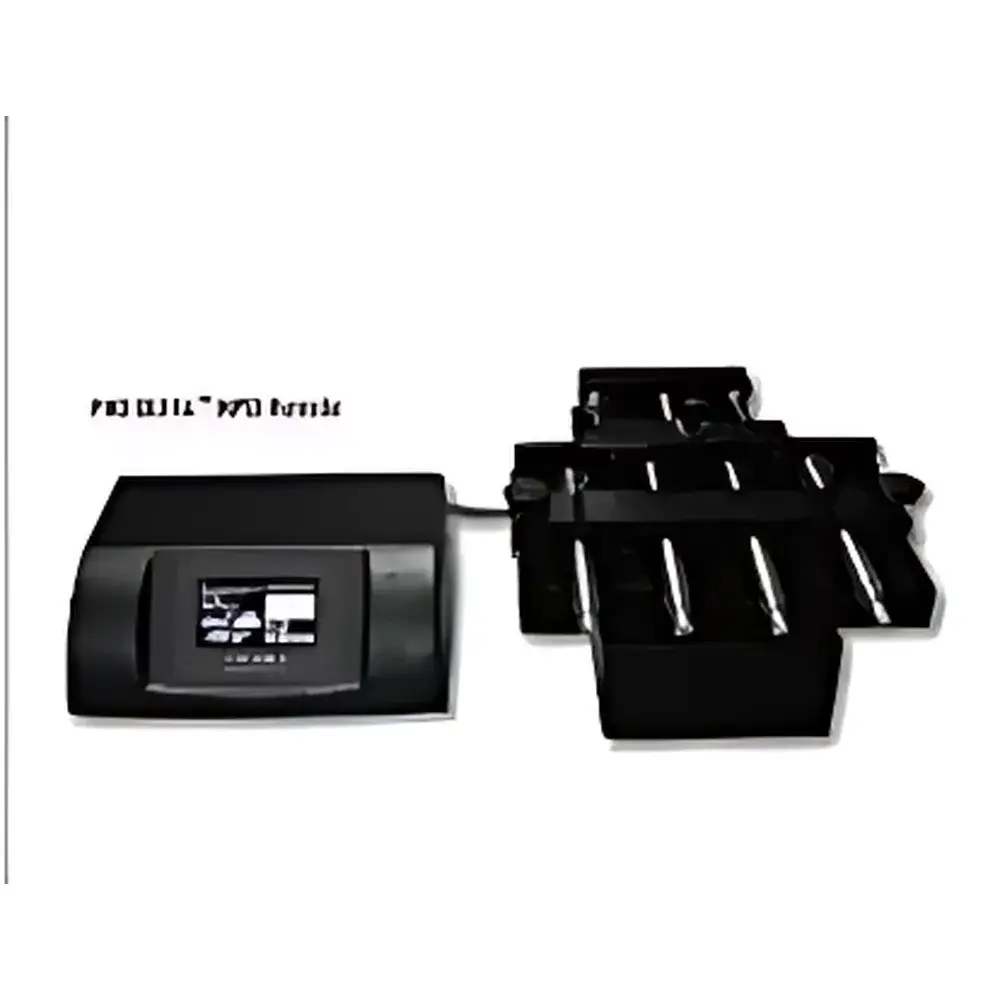
Harvard Apparatus PHD ULTRA HPSI High-Pressure Syringe Pump
| Brand | Harvard Apparatus |
|---|---|
| Origin | USA |
| Model | PHD ULTRA HPSI |
| Maximum Flow Rate | 220.82 mL/min (with 140 mL syringe) |
| Max Force Output | 400 lbf |
| Syringe Compatibility | Harvard stainless steel syringes only |
| Programmable Modes | Continuous infusion, Volume-based dispensing, Auto-fill with valve manifold |
| Internal Non-Volatile Memory | Yes |
| Construction | Industrial-grade stainless steel chassis |
| Power Supply | 100–240 VAC, 50/60 Hz |
| Certifications | CE, UL 61010-1 compliant |
| Operating Temperature | 10–40 °C |
| Relative Humidity | ≤80% non-condensing |
| Dimensions (W×H×D) | 25.4 × 17.8 × 30.5 cm |
| Weight | 9.1 kg |
Overview
The Harvard Apparatus PHD ULTRA HPSI is a high-force, microprocessor-controlled syringe pump engineered for precision fluid delivery under elevated backpressure conditions commonly encountered in chromatography, microfluidics, high-pressure reactor feeding, and analytical sample introduction systems. Unlike conventional peristaltic or piston-driven pumps, the PHD ULTRA HPSI employs a dual-lead-screw linear actuator system coupled with closed-loop force feedback to maintain consistent volumetric displacement—even when downstream resistance fluctuates significantly. Its design adheres to the fundamental principle of positive displacement: flow rate is determined solely by syringe geometry and plunger advancement velocity, enabling traceable, repeatable delivery independent of fluid viscosity or compressibility within operational limits. The system is optimized for use exclusively with Harvard Apparatus stainless steel syringes—ensuring mechanical integrity, chemical compatibility with aggressive solvents (e.g., THF, concentrated acids/bases), and dimensional consistency critical for calibration traceability.
Key Features
- High-force actuation delivering up to 400 lbf (1.78 kN) of push force—enabling operation against backpressures exceeding 10,000 psi when paired with appropriately rated stainless steel syringes and tubing.
- Scalable volume capacity: supports single syringes up to 140 mL or quad-syringe configurations (four 200 mL syringes) for extended unattended operation up to 800 mL total volume.
- Onboard programmability without external PC: intuitive keypad interface with real-time parameter display allows creation, storage, and recall of multi-step protocols—including ramped flow rates, timed pauses, and conditional triggers—directly in non-volatile memory.
- Dual operational modes: continuous infusion (constant flow rate) and volume-based dispensing (precise endpoint control), both with adjustable acceleration/deceleration profiles to minimize pulsation and pressure transients.
- Auto-fill capability via integrated valve manifold interface—supports automated priming, recirculation, and solvent exchange sequences compatible with standard or high-pressure fluidic switching valves (e.g., Rheodyne, VICI Valco).
- Rugged industrial architecture: machined stainless steel frame, sealed electronics, and hardened lead screws ensure long-term mechanical stability and resistance to laboratory environmental stressors including vibration, thermal drift, and incidental chemical exposure.
Sample Compatibility & Compliance
The PHD ULTRA HPSI is validated for use only with Harvard Apparatus-certified stainless steel syringes (e.g., SS-140, SS-200), which undergo dimensional inspection per ISO 7886-1 and pressure rating verification per ASME B31.3 process piping guidelines. This exclusivity ensures predictable force transmission, eliminates seal extrusion risk at high loads, and maintains metrological traceability to NIST-traceable calibration standards. The pump complies with IEC/EN 61010-1 for electrical safety in laboratory equipment and carries CE marking under the EU Low Voltage and EMC Directives. It supports GLP/GMP workflows through audit-ready protocol logging (time-stamped start/stop events, parameter changes, error flags) and optional RS-232 or USB-C communication for integration into LIMS or SCADA environments requiring 21 CFR Part 11-compliant electronic records.
Software & Data Management
While fully functional as a standalone instrument, the PHD ULTRA HPSI offers bidirectional serial communication (RS-232 or USB-C) for remote command execution and real-time telemetry. Harvard’s proprietary PumpControl software (Windows/macOS) enables advanced scripting—such as synchronized multi-pump coordination, time-series data export in CSV/TXT format, and automated calibration curve generation using known syringe diameters. All user-defined methods are stored in battery-backed SRAM, retaining settings across power cycles without dependency on external storage. Firmware updates are delivered via signed binary packages to ensure integrity; version history and checksum validation are logged internally for regulatory review.
Applications
- HPLC/UHPLC mobile phase delivery in method development where gradient delay volume minimization and pulse-free flow are critical.
- Microreactor feed systems requiring stoichiometrically precise reagent addition under pressures >6,000 psi.
- Preparative-scale supercritical fluid chromatography (SFC) with CO₂/methanol mobile phases.
- Calibration standard delivery in elemental analysis (ICP-MS, ICP-OES) where sub-microliter accuracy and matrix-matched dilution are required.
- Long-duration pharmacokinetic studies involving multi-hour intravenous infusions with programmable dose escalation.
- Material science applications including ceramic slurry injection into porous molds under controlled shear conditions.
FAQ
Can the PHD ULTRA HPSI be used with glass or plastic syringes?
No. Only Harvard Apparatus stainless steel syringes are supported due to mechanical load requirements and dimensional tolerances essential for force calibration and leak-free operation at high pressure.
Is the pump suitable for corrosive solvents such as hydrofluoric acid or fuming nitric acid?
Stainless steel syringes exhibit limited resistance to HF and fuming HNO₃; consult Harvard’s Chemical Compatibility Guide and consider PTFE-lined or Hastelloy alternatives where applicable—pump body materials remain compatible, but syringe selection is application-specific.
Does the internal memory retain programs after power loss?
Yes. All user protocols, calibration offsets, and system configurations are stored in non-volatile memory with guaranteed retention exceeding 10 years.
What validation documentation is provided for GxP environments?
Factory-issued IQ/OQ documentation, as-found/as-left calibration reports traceable to NIST standards, and firmware version audit logs are available upon request to support 21 CFR Part 11 and Annex 11 compliance.
How is flow accuracy verified across different syringe sizes?
Accuracy is maintained via diameter input validation against Harvard’s internal lookup table (ISO 7886-1 certified dimensions); users may also perform gravimetric verification per USP using certified analytical balances and temperature-controlled collection vessels.



