
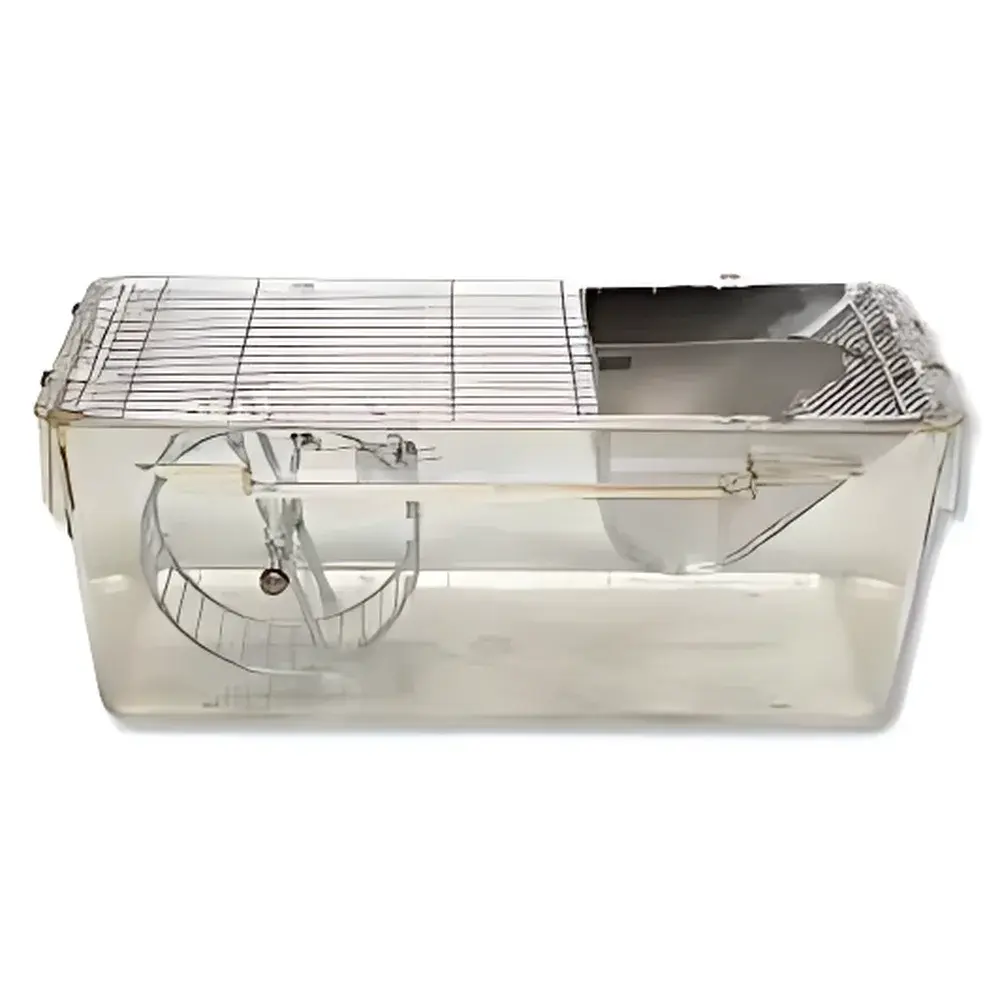
ClockLab Animal Circadian Rhythm Analysis Software by Harvard Apparatus
| Brand | Harvard Apparatus |
|---|---|
| Origin | USA |
| Model | ClockLab |
| Interface | USB 2.0 + RJ-45 high-throughput data acquisition |
| Max Input Channels | 448 (8 interface boxes × 56 channels each) |
| Output Channels | 64 light-control channels (8 boxes × 8 outputs) |
| Supported Species | Mus musculus, Rattus norvegicus, Mesocricetus auratus, Drosophila melanogaster, Apis mellifera, Chlamydomonas reinhardtii, Lynx lynx, Sciurus carolinensis, Thomomys bottae, Chelonia mydas, Limulus polyphemus, Homo sapiens |
| Data File Compatibility | Minimitter, Actiwatch, Dataquest, Stanford Sleep Lab formats |
| OS Support | Windows 2000/XP/Vista/7/10, macOS 9.x and macOS X (Intel & Apple Silicon via Rosetta 2) |
| Power Failure Recovery | Full session state retention and auto-resume |
| Data Export | CSV, MATLAB (.mat), XML, PNG, TIFF, PDF |
| Compliance | GLP-aligned metadata logging, FDA 21 CFR Part 11–ready audit trail (optional configuration) |
Overview
ClockLab is a rigorously engineered software platform developed by Harvard Apparatus for the acquisition, visualization, and quantitative analysis of circadian and ultradian behavioral rhythms in biological systems. Built upon a deterministic real-time data acquisition architecture, ClockLab implements event-driven timestamping with microsecond-level resolution for photobeam breaks, wheel rotations, and digital stimulus outputs. Its core analytical engine applies robust periodogram methods—including chi-square periodogram, Lomb-Scargle spectral estimation, and FFT-based power spectrum analysis—to extract free-running period (τ), phase angle of entrainment (ψ), activity onset (α), and rhythm amplitude from long-term locomotor records. Designed explicitly for chronobiology laboratories, ClockLab supports both constant darkness (DD) and entrained lighting paradigms—including T-cycles (e.g., T20, T22, T26), skeleton photoperiods, and discrete light pulses—enabling precise quantification of phase shifts, aftereffects, and entrainment thresholds per ISO 8601-compliant time-series metadata.
Key Features
- Modular hardware interface architecture: Each USB-connected interface box supports 56 digital input channels (for running wheels, infrared beam breaks, piezoelectric sensors) and 8 programmable TTL-compatible light-control outputs, scalable to 448 simultaneous inputs across eight units.
- Real-time, non-blocking data streaming: Continuous acquisition persists during file export, graph rendering, or parameter reconfiguration; no data loss during network transfer or system sleep/wake cycles.
- Deterministic phase analysis workflow: Automated activity onset detection using adaptive thresholding and moving-window smoothing; manual override with frame-accurate cursor placement for validation.
- Multi-species rhythm profiling: Preconfigured templates and normalization protocols for rodents, insects, algae, reptiles, and even non-biological time-series (e.g., Mars lander soil chemistry logs), ensuring cross-taxa comparability.
- Fault-tolerant operation: Full session state persistence across unexpected power loss or OS crash; automatic recovery preserves timestamps, channel mappings, and experimental metadata without user intervention.
Sample Compatibility & Compliance
ClockLab accommodates diverse behavioral assay configurations—from single-wheel cages to multi-tiered photoperiod arrays—and natively ingests binary and ASCII-formatted logs from third-party systems including Mini-Mitter G2/G3, Philips Actiwatch Spectrum, Dataquest A.R.T., and Stanford Sleep Lab archives. All data files retain embedded acquisition timestamps synchronized to UTC via NTP-capable host systems. The software adheres to GLP principles through immutable metadata tagging (operator ID, protocol version, cage ID, light history), optional electronic signature enforcement, and configurable audit trails compliant with FDA 21 CFR Part 11 when deployed with validated IT infrastructure. Exported datasets include ISO 8601 timestamps, SI-unit–normalized activity counts (rev/min, beam-breaks/hour), and machine-readable JSON sidecar files for FAIR data management.
Software & Data Management
The ClockLab desktop application features a dual-pane interface: left-side tree navigation for hierarchical experiment organization (project → cohort → animal → session), and right-side dynamic canvas supporting synchronized overlay of actograms, periodograms, waveform plots, and phase-response curves. Batch processing enables parallel analysis of >100 subjects using identical parameters; results are aggregated into summary spreadsheets with statistical descriptors (mean τ ± SD, inter-animal phase variance, rhythm strength index). Raw data is stored in compressed HDF5 containers with checksum integrity verification; exports support publication-grade vector graphics (PDF/EPS) and raster formats (TIFF/PNG) at user-defined DPI. Remote access is enabled via secure HTTP(S) endpoints—allowing off-site monitoring of ongoing experiments without interrupting local acquisition threads.
Applications
ClockLab serves as the de facto standard platform in academic and pharmaceutical chronobiology labs for: characterizing genetic perturbations in clock gene knockouts (e.g., Bmal1⁻/⁻, Per2luc); evaluating pharmacological phase-resetting agents (melatonin agonists, REV-ERB modulators); modeling jet-lag and shift-work desynchrony in murine models; validating optogenetic entrainment protocols in Drosophila; correlating locomotor fragmentation with neurodegenerative progression in tauopathy models; and benchmarking environmental zeitgeber strength (e.g., dim-light melatonin onset, DLMO) in human clinical trials. Its extensible plugin API also permits integration with electrophysiology suites (e.g., Spike2, Plexon) and metabolic monitoring platforms (e.g., Promethion, CLAMS) for multimodal circadian phenotyping.
FAQ
Does ClockLab support automated phase-shift calculation following light pulses?
Yes. The software computes phase advances or delays relative to baseline using the “cross-correlation onset” method, with user-definable pre-pulse baselines (typically 5–7 days) and post-pulse windows (up to 14 days). Results are reported in circadian hours (±0.1 h resolution) with confidence intervals derived from bootstrap resampling.
Can I import and reanalyze legacy data collected with older versions of ClockLab or third-party systems?
Yes. ClockLab includes backward-compatible readers for ClockLab v1.x .clb archives, as well as converters for Actiwatch .awd, Mini-Mitter .bin/.txt, and Dataquest .dat formats. Metadata mapping preserves original acquisition settings, including sampling rate and channel calibration.
Is ClockLab validated for use in regulated preclinical studies?
While ClockLab itself is not an FDA-cleared device, its architecture meets key elements of ALCOA+ (Attributable, Legible, Contemporaneous, Original, Accurate, Complete, Consistent, Enduring, Available) data integrity criteria. Validation packages—including IQ/OQ documentation, boundary testing reports, and electronic signature configuration guides—are available under NDA for GxP environments.
How does ClockLab handle data from multiple light-controlled chambers operating under different photoperiods?
Each interface box maintains independent light-output scheduling tables, synchronized to a master system clock. The software logs irradiance history per channel (lux or µW/cm² if calibrated) alongside behavioral events, enabling post-hoc correlation of light exposure dose–response relationships with phase resetting magnitude.
What computing resources are required for real-time analysis of 448-channel datasets?
A minimum of 16 GB RAM, quad-core x64 CPU (Intel i5-8500 or equivalent), and SSD storage is recommended. For continuous 30-day acquisitions across all channels, sustained write throughput of ≥80 MB/s is required; ClockLab dynamically throttles GUI updates to maintain acquisition fidelity under load.




