
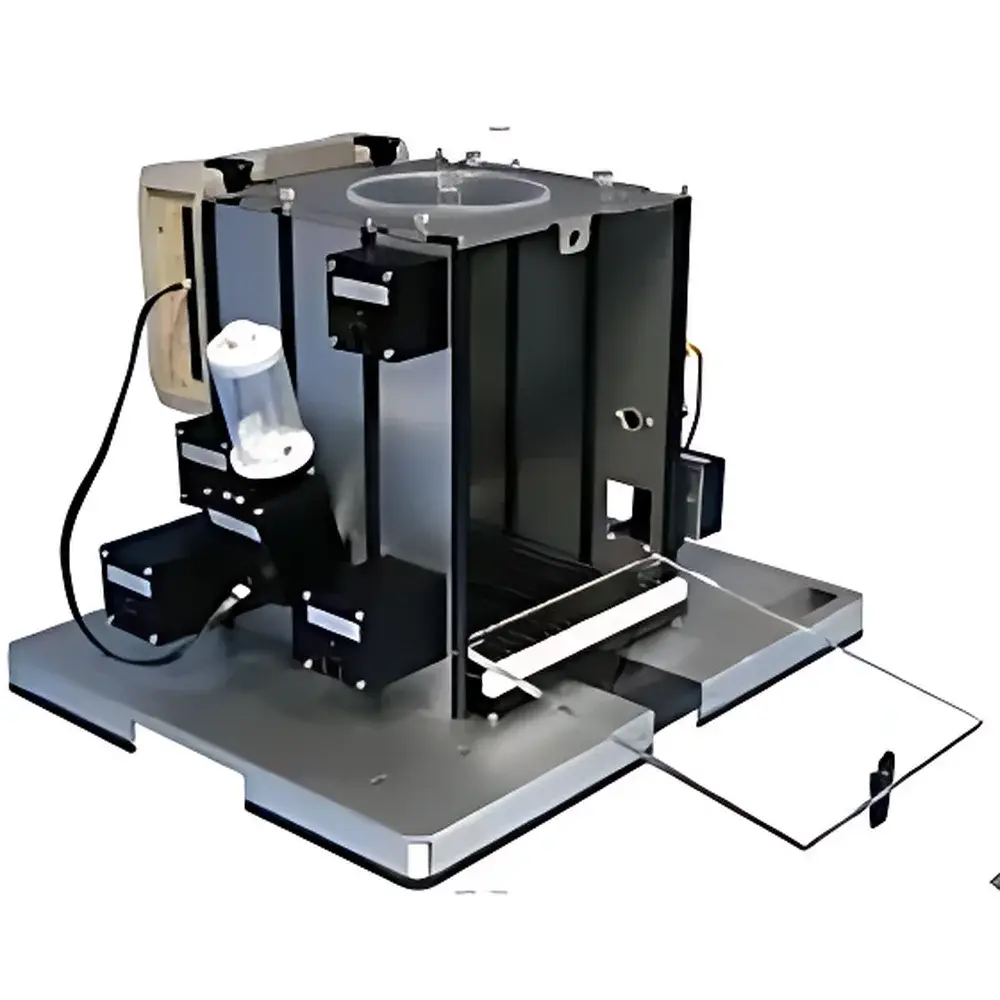
Panlab Modular Operant Conditioning Chamber
| Brand | Harvard Apparatus |
|---|---|
| Origin | USA |
| Model | LE1002 / LE1005 |
| Construction | Stainless steel, aluminum alloy, and methyl methacrylate |
| Dimensions (Base) | 400 × 360 × 35 mm |
| Mouse Chamber | 200 × 200 × 250 mm |
| Rat Chamber | 250 × 250 × 250 mm |
| Scalability | 1–8 chambers standard, upgradable to 16 |
| Connectivity | USB-based hardware interface (no PCI card required) |
| Software Platform | Packwin 2.0 |
| Module Options | Lever press, nose-poke, food/water delivery, auditory stimuli (pure tone & broadband noise), visual stimuli (LED lighting), foot shock, intracranial/IV drug infusion ports, transparent access door, overhead camera port, interchangeable floor/wall panels (material & color configurable) |
Overview
The Panlab Modular Operant Conditioning Chamber (LE1002/LE1005) is a rigorously engineered platform for preclinical behavioral neuroscience research, rooted in the operant conditioning paradigm pioneered by B.F. Skinner. Designed for high-fidelity replication of learning, motivation, and decision-making processes in rodents, this system implements precise stimulus-response-contingency protocols grounded in principles of instrumental conditioning. Its architecture supports both discrete-trial and continuous-time behavioral paradigms—including fixed-ratio, variable-interval, and chained schedules—enabling quantitative assessment of cognitive flexibility, reinforcement sensitivity, inhibitory control, and adaptive behavior. The chamber operates as a closed-loop experimental environment where hardware events (lever press, nose-poke, shock onset) are temporally synchronized with software-defined contingencies and real-time data acquisition. This integration ensures compliance with GLP-aligned experimental traceability standards, supporting longitudinal studies in translational models of psychiatric disorders, neuropharmacology, and circuit-level behavioral phenotyping.
Key Features
- True modularity: Interchangeable walls, floors, and mounting interfaces permit rapid reconfiguration between mouse and rat configurations without tools—validated for both C57BL/6 and Sprague-Dawley strains.
- Stimulus diversity: Integrated, calibrated modules include precision lever actuators (±0.5 g force threshold), infrared nose-poke detectors (10 ms latency), programmable LED arrays (450–650 nm, 0–100% intensity), audio transducers (20 Hz–20 kHz, ±1 dB flat response), and constant-current foot shock units (0.01–1.0 mA, 10 µs pulse resolution).
- Non-invasive access architecture: Front-mounted transparent polycarbonate door enables unobstructed video tracking; top-mounted optical port accommodates stereotactic cannulae or endoscopic imaging systems without chamber disassembly.
- Material versatility: Floor and wall panels available in matte black acrylic (low reflectance), stainless steel (electrophysiological grounding), or textured polymer (tactile cue differentiation)—all autoclavable and compliant with IACUC housing standards.
- Scalable deployment: Synchronized operation of up to 16 chambers via single USB hub interface; no dedicated expansion cards or proprietary bus architecture required.
Sample Compatibility & Compliance
The LE1002/LE1005 chamber meets NIH OLAW and AAALAC International requirements for rodent behavioral testing infrastructure. Its mechanical design conforms to Guide for the Care and Use of Laboratory Animals (8th ed.) specifications for enclosure volume, ventilation rate (>15 air changes/hour), and acoustic isolation (≥35 dB attenuation at 1 kHz). All electrical components comply with UL 61010-1 and IEC 61000-6-3 EMC standards. Stimulus delivery modules are calibrated per ASTM E2911-13 (standard practice for calibration of behavioral apparatus) and support audit trails required under FDA 21 CFR Part 11 when used with Packwin 2.0’s electronic signature and version-controlled protocol archiving.
Software & Data Management
Packwin 2.0 serves as the deterministic control and analysis engine for the entire Panlab operant platform. Written in C++ with real-time kernel scheduling, it guarantees sub-millisecond event timing accuracy (<50 µs jitter) across all connected chambers. Its modular architecture allows selective licensing of protocol libraries—including DRL-72s, DMTP/DNMTS, Vogel conflict, Geller-Seifter, and intravenous self-administration templates—each validated against published behavioral benchmarks. Data streams (event timestamps, stimulus parameters, analog inputs) are stored in HDF5 format with embedded metadata (animal ID, protocol version, operator, timestamp, hardware firmware revision). Batch analysis tools generate standardized reports compliant with ARRIVE 2.0 guidelines, including inter-response time distributions, session-by-session learning curves, and Pavlovian-to-instrumental transfer indices. Packwin 2.0 also provides native API hooks (DLL/COM) for MATLAB, Python (via PyPackwin), and LabVIEW integration—enabling closed-loop optogenetic or electrophysiological triggering.
Applications
This system supports rigorous investigation across multiple domains of behavioral neuroscience:
• Cognitive assays: Delayed matching-to-position (DMTP), non-matching-to-position (DNMTP), and set-shifting tasks requiring working memory and rule updating.
• Affective modeling: Vogel conflict test (punishment-suppressed drinking), Geller-Seifter schedule-induced polydipsia, and chronic mild stress paradigms with automated behavioral scoring.
• Motivational phenotyping: Progressive ratio breakpoint analysis, effort-based decision making (T-maze effort discounting), and sucrose preference with lickometer integration.
• Addiction research: Intravenous self-administration (IVSA) of cocaine, nicotine, or opioids with dose escalation, extinction/reinstatement, and cue-induced relapse protocols.
• Psychopharmacology: Dose-response characterization of dopaminergic, serotonergic, or glutamatergic agents on response inhibition (stop-signal task) or compulsive checking behavior.
• Circuit dissection: Combined use with fiber photometry or miniscope recording via synchronized TTL triggers and analog voltage outputs.
FAQ
What rodent species and strains are validated for use with the LE1002/LE1005 chamber?
The system is validated for C57BL/6J, BALB/c, CD-1, and Sprague-Dawley rats and mice; strain-specific mounting kits and stimulus thresholds are included in the configuration wizard.
Does Packwin 2.0 support third-party hardware integration?
Yes—via TTL, analog voltage, and RS-232 interfaces; documented SDKs enable bidirectional communication with optogenetic controllers (e.g., Prizmatix), electrophysiology amplifiers (e.g., Intan), and environmental monitoring systems.
How is timing accuracy verified and maintained across multi-chamber experiments?
Each chamber’s microcontroller performs internal clock synchronization via USB frame timing; Packwin logs hardware timestamp offsets and applies dynamic skew correction during post-hoc alignment.
Can protocols be exported for regulatory submission or cross-laboratory replication?
Yes—protocols are saved as XML with embedded parameter constraints and version history; export packages include human-readable PDF summaries, raw HDF5 datasets, and checksum-verified archives for audit readiness.
Is remote monitoring and control supported?
Packwin 2.0 includes secure RDP-compatible remote desktop mode with role-based access controls; live event streaming to networked displays is enabled via UDP multicast with configurable bandwidth limits.




