
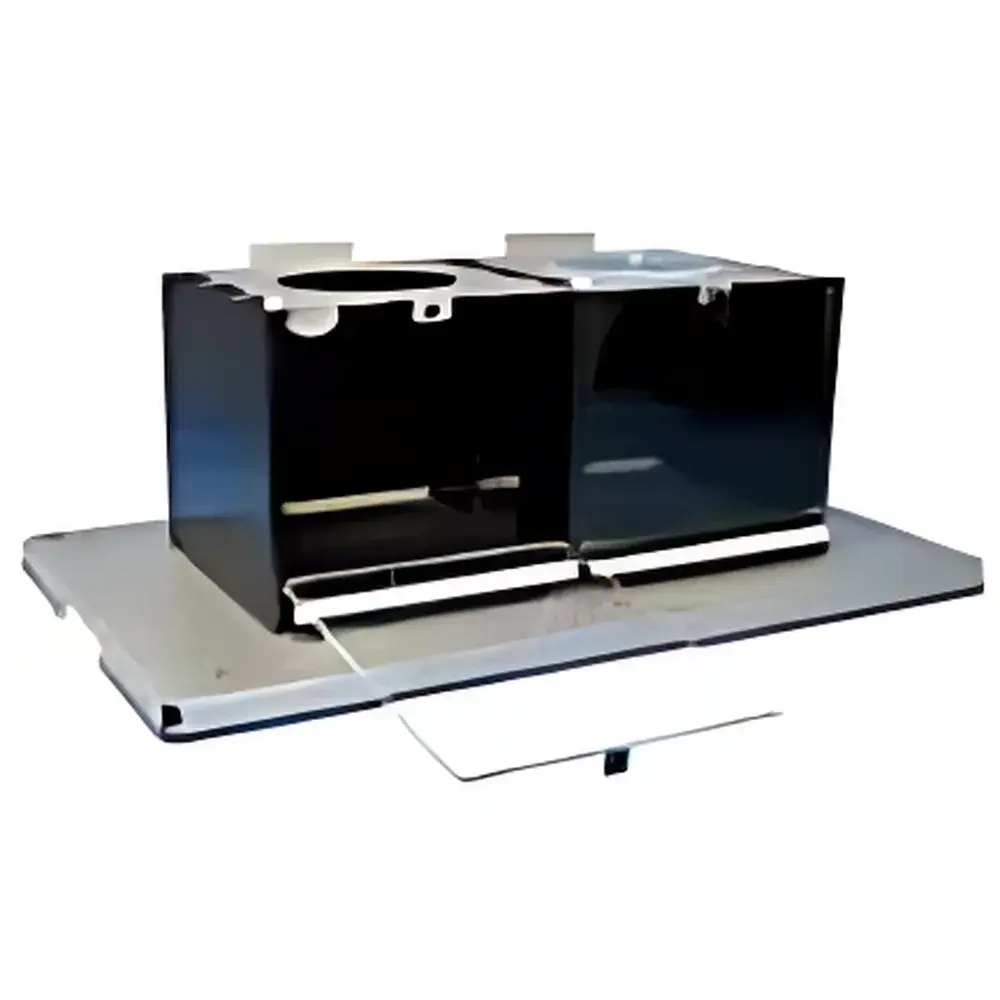
Panlab LE916/LE918 Shuttle Box System
| Brand | Harvard Apparatus |
|---|---|
| Origin | USA |
| Model | LE916 (Rat) / LE918 (Mouse) |
| Sample Capacity | Single-animal chamber |
| Stimulus Modalities | Auditory (tone/noise), Visual (LED light), Electrical (foot shock, adjustable voltage/current), Mechanical (automated guillotine door) |
| Detection Method | Dual independent load-cell-based gravimetric sensing (left/right compartment) |
| Software | ShutAvoid v3.x (Windows-based, real-time monitoring & offline analysis) |
| Compliance | Designed for GLP-compliant behavioral phenotyping |
| Accessories | Motorized升降 door module, white chamber insert kit, acoustically insulated enclosure with ventilation fan and ambient LED lighting |
Overview
The Panlab LE916 (rat-optimized) and LE918 (mouse-optimized) Shuttle Box Systems are precision-engineered platforms for standardized active and passive avoidance paradigms in rodent behavioral neuroscience. These systems operate on the principle of associative learning assessment through operant conditioning, where animals learn to associate discrete sensory cues (e.g., tone, light) with aversive stimuli (e.g., mild foot shock) and execute spatially contingent responses—either crossing between two compartments (active avoidance) or remaining in a safe zone (passive avoidance). Unlike spatial navigation assays such as the Morris water maze, shuttle box protocols rely on discrete cue–consequence associations, enabling high-throughput acquisition of learning curves within minutes per session and reducing inter-subject variability linked to spatial strategy bias. The core measurement architecture employs dual independent load-cell transducers embedded beneath each compartment floor, delivering continuous, contactless, and artifact-resistant detection of animal mass displacement—eliminating occlusion errors common in infrared beam or video-based tracking.
Key Features
- Gravimetric activity detection: Two calibrated load cells (one per compartment) provide milligram-level resolution for precise determination of animal position, movement onset, and dwell time—immune to fur color, lighting conditions, or camera calibration drift.
- Dual-model hardware optimization: LE916 features a 30 × 15 × 15 cm (L×W×H) chamber with reinforced flooring for rat-scale weight dynamics; LE918 utilizes a 20 × 10 × 12 cm chamber with refined transducer sensitivity for murine locomotor patterns.
- Integrated multimodal stimulus delivery: Programmable tone generator (0.5–10 kHz, ±1 dB SPL accuracy), high-intensity white LED array (0–1000 lux, calibrated), and constant-current foot shock unit (0.05–1.0 mA, 0.1 mA resolution, isolated output).
- Real-time hardware control interface: Front-panel tactile buttons enable manual trigger of shock, door actuation, or stimulus reset—critical for experimenter-initiated interventions during live sessions without software latency.
- Acoustically shielded enclosure: Includes active ventilation, uniform background illumination, and >45 dB(A) noise attenuation—ensuring consistent sensory baseline across repeated testing days.
Sample Compatibility & Compliance
The LE916/LE918 supports single-housed adult Sprague-Dawley rats (250–450 g) and C57BL/6 or BALB/c mice (20–35 g). Chamber dimensions and stimulus parameters comply with established guidelines from the NIH Office of Laboratory Animal Welfare (OLAW) and the European Directive 2010/63/EU for humane endpoint definition. All electrical stimulation protocols adhere to IACUC-recommended maximum thresholds (≤0.8 mA for mice, ≤1.0 mA for rats) and include automatic current-limiting circuitry. Data integrity meets ALF (Animal Lab Framework) metadata standards, and ShutAvoid software supports export in CSV, MATLAB (.mat), and Neurodata Without Borders (NWB) format for reproducible analysis pipelines.
Software & Data Management
ShutAvoid v3.x provides synchronized acquisition of 12+ behavioral metrics per trial, including conditioned response latency (CRL), unconditioned response latency (URL), escape failures, inter-trial interval occupancy, and compartment-specific dwell ratios. The software implements timestamped event logging with microsecond precision, supports batch processing of multi-day datasets, and generates publication-ready graphs (latency curves, avoidance probability heatmaps, session-by-session progression plots). Audit trail functionality records user login/logout events, protocol modifications, and data export actions—fully configurable to satisfy FDA 21 CFR Part 11 electronic record requirements when paired with institutional authentication servers.
Applications
These systems are validated for use in preclinical studies of hippocampal- and amygdala-dependent learning deficits, including models of Alzheimer’s disease (e.g., APP/PS1 mice), post-traumatic stress disorder (e.g., single-prolonged stress rats), and antidepressant screening (chronic mild stress paradigms). Passive avoidance protocols further support translational anxiety assessment (e.g., elevated plus maze cross-validation) and cognitive flexibility evaluation in aging cohorts. The modular design enables integration with third-party tools—such as optogenetic stimulators (via TTL sync ports) or EEG amplifiers (analog voltage input)—for closed-loop neurobehavioral interrogation.
FAQ
What is the difference between active and passive avoidance in shuttle box testing?
Active avoidance requires the animal to cross into the opposite compartment *before* shock onset upon cue presentation; passive avoidance measures latency to enter a punished zone *after* cue termination.
Can the same system be used for both rats and mice?
No—LE916 and LE918 are physically distinct units optimized for species-specific biomechanics and stimulus scaling; cross-species use compromises detection fidelity and ethical compliance.
Is the gravimetric detection method validated against gold-standard video tracking?
Yes—peer-reviewed comparative studies (e.g., J Neurosci Methods 2021;347:108942) confirm >98.7% concordance in entry/exit event detection and superior signal-to-noise ratio in long-duration (>4 h) sessions.
Does ShutAvoid support automated scoring of freezing behavior?
No—freezing quantification requires frame-difference video analysis; gravimetric sensing detects mass displacement only, not posture or immobility duration.
How is stimulus calibration maintained over time?
Each system includes factory-calibrated transducers with annual NIST-traceable recalibration certificates; shock output is verified using a programmable load resistor and digital multimeter prior to each study phase.





