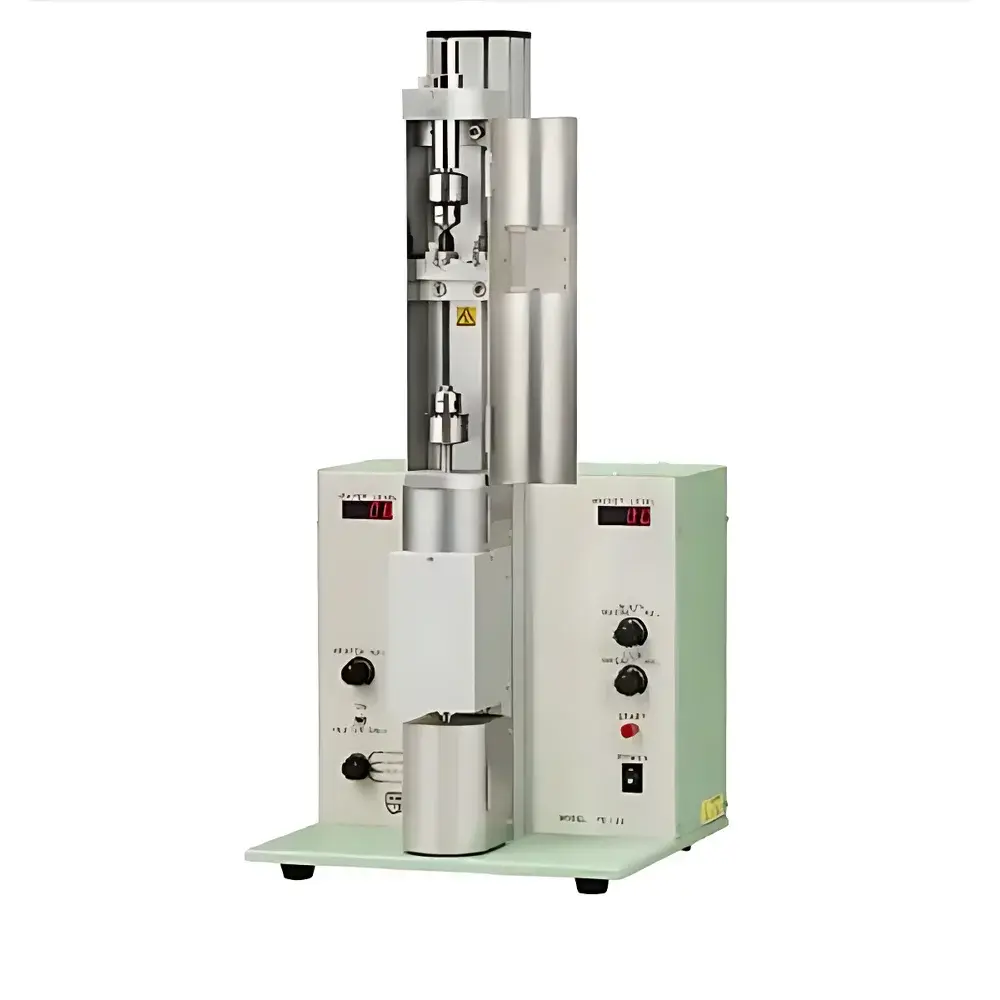
Narishige PE-22 Multi-Channel Micropipette Puller
| Brand | Narishige |
|---|---|
| Origin | Japan |
| Model | PE-22 |
| Power Supply | AC 100–240 V (±5%), 50/60 Hz |
| Max. Power Consumption | ~500 W |
| Filament Current | ~17 A |
| Filament Voltage | ~6 V |
| Dimensions (W×D×H) | 280 × 280 × 610 mm |
| Weight | 20.7 kg |
| Capillary Compatibility | 2–6 mm OD (standard) |
| Heating & Magnet Output Control | Digital display (0–100 scale) |
| Safety | Integrated metal shield, reinforced heater–axis coupling, fail-safe microswitch calibration |
Overview
The Narishige PE-22 Multi-Channel Micropipette Puller is an evolution of the long-established tower-type puller platform (e.g., PE-2), engineered specifically for reproducible fabrication of robust, high-aspect-ratio glass micropipettes used in intracranial neurophysiology, patch-clamp electrophysiology, and multi-barrel microinjection applications. Unlike horizontal or laser-based pullers, the PE-22 employs a gravity-assisted vertical pulling mechanism: a heated glass capillary—clamped vertically via a precision drill-chuck system—is drawn downward under controlled magnetic force and thermal softening. This classical yet highly refined Couette-style elongation process ensures consistent taper geometry, minimal tip asymmetry, and superior mechanical rigidity—critical when fabricating long, slender electrodes (>50 mm) intended for deep brain penetration with parallel-sided shanks and precisely defined tip diameters (sub-micron to several microns). The instrument integrates dual digital control loops for independent adjustment of heater output and magnetic pull force—both scaled 0–100 on LED displays—enabling fine-grained parametric tuning essential for batch-to-batch reproducibility in regulated laboratory environments.
Key Features
- Vertical gravity-driven pulling architecture with magnetically augmented tension, eliminating mechanical drive belts or stepper motors that introduce vibration or positional drift.
- Digital dual-parameter interface: separate 0–100 scale controls for heating element power and magnetic pull strength, enabling precise decoupling of thermal softening kinetics from mechanical draw rate.
- Reinforced safety design: full-metal enclosure shielding the heater assembly and vertical axis; integrated thermal cutoff and calibrated microswitches for repeatable clamp positioning and zero-point verification.
- Drill-chuck capillary holder accommodates standard borosilicate glass capillaries with outer diameters from 2 mm to 6 mm; compatible with bundled configurations (3-, 4-, or 7-channel assemblies using 1 mm OD capillaries).
- Modular heater system: interchangeable resistive heating elements (PE-21HA–HD series) optimized for specific capillary diameters (2 mm, 3 mm, 6 mm) and winding geometries (straight vs. helical filament layout), ensuring uniform axial heat distribution.
- Space-efficient integrated design consolidates functions previously requiring two separate instruments—reducing footprint while maintaining full operational independence between heating and pulling subsystems.
Sample Compatibility & Compliance
The PE-22 is validated for use with standard soda-lime and borosilicate glass capillaries (e.g., GC150F-10, BF150-86-10) in outer diameters ranging from 2.0 mm to 4.0 mm for single-pull applications; larger diameters (up to 6.0 mm) are supported subject to wall thickness and length constraints (consult technical documentation). Multi-tube electrode fabrication—including triple-, quadruple-, and septuple-barrel configurations—is routinely performed using 1.0 mm OD capillaries fused into coaxial or side-by-side arrays. All operational parameters adhere to IEC 61010-1 safety standards for laboratory electrical equipment. While the PE-22 itself does not generate electronic records, its analog-digital hybrid control architecture supports integration into GLP-compliant workflows when paired with external logging systems; heater/magnet output settings are manually documented per SOP to satisfy traceability requirements under ISO/IEC 17025 and FDA 21 CFR Part 11 Annex 11 guidance for instrument qualification.
Software & Data Management
The PE-22 operates as a stand-alone hardware platform without embedded firmware or network connectivity. Parameter settings (heater level, magnet level) are set via front-panel rotary dials and displayed numerically on dual 3-digit LED readouts—ensuring deterministic, non-volatile operation unaffected by software crashes or OS updates. For laboratories requiring audit trails, users implement manual logbooks or integrate the instrument into LIMS via external USB/hardware trigger interfaces (e.g., TTL pulse synchronization with video capture or electrophysiology acquisition systems). Calibration records—including microswitch actuation thresholds and heater resistance verification—are maintained per Narishige’s recommended annual service schedule, aligning with ISO/IEC 17025 clause 6.4 on equipment management.
Applications
- Neurophysiological intracellular recording: fabrication of rigid, long-shank micropipettes (>60 mm) with symmetric tapered tips (taper ratios 1:15–1:30) for stable penetration through dura and cortical layers.
- Multi-barrel iontophoresis and pressure ejection: simultaneous pulling of 3–7 capillaries into fused arrays for co-delivery of pharmacological agents, tracers, or neurotransmitters with spatially resolved targeting.
- Custom microinjection needles: production of blunt-ended or beveled capillaries (via post-pull grinding) for embryonic, oocyte, or tissue injection protocols requiring high burst pressure tolerance.
- Electrode array prototyping: iterative development of bespoke geometries (e.g., offset tapers, stepped shafts) for chronic implantable devices where mechanical fatigue resistance and tip consistency are paramount.
- Teaching laboratories: robust mechanical design and intuitive parameter scaling enable reliable student training in fundamental micropipette fabrication principles without dependency on proprietary software stacks.
FAQ
What capillary sizes are supported for single-tube pulling?
The PE-22 accepts glass capillaries with outer diameters from 2.0 mm to 6.0 mm; optimal performance is achieved with 2.0–4.0 mm OD tubes of standard wall thickness (e.g., 0.5–1.0 mm).
Can the PE-22 produce patch-clamp pipettes with sub-micron tips?
Yes—when configured with appropriate 2.0 mm OD capillaries and optimized heater/magnet profiles, the PE-22 achieves tip openings down to 0.3–0.5 µm, verified by scanning electron microscopy (SEM) and resistance testing.
Is the instrument compatible with 220 V / 50 Hz mains supply?
Yes—the PE-22 supports universal AC input (100–240 V, ±5%, 50/60 Hz) via internal auto-ranging power supply; no external transformer is required.
How is calibration maintained over time?
Microswitch position calibration is user-adjustable via dedicated trim pots; heater resistance is verified annually using a 4-wire ohmmeter per Narishige Service Bulletin SB-PE22-03.
Are replacement heaters model-specific?
Yes—each heater module (PE-21HA, PE-21HB, PE-21HC, PE-21HD) is mechanically and electrically matched to a defined capillary diameter range and filament geometry; cross-substitution is not recommended.