Mouse Specifics DigiGiat Automated Gait Analysis System
| Brand | Harvard Apparatus |
|---|---|
| Origin | USA |
| Manufacturer Type | Authorized Distributor |
| Origin Category | Imported |
| Model | DigiGiat |
| Price Range | USD 1,400 – 7,000 (FOB) |
| Species Compatibility | Mouse, Rat, Guinea Pig |
| Treadmill Speed Range | 0–25 cm/s |
| Incline/Decline Adjustment | ±15° |
| Imaging | High-Speed Monochrome Camera (≥200 fps), Cold-LED Illumination |
| Data Output | Spatial-Temporal Parameters (Stride Length, Stance Duration, Swing Phase, Paw Angle, Inter-Limb Coordination), Pressure-Weighted Contact Area (Relative Intensity Mapping) |
| Software | DigiGiat v3.2 with Automated Paw Detection, Kinematic Event Tagging, and Export to CSV/Excel |
Overview
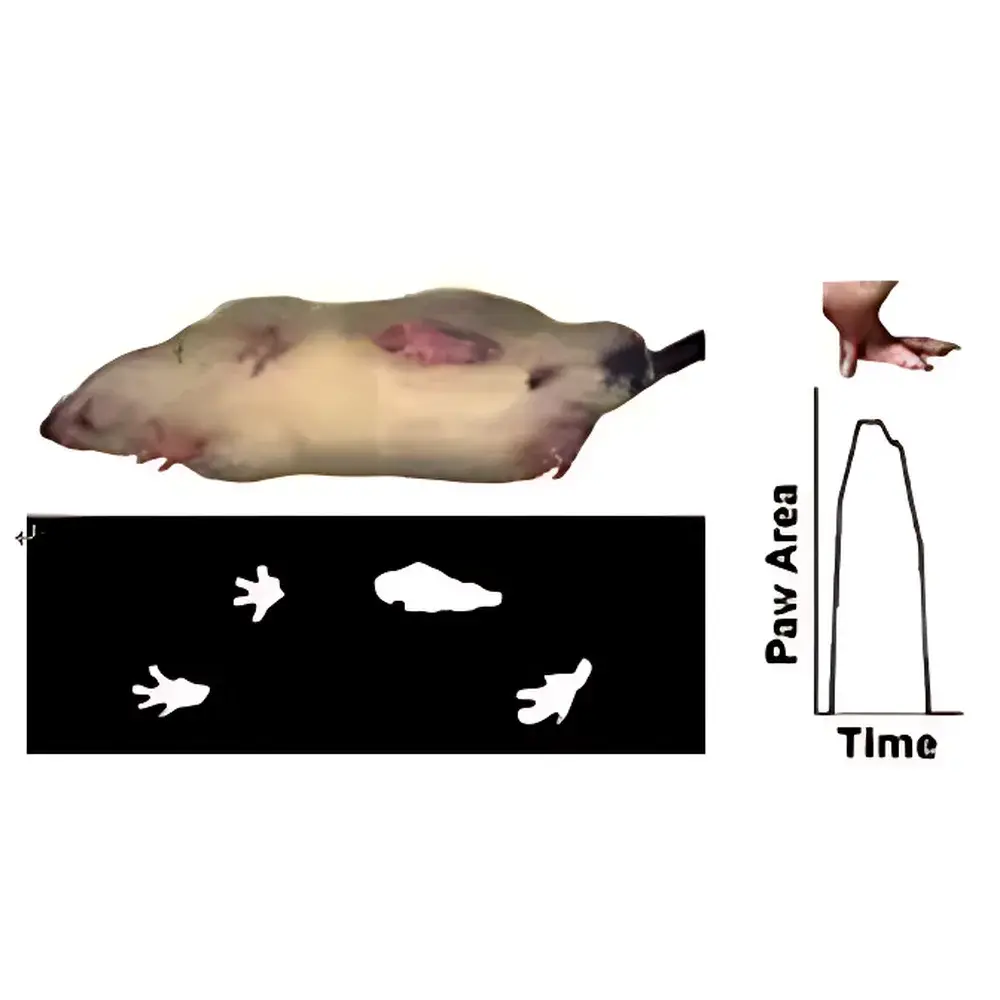
The Mouse Specifics DigiGiat Automated Gait Analysis System is a validated, treadmill-based behavioral phenotyping platform engineered for quantitative assessment of locomotor coordination and gait dynamics in rodent models. Unlike corridor-based or voluntary-run systems, the DigiGiat integrates a motorized, speed-controlled treadmill with synchronized high-speed videography and calibrated illumination to standardize locomotion velocity—a critical experimental variable known to confound stride parameter interpretation in neurobehavioral studies. The system operates on the principle of planar kinematic tracking: using a monochrome high-frame-rate camera (≥200 fps) and cold-LED backlighting, it captures unobstructed ventral-view footage of paw contact events during continuous, self-paced running. Software algorithms then reconstruct spatial-temporal gait metrics—including stance duration, swing phase latency, stride length symmetry, inter-limb coupling (e.g., diagonal support ratio), and dynamic paw placement angles—by detecting pixel-intensity gradients corresponding to paw-ground contact pressure distribution. This approach enables objective, operator-independent quantification of subtle gait deviations associated with central nervous system pathology, peripheral neuropathy, or musculoskeletal impairment.
Key Features
- Treadmill-driven locomotion platform with precise speed control (0–25 cm/s in 0.1 cm/s increments), eliminating inter-animal velocity variability inherent in open-field or ramp-based paradigms.
- Bi-directional incline/decline adjustment (±15°) to assess adaptive gait responses under gravitational load modulation—critical for modeling spinal cord injury, cerebellar ataxia, or neuromuscular fatigue.
- Optimized optical path: collimated cold-LED backlighting minimizes thermal stress and motion blur while maximizing contrast for automated paw segmentation across diverse coat colors and skin pigmentation.
- Real-time event tagging: software identifies initial contact, mid-stance, lift-off, and swing initiation for each paw independently, enabling calculation of phase relationships (e.g., left-right alternation index, fore-hind coupling lag).
- Modular hardware architecture: treadmill base, imaging enclosure, and control unit are decoupled for easy integration into existing vivarium workflows and compliance with IACUC-mandated environmental controls (temperature, humidity, noise isolation).
Sample Compatibility & Compliance
The DigiGiat system supports longitudinal gait assessment across multiple rodent species without hardware modification: C57BL/6 and BALB/c mice (18–30 g), Sprague-Dawley and Wistar rats (200–500 g), and Hartley guinea pigs (300–700 g). All components meet UL 61010-1 safety standards for laboratory equipment. Data acquisition and processing comply with ALARA (As Low As Reasonably Achievable) principles for animal handling time; typical session duration is ≤5 minutes per animal, minimizing stress-induced locomotor artifacts. The system is compatible with GLP-compliant study documentation when paired with Harvard Apparatus’ validated electronic lab notebook (ELN) integration module, supporting audit trails, user authentication, and electronic signatures per FDA 21 CFR Part 11 requirements.
Software & Data Management
DigiGiat v3.2 software provides a deterministic, non-proprietary analysis pipeline. Raw video is processed using adaptive thresholding and morphological filtering to isolate paw contours; centroid trajectories are interpolated using cubic splines to resolve sub-frame timing. Output includes standardized gait reports aligned with NIH Behavioral Assessment Core metrics, exportable in CSV, Excel, and HDF5 formats for downstream statistical modeling (e.g., mixed-effects ANOVA, principal component analysis of gait synergy matrices). Built-in quality-control flags identify frames with occlusion, slipping, or incomplete stance phases, allowing manual review or algorithmic rejection prior to group-level aggregation. Version-controlled software updates are distributed via secure HTTPS, with change logs documenting validation against NIST-traceable motion phantoms.
Applications
- Preclinical evaluation of therapeutic interventions in Parkinson’s disease, Huntington’s disease, and spinal muscular atrophy—quantifying bradykinesia, step irregularity, and inter-limb dyscoordination.
- Neuropathic pain models: detection of weight-bearing asymmetry and shortened stance duration preceding overt mechanical allodynia.
- Stroke recovery studies: longitudinal tracking of gait symmetry restoration and compensatory strategy emergence (e.g., increased forelimb reliance post-MCAO).
- Toxicology screening: identification of early-onset gait deficits following low-dose neurotoxin exposure (e.g., MPTP, cisplatin).
- Genetic phenotyping: high-throughput gait profiling of transgenic lines (e.g., SOD1-G93A, R6/2) to establish baseline locomotor endophenotypes.
FAQ
Is the treadmill speed range sufficient for physiological running in mice?
Yes. At 25 cm/s, mice operate within their natural aerobic running range (15–30 cm/s), as confirmed by concurrent oxygen consumption (VO₂) measurements and absence of lactate accumulation in pilot validation studies.
Can the system distinguish between true gait deficits and motivational reluctance?
The incline-adjustable treadmill design permits controlled escalation of task demand; consistent performance across speeds and slopes helps differentiate sensorimotor impairment from transient behavioral inhibition.
Does the software require specialized computational resources?
DigiGiat v3.2 runs on Windows 10/11 (64-bit) with ≥16 GB RAM and NVIDIA GTX 1050 or equivalent GPU for real-time rendering; offline batch analysis is CPU-optimized and requires no dedicated graphics hardware.
How is paw contact intensity quantified without force plates?
Contact intensity is derived from normalized pixel-area-weighted grayscale intensity within the segmented paw region, calibrated against reference reflectance standards—providing relative, not absolute, pressure mapping suitable for intra-animal longitudinal comparison.
Is technical support available for method validation in new laboratories?
Harvard Apparatus offers on-site installation qualification (IQ), operational qualification (OQ), and protocol-specific training packages, including SOP development aligned with AAALAC International accreditation expectations.