
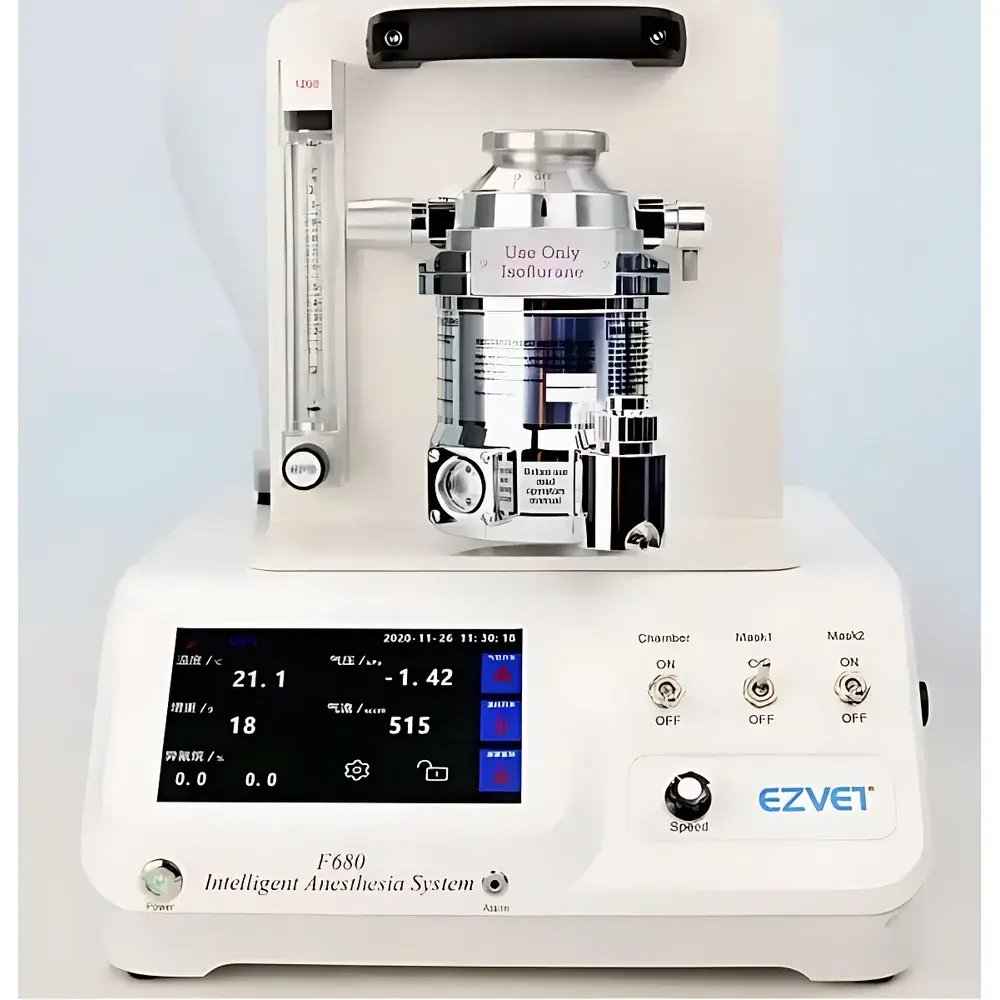
Smart Animal Anesthesia System F680
| [Origin | Beijing, China |
|---|---|
| Manufacturer Type | Authorized Distributor |
| Model | F680 |
| Price Range | USD 140 – 700] |
Overview
The Smart Animal Anesthesia System F680 is an integrated, benchtop-grade anesthesia platform engineered for precision and safety in preclinical research. It operates on a dual-phase volatile anesthetic delivery principle—combining calibrated vaporizer-based induction and maintenance with real-time feedback-controlled physiological support. Designed specifically for small-to-medium laboratory animals (≤7 kg), including mice, rats, hamsters, guinea pigs, rabbits, and cats, the F680 supports concurrent anesthesia of 2–5 subjects via independently regulated gas pathways. Its architecture integrates inhalational anesthetic delivery (isoflurane or sevoflurane), active waste-gas scavenging, closed-loop thermoregulation, and multi-parameter physiological monitoring—all within a compact, MRI-compatible footprint. The system complies with core occupational health standards for veterinary and biomedical laboratories, including OSHA-recommended exposure limits for halogenated anesthetics and ISO 8573-1 Class 3 compressed air purity requirements for medical-grade oxygen circuits.
Key Features
- Modular dual-mode anesthesia control: Independent adjustment of induction and maintenance gas flows per channel using precision flowmeters (0.1–2.0 L/min range, calibrated for low-flow small-animal protocols)
- 3.5-inch full-color capacitive touchscreen interface with real-time display of anesthetic concentration (vol%), inspired oxygen fraction (FiO₂), circuit pressure (kPa), waste-gas canister weight gain (g), and animal core temperature (°C)
- Integrated thermoregulation subsystem: PID-controlled heating blanket with subcutaneous temperature probe feedback; preset at 37°C, adjustable from 35–40°C; power output dynamically modulated via low-voltage DC regulation
- Dual-vaporizer compatibility: Supports both domestically manufactured anesthetic vaporizers and OEM-certified UK-sourced units for isoflurane and sevoflurane—ensuring traceable calibration and vapor output linearity per ISO 8573-7
- Active waste-gas management: Scavenging system with activated charcoal canisters (tested per ASTM D5228 for halogenated hydrocarbon adsorption capacity); exhaust routed to external vent or recirculated through secondary filtration
- MRI-safe configuration options: Non-ferromagnetic face masks, RF-shielded tubing sets, and non-magnetic flow sensors available for intra-scanner use
- Closed breathing circuit architecture with medical-grade silicone and stainless-steel gas pathways; compliant with ISO 13485 design controls for Class IIa medical devices
Sample Compatibility & Compliance
The F680 accommodates standard rodent and lagomorph species across common experimental weight bands: mice (15–35 g), rats (100–500 g), guinea pigs (250–800 g), rabbits (1–4 kg), and domestic cats (2.5–7 kg). Face mask configurations include nose-only, whole-body induction chambers, and endotracheal adapter kits. All consumables meet USP Class VI biocompatibility requirements. System-level documentation supports GLP-compliant study execution, including audit-ready calibration logs, vaporizer verification reports (per ISO 80601-2-13), and scavenging efficiency validation records (measured via GC-MS quantification of residual anesthetic in exhaust streams). The platform is compatible with FDA 21 CFR Part 11–enabled data archiving when paired with optional LIMS-integrated software modules.
Software & Data Management
The embedded firmware enables timestamped parameter logging at 1 Hz resolution, exportable in CSV and HDF5 formats. Optional PC-based software provides waveform visualization (temperature vs. time, FiO₂ drift analysis), automated alarm thresholds (e.g., hypothermia 5% CO₂), and electronic signature-enabled protocol archiving. Audit trails record all user-initiated changes—including vaporizer concentration adjustments, temperature setpoint modifications, and scavenger canister replacement events—satisfying ALAC and AAALAC International record-keeping expectations. Data encryption (AES-256) and role-based access control align with institutional IT security policies for animal facility networks.
Applications
- Surgical procedures requiring stable plane I–III anesthesia: craniotomy, orthotopic tumor implantation, vascular cannulation, and spinal cord injury modeling
- Functional imaging workflows: longitudinal fMRI, PET-MRI, and optical coherence tomography under controlled anesthetic depth
- Neuroscience interventions: optogenetic stimulation, electrophysiological recording (EEG/LFP), and microdialysis during maintained anesthesia
- Pharmacokinetic/pharmacodynamic studies: dose-response characterization of novel anesthetics or adjuvants
- Educational training: veterinary student surgical labs, certified technician credentialing programs, and IACUC-approved demonstration modules
- Chronic instrumentation: telemetry transmitter implantation with intraoperative thermoregulatory support
FAQ
What anesthetic agents are validated for use with the F680 system?
Isoflurane and sevoflurane are fully supported; vaporizer calibration certificates and concentration linearity data are provided for both agents per ISO 80601-2-13 Annex BB.
Can the F680 be used inside a 7T MRI scanner bore?
Yes—when equipped with MRI-compatible accessories (non-ferromagnetic face masks, carbon-fiber induction chambers, and RF-decoupled pressure sensors), the system meets ASTM F2503-22 labeling requirements for MR Conditional devices.
How often must the charcoal scavenging canister be replaced?
Replacement frequency depends on cumulative anesthetic exposure; typical service life is 40–60 hours of continuous isoflurane use at 2% concentration. Weight gain ≥15 g above tare indicates saturation and requires immediate replacement.
Is the heating blanket’s temperature control algorithm documented for regulatory submission?
Yes—the PID coefficients, sensor response time (<1.2 s), and thermal stability profile (±0.3°C over 4 h at 37°C) are included in the Technical Construction File per MDR 2017/745 Annex II.
Does the F680 support integration with third-party ventilators or physiological monitors?
Analog outputs (0–5 V) for temperature, pressure, and anesthetic concentration are available via DB9 connector; digital communication via RS-485 Modbus RTU enables synchronization with commercial ventilators (e.g., Harvard Apparatus, Kent Scientific) and data acquisition systems (e.g., PowerLab, Spike2).
Related Products




