
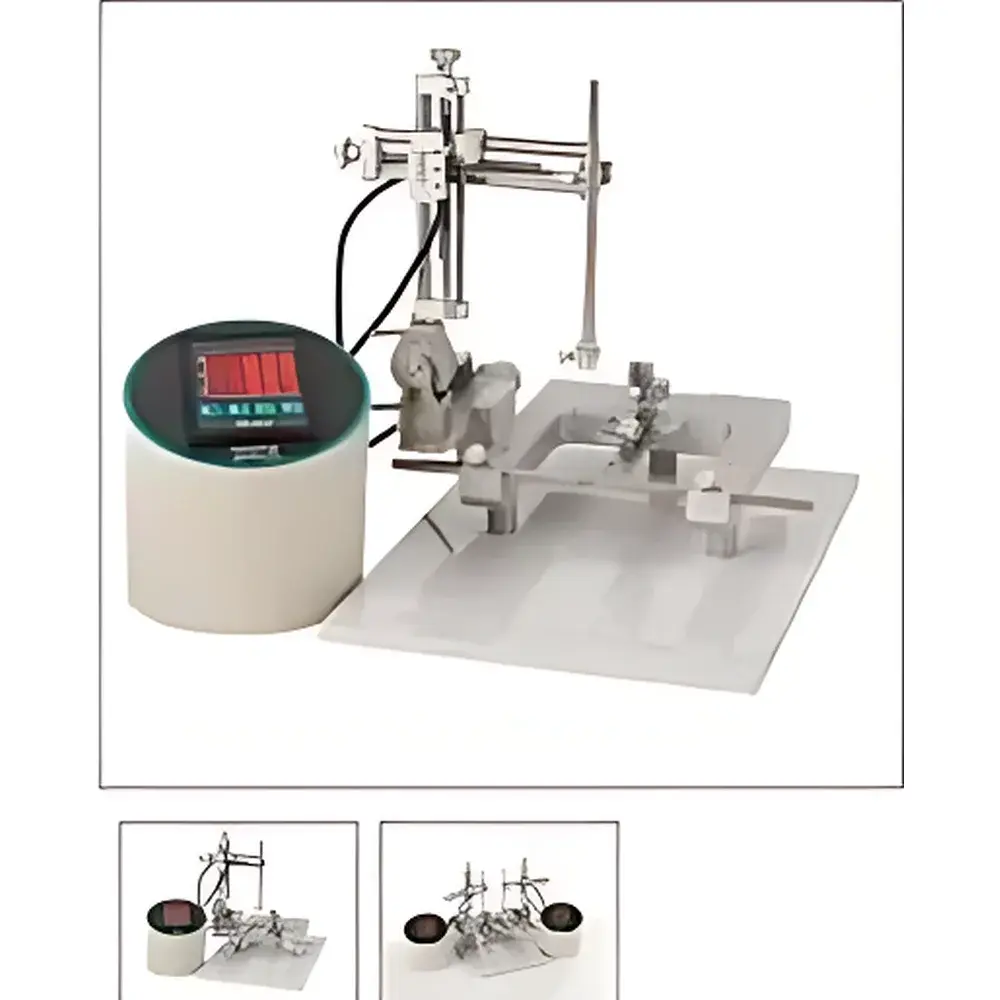
Stoelting Digital Display Stereotaxic Instrument
| Origin | USA |
|---|---|
| Manufacturer Type | Authorized Distributor |
| Origin Category | Imported |
| Model | Stoelting |
| Pricing | Available Upon Request |
Overview
The Stoelting Digital Display Stereotaxic Instrument is a precision-engineered neurosurgical alignment system designed for reproducible, high-accuracy intracranial targeting in rodent and small-animal models. Built upon the foundational principles of stereotaxic coordinate geometry—where anatomical targets are localized relative to standardized bregma-lambda reference points—the instrument integrates high-resolution digital position sensing directly into each manipulator axis. Unlike analog or vernier-based systems, this model employs fully sealed, contactless electronic displacement sensors mounted within the X-, Y-, and Z-axis manipulator arms, enabling real-time, direct-readout coordinate acquisition without mechanical backlash or parallax error. The system operates under the assumption that skull flatness and bregma identification are performed per standard neuroanatomical protocols (e.g., Paxinos & Watson atlas alignment), and it supports both unilateral and bilateral electrode, cannula, or microinjection needle placements with sub-millimeter spatial fidelity.
Key Features
- Integrated 10 µm resolution digital position sensors on all three orthogonal axes (X, Y, Z), eliminating interpolation errors inherent in manual scale reading
- Self-contained, backlit digital display module embedded in the manipulator arm housing—no external monitor, cables, or benchtop footprint required
- One-touch zeroing function at any arbitrary coordinate point, enabling rapid re-referencing to atlas-defined landmarks or intraoperative landmarks
- Sealed sensor architecture protects against dust, saline mist, and cleaning agent ingress—critical for compliance with IACUC-mandated cage-side decontamination protocols
- Long-life coin-cell battery power (CR2032) with >12 months typical operational life under standard lab usage; battery replacement requires no calibration recalibration
- Modular arm design compatible with standard Stoelting base plates, ear bars, and incisor hooks—including compatibility with cryo-cooled or heated platforms for thermoregulated procedures
Sample Compatibility & Compliance
The instrument is validated for use with mice (C57BL/6, BALB/c), rats (Sprague-Dawley, Wistar), and other small mammals up to 500 g body weight. It conforms to NIH Guide for the Care and Use of Laboratory Animals requirements for mechanical stability and positional repeatability. All structural components meet ISO 13485–aligned manufacturing controls for Class I medical-grade laboratory devices. While not a regulated medical device, its dimensional traceability supports GLP-compliant study documentation when paired with SOP-controlled surgical workflows and audit-ready electronic lab notebooks (ELNs).
Software & Data Management
This is a hardware-only stereotaxic platform with no embedded firmware or network interface. Coordinate values are displayed numerically in real time but are not automatically logged or exportable. For regulatory traceability, users are advised to record final coordinates manually in bound lab notebooks or integrate with third-party ELN systems (e.g., LabArchives, Benchling) via documented SOPs. The absence of wireless connectivity or data transmission ensures full compliance with institutional IT security policies and eliminates potential FDA 21 CFR Part 11 validation burdens associated with electronic records in preclinical research settings.
Applications
- Precise intracerebral injection of viral vectors, tracers, or pharmacological agents in behavioral neuroscience studies
- Chronic implantation of microelectrode arrays, optrodes, or fiber photometry cannulas for in vivo electrophysiology or calcium imaging
- Stereotactic lesioning or ablation using radiofrequency, electrolytic, or laser probes
- Targeted delivery of stem cells or nanoparticles into discrete nuclei (e.g., hippocampus, ventral tegmental area, nucleus accumbens)
- Validation and calibration of MRI-guided or ultrasound-guided targeting workflows in translational animal models
FAQ
Does the digital display require external power or USB connection?
No—the unit operates exclusively on an internal CR2032 coin cell battery and contains no external power input or data port.
Can the instrument be calibrated in-house?
Yes—zero-point offset correction is user-adjustable per axis via the front-panel interface; full factory calibration is recommended annually or after impact events.
Is the system compatible with MRI-compatible or non-ferromagnetic accessories?
The primary frame and manipulator arms are constructed from anodized aluminum and stainless steel; however, users must verify ferromagnetic properties of third-party accessories (e.g., electrodes, holders) separately.
What atlas formats does the zeroing function support?
The display itself does not store or interpret atlas data—it provides absolute Cartesian coordinates; users apply Paxinos & Watson, Franklin & Paxinos, or custom atlas transformations externally.
How is positional accuracy verified during IQ/OQ/PQ qualification?
Accuracy verification follows ASTM E2500-13 guidelines using certified gauge blocks and optical interferometry across the full travel range of each axis.





