
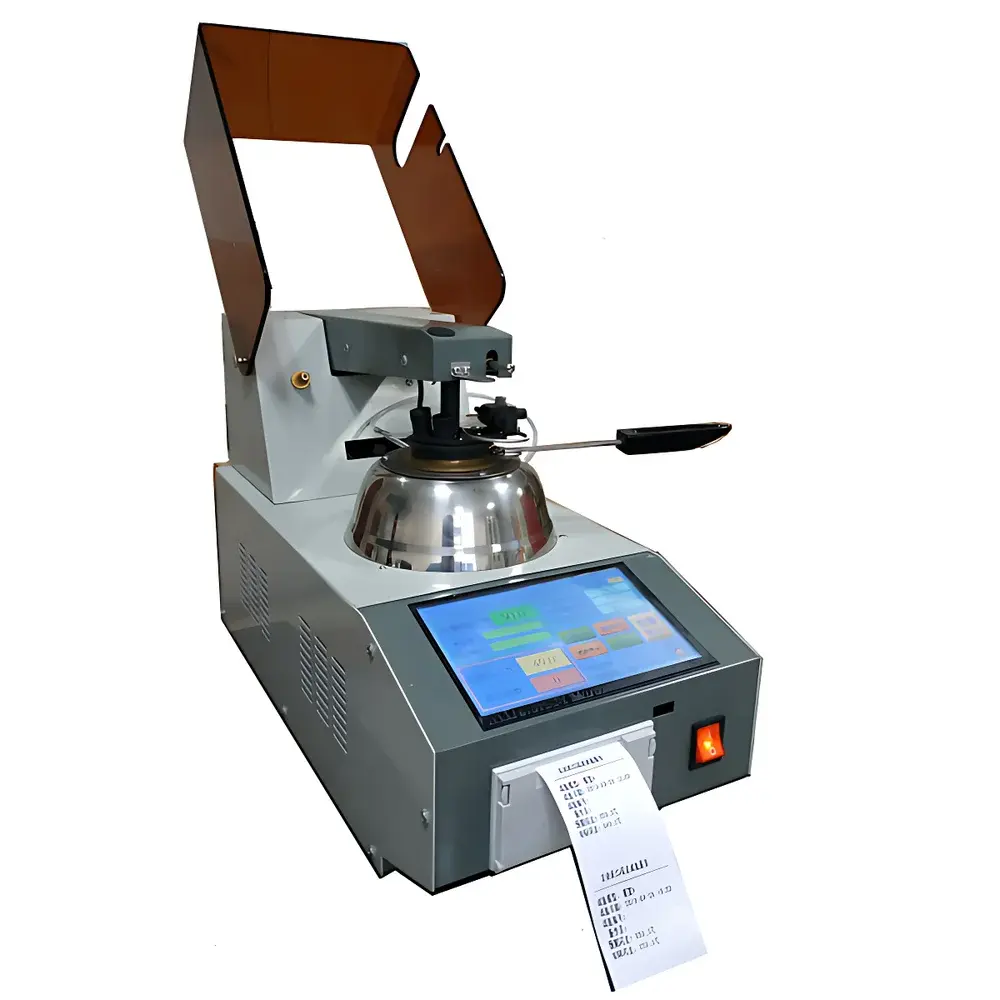
Xufeng XF-92SE Automatic Cleveland Open Cup Flash Point and Fire Point Tester
| Brand | Xufeng |
|---|---|
| Origin | Shanghai, China |
| Model | XF-92SE |
| Detection Method | Cleveland Open Cup (ASTM D92 / GB/T 3536) |
| Operation Mode | Fully Automatic |
| Temperature Range | 80 °C to 400 °C |
| Ignition Methods | Electric spark ignition (standard) and optional gas-fueled ignition |
| Repeatability | Compliant with ASTM D92 and GB/T 3536 requirements |
| Applicable Standards | ASTM D92, GB/T 3536 |
Overview
The Xufeng XF-92SE Automatic Cleveland Open Cup Flash Point and Fire Point Tester is a precision-engineered instrument designed for the standardized determination of flash point and fire point of petroleum products, bituminous materials, lubricants, and other combustible liquids using the Cleveland open cup method. It operates in strict accordance with ASTM D92 (“Standard Test Method for Flash and Fire Points by Cleveland Open Cup Tester”) and GB/T 3536 (“Petroleum Products — Determination of Flash and Fire Points — Cleveland Open Cup Method”). The instrument employs a controlled heating ramp, real-time temperature monitoring via high-stability Pt100 sensor, and automated spark-based ignition—eliminating manual intervention while ensuring metrological traceability and inter-laboratory reproducibility. Unlike closed-cup testers, the Cleveland open cup configuration enables direct observation of vapor-air mixture behavior under atmospheric pressure, making it particularly suitable for evaluating high-boiling, viscous, or residuum-grade samples where volatility onset must be assessed under realistic thermal exposure conditions.
Key Features
- Fully automatic operation from initialization to final report generation—users select test mode (ASTM D92, GB/T 3536, or auto-search), input expected flash point range, and initiate via START button; all heating, scanning, ignition timing, and endpoint detection proceed without operator interaction.
- Dual ignition architecture: standard electric spark ignition (no external gas supply required) with optional retrofit capability for gas-fueled ignition (e.g., propane or butane), enabling flexibility across lab infrastructure constraints.
- High-resolution temperature control: ±0.1 °C accuracy over 0–400 °C range, with operational flash point measurement interval spanning 80–400 °C—optimized for heavy fuels, asphalt binders, transformer oils, and industrial lubricants.
- Intuitive Chinese-language LCD interface with tactile keypad navigation—displays real-time bath temperature, setpoint, ignition status, fault diagnostics, and step-by-step progress tracking per ASTM/GB procedural logic.
- Modular design supports future expansion: compatible with Xufeng’s multi-unit synchronization framework (e.g., XF-2S dual-cup system), allowing concurrent execution of identical or mixed open/closed cup tests under centralized control.
- Self-diagnostic firmware with audible/visual alarms for heater failure, thermocouple disconnection, ignition misfire, or ambient pressure deviation beyond ±5 kPa—ensuring immediate awareness of non-conforming test conditions.
- RS-232C serial port compliant with ANSI/TIA/EIA-232-F standards for bidirectional communication with LIMS or QC data servers; supports ASCII-based command protocol for remote start/stop, parameter upload, and result export.
Sample Compatibility & Compliance
The XF-92SE accommodates standard Cleveland open cups (63.5 mm diameter × 33 mm depth, ASTM-compliant stainless steel construction) and accepts sample volumes of 70 ± 5 mL. It is validated for use with crude oil fractions, fuel oils (No. 4–No. 6), bitumen emulsions, bio-diesel blends, and synthetic ester-based dielectric fluids. All mechanical, thermal, and ignition subsystems are calibrated against NIST-traceable references prior to shipment. The instrument meets functional safety requirements per IEC 61010-1:2010 for electrical equipment used in laboratory environments. Its test methodology satisfies regulatory acceptance criteria under U.S. EPA Method 1010A, OSHA 29 CFR 1910.1200 (HCS), and EU CLP Regulation (EC) No. 1272/2008 for hazard classification of flammable liquids.
Software & Data Management
Embedded firmware implements full audit trail functionality per FDA 21 CFR Part 11 requirements—including electronic signature support (via password-protected user roles), immutable timestamped records of all parameter changes, ignition events, temperature logs, and final flash/fire point determinations. Data output includes CSV-compatible print reports via integrated thermal dot-matrix printer (paper width: 57 mm), as well as machine-readable serial dumps for integration into enterprise quality management systems (QMS). Optional PC software (Xufeng FlashLab v3.x) provides graphical trend analysis, batch reporting, statistical process control (SPC) charting, and GLP-compliant electronic lab notebook (ELN) export.
Applications
- Quality assurance of refinery intermediates and finished fuels per ASTM D975, D396, and D910 specifications.
- Fire safety evaluation of base oils and greases during R&D formulation stages.
- Regulatory compliance testing for transport classification (UN TDG Class 3, IMDG Code) and SDS preparation.
- Research on thermal stability limits of bio-based lubricants and hydrogenated vegetable oils.
- Third-party certification labs performing accredited testing to ISO/IEC 17025:2017 requirements.
FAQ
Does the XF-92SE require external gas supply for ignition?
No—the XF-92SE model features built-in electric spark ignition and operates independently of external gas sources. The XF-92S variant requires propane or butane supply.
Can the instrument perform both flash point and fire point measurements in a single run?
Yes—per ASTM D92 protocol, the instrument automatically continues heating after flash point detection and identifies fire point as the lowest temperature at which the specimen sustains combustion for at least 5 seconds.
Is temperature calibration traceable to national standards?
Yes—each unit ships with a calibration certificate referencing NIST SRM 736 (industrial platinum resistance thermometer) and includes onboard verification routines for field recalibration.
What maintenance intervals are recommended for long-term reliability?
We recommend quarterly cleaning of the cup holder and ignition electrode, annual verification of bath temperature uniformity (±0.5 °C across cup zone), and biannual firmware updates via RS-232 connection.
Can test results be exported directly to Excel or LIMS?
Yes—ASCII-formatted data streams via RS-232 support direct ingestion into spreadsheet applications or validated LIMS platforms using configurable delimiter settings (comma, tab, or semicolon).






